
Title
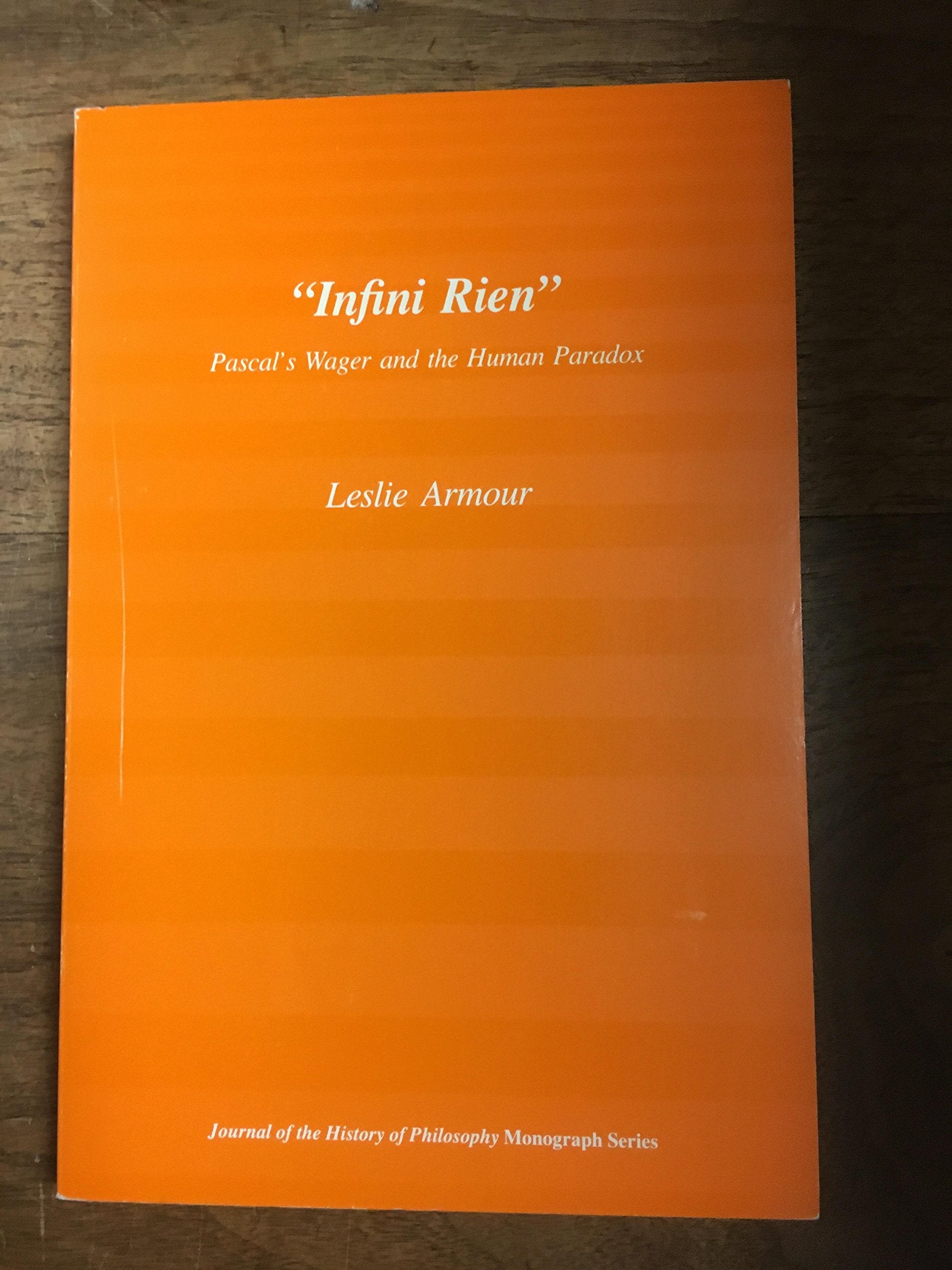
Infini Rien': Pascal'S Wager And The Human Paradox (Journal On The History Of Philosophy),Used
Sold by Ergodebooks, an authorized reseller.
Returns accepted within 30 days | support@ergodebooks.com
Shipping Information
- Free Standard Shipping — United States only
- Processing Time: 3–5 business days
- Estimated Delivery: 6–10 business days after dispatch
- Double-boxed, fully insured & discreetly packaged
- Tracking number sent via email once dispatched
Returns & Refund
Returns accepted within 30 days of delivery.
Damaged or Defective Item
Free return shipping + replacement or full refund
Wrong Item Received
Free return shipping + replacement or full refund
Change of Mind
Return shipping at customer's expense · 25% restocking fee applies
Payment Option

The wager fragment in Blaise Pascals Penses opens with the phrase 'infini rien''infinite nothing'which is meant to describe the human condition. Pascal was responding to what was, even in the seventeenth century, becoming a pressing human problem: we seem to be able to know much about the world but less about ourselves.The traditional European view of human beings as creatures made in the image of God and potentially capable of a mystical union with God was increasingly confounded by the difficulty of finding God in nature. Despite his own scientific work, however, Pascal argued that if one does not know whether or not God exists, one should bet that he does: if one is right the rewards are infinitely good and, if one is wrong, what one has lost is, by comparison, utterly trivial.The argument behind this wager is one of the most celebratedand disputedin the history of philosophy. It has been seen in terms of the calculus of probabilities, as a piece of religious apologetic, as an event in the religious and psychological life of Pascal himself, and as an event in the life of the Jansenist movement and its various expressions at PortRoyal.In this book, Leslie Armour explores the underlying logic of ideas brought to the surface by the intersection of two philosophical lines of thought. He shows that Pascal had come to philosophy by way of two particular strands of Platonism, one strongly mystical, associated with the founder of the French Oratorian order, Pierre de Brulle, and the other the Augustinian Platonism associated with Duvergier de Hauranne and Cornelius Jansen. At the same time Pascal was engaged in an internal struggle with skepticism. While he agreed that it is difficult to find God in physical nature, he disagreed with the claim that we know nothing of nature. The problem is that the human being is both infinite and nothing.Thus, Armour locates Pascals wager within the confluence of a vital neoPlatonism and an intellectually powerful skepticism. He concludes that even today, 'If we must act and cannot know enough, we must bet.'
⚠️ WARNING (California Proposition 65):
This product may contain chemicals known to the State of California to cause cancer, birth defects, or other reproductive harm.
For more information, please visit www.P65Warnings.ca.gov.