If you have any questions, you are always welcome to contact us. We'll get back to you as soon as possible, withing 24 hours on weekdays.
Customer service
All questions about your order, return and delivery must be sent to our customer service team by e-mail at yourstore@yourdomain.com
Sale & Press
If you are interested in selling our products, need more information about our brand or wish to make a collaboration, please contact us at press@yourdomain.com
Help
If you have any questions, you are always welcome to contact us. We'll get back to you as soon as possible, withing 24 hours on weekdays.
Customer service
All questions about your order, return and delivery must be sent to our customer service team by e-mail at yourstore@yourdomain.com
Sale & Press
If you are interested in selling our products, need more information about our brand or wish to make a collaboration, please contact us at press@yourdomain.com
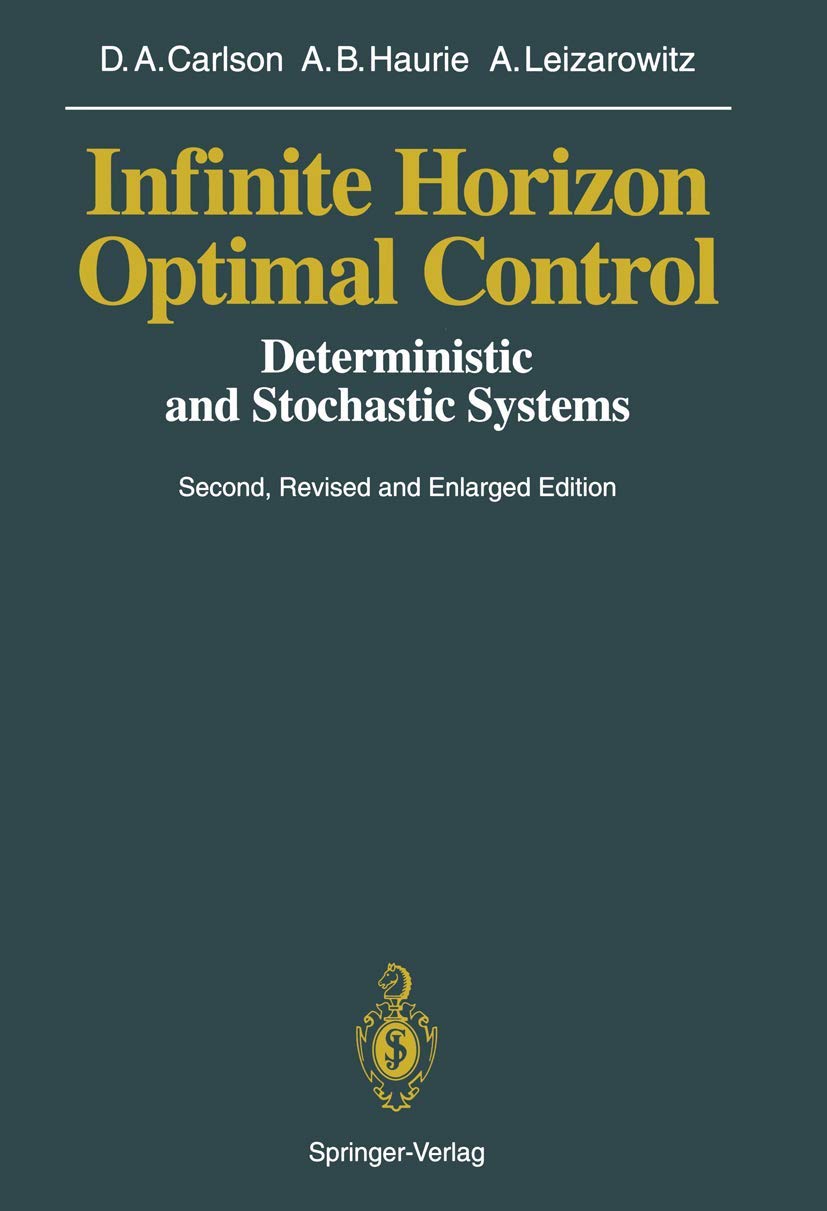
This monograph deals with various classes of deterministic and stochastic continuous time optimal control problems that are defined over unbounded time intervals. For these problems the performance criterion is described by an improper integral and it is possible that, when evaluated at a given admissible element, this criterion is unbounded. To cope with this divergence new optimality concepts, referred to here as overtaking optimality, weakly overtaking optimality, agreeable plans, etc. , have been proposed. The motivation for studying these problems arises primarily from the economic and biological sciences where models of this type arise naturally. Indeed, any bound placed on the time hori zon is artificial when one considers the evolution of the state of an economy or species. The responsibility for the introduction of this interesting class of problems rests with the economists who first studied them in the modeling of capital accumulation processes. Perhaps the earliest of these was F. Ramsey [152] who, in his seminal work on the theory of saving in 1928, considered a dynamic optimization model defined on an infinite time horizon. Briefly, this problem can be described as a Lagrange problem with unbounded time interval. The advent of modern control theory, particularly the formulation of the famous Maximum Principle of Pontryagin, has had a considerable impact on the treat ment of these models as well as optimization theory in general.
⚠️ WARNING (California Proposition 65):
This product may contain chemicals known to the State of California to cause cancer,
birth defects, or other reproductive harm.
For MAP (Minimum Advertised Price) violations and Intellectual Property (IP) or Trademark concerns, please contact:
support@ergodebooks.com
⚠️ California Proposition 65 Warning: Some products sold on this website may expose you to chemicals known to the State of California to cause cancer, birth defects, or other reproductive harm. For more information, visit www.P65Warnings.ca.gov.