
Title
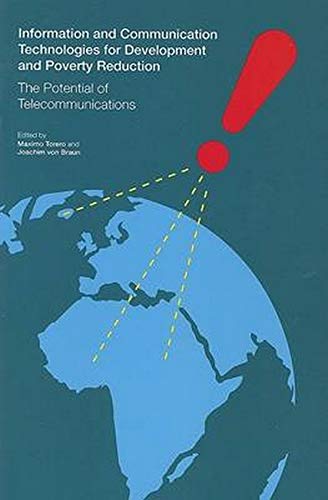
Information and Communication Technologies for Development and Poverty Reduction: The Potential of Telecommunications,Used
Sold by Ergodebooks, an authorized reseller.
Returns accepted within 30 days | support@ergodebooks.com
Shipping Information
- Free Standard Shipping — United States only
- Processing Time: 3–5 business days
- Estimated Delivery: 6–10 business days after dispatch
- Double-boxed, fully insured & discreetly packaged
- Tracking number sent via email once dispatched
Returns & Refund
Returns accepted within 30 days of delivery.
Damaged or Defective Item
Free return shipping + replacement or full refund
Wrong Item Received
Free return shipping + replacement or full refund
Change of Mind
Return shipping at customer's expense · 25% restocking fee applies
Payment Option

The IT revolution made some glorious promises to the world's poor: instant access to information and farflung markets, political empowerment, greater growth, even the possibility that countries could leapfrog entire stages of development. But when none of that happened in a hurry, the hoopla gave way to concern that rather than closing the wealth gap, IT was exacerbating it.Yet for all the international debate and millions of words written about the digital divide, very little systematic empirical research or studies over time have been done to confirm claims and counterclaims and to guide policymakers on how this technology actually affects the development of lowincome countries.In this volume, Maximo Torero and Joachim von Braun seek to address this omission with a collection of case studies exploring the relationship between information and communication technologies (ICTs) and development in Bangladesh, China, India, Ghana, Laos, Peru, and East Africa.Their conclusion is that yes, ICTs do have potential to serve and empower the poor by linking them to commercial and social networks, cutting transaction costs, and making the delivery of public goods like education and healthcare more efficient. But these benefits can accrue only when the supporting infrastructure is in place and when ICT policies take into account not only questions of connectivity but also of capability (how to help poor people use the new tools) and of content (what is relevant and in what form). All three c's are critical. Without coherent strategies and the right regulatory policies there is the very real likelihood that scarce resources will be misallocated and that ICTinduced growth will remain elusive.Contributors: Abdul Bayes, Arjun Bedi, Romeo Bertolini, Shyamal K. Chowdhury, Virgilio Galdo, K. Lal, Francis A.S.T. Matambalya, Maja Micevska, Dietrich MuellerFalcke, GiSoon Song, Maximo Torero, Joachim von Braun, Wensheng Wang, and Susanna Wolfe, GiSoon Song, Maximo Torero, Joachim von Braun, Wensheng Wang, Susanna Wolf.
⚠️ WARNING (California Proposition 65):
This product may contain chemicals known to the State of California to cause cancer, birth defects, or other reproductive harm.
For more information, please visit www.P65Warnings.ca.gov.