If you have any questions, you are always welcome to contact us. We'll get back to you as soon as possible, withing 24 hours on weekdays.
Customer service
All questions about your order, return and delivery must be sent to our customer service team by e-mail at yourstore@yourdomain.com
Sale & Press
If you are interested in selling our products, need more information about our brand or wish to make a collaboration, please contact us at press@yourdomain.com
Help
If you have any questions, you are always welcome to contact us. We'll get back to you as soon as possible, withing 24 hours on weekdays.
Customer service
All questions about your order, return and delivery must be sent to our customer service team by e-mail at yourstore@yourdomain.com
Sale & Press
If you are interested in selling our products, need more information about our brand or wish to make a collaboration, please contact us at press@yourdomain.com
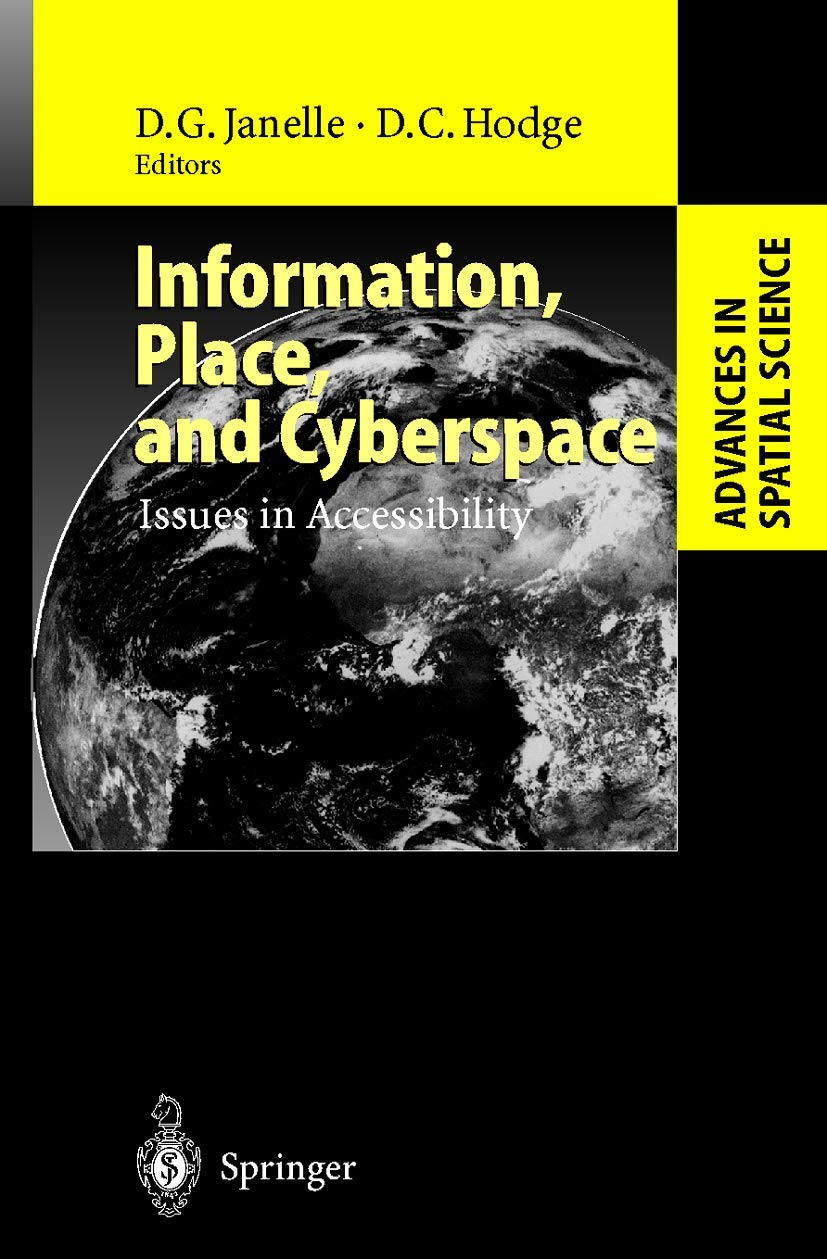
This book explores how new communication and information technologies combine with transportation to modify human spatial and temporal relationships in everyday life. It targets the need to differentiate accessibility levels among a broad range of social groupings, the need to study disparities in electronic accessibility, and the need to investigate new measures and means of representing the geography of opportunity in the information age. It explores how models based on physical notions of distance and connectivity are insufficient for understanding the new structures and behaviors that characterize current regional realities, with examples drawn from Europe, New Zealand, and North America. While traditional notions of accessibility and spatial interaction remain important, information technologies are dramatically modifying and expanding the scope of these core geographical concepts.
⚠️ WARNING (California Proposition 65):
This product may contain chemicals known to the State of California to cause cancer,
birth defects, or other reproductive harm.
For MAP (Minimum Advertised Price) violations and Intellectual Property (IP) or Trademark concerns, please contact:
support@ergodebooks.com
⚠️ California Proposition 65 Warning: Some products sold on this website may expose you to chemicals known to the State of California to cause cancer, birth defects, or other reproductive harm. For more information, visit www.P65Warnings.ca.gov.