
Title
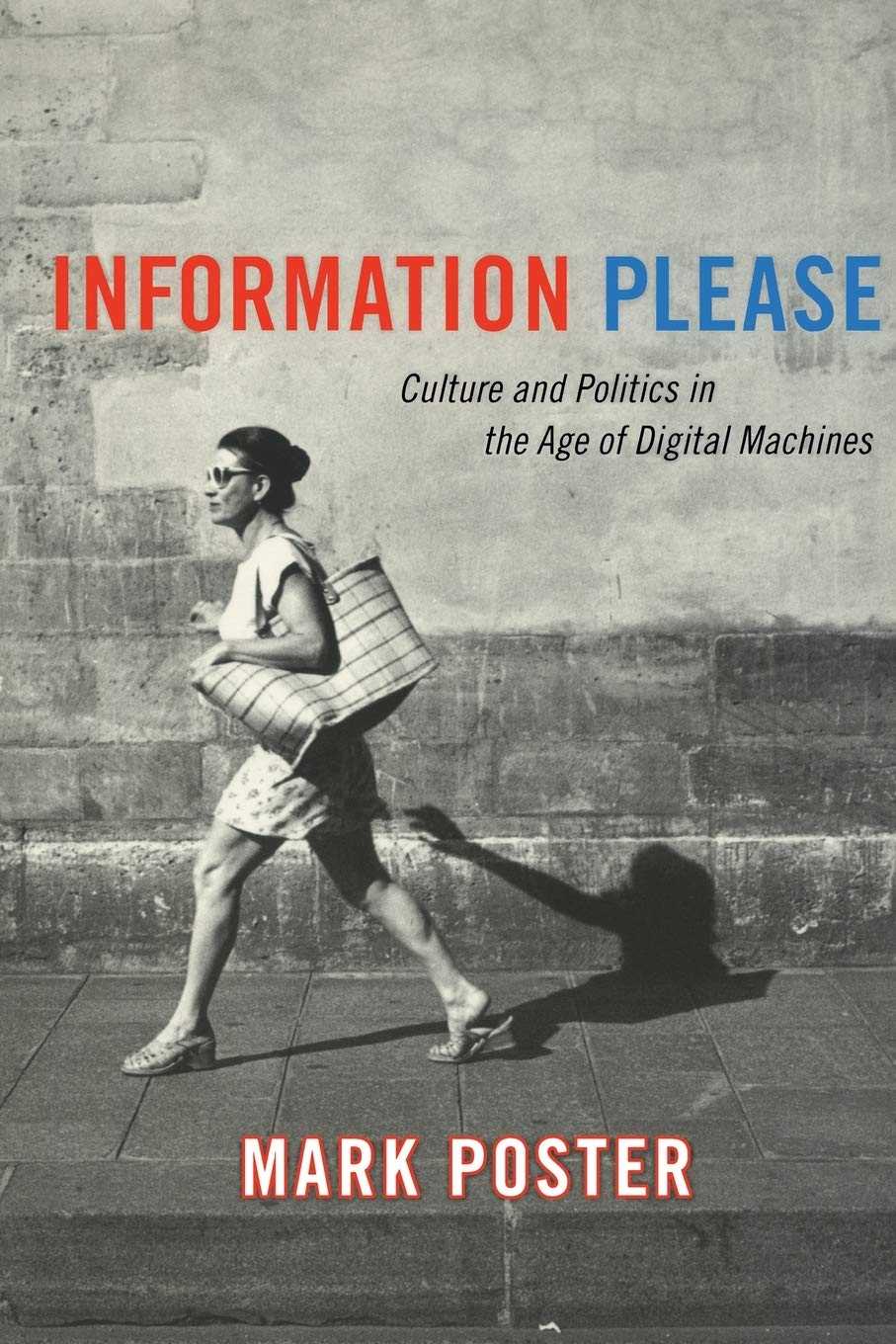
Information Please: Culture And Politics In The Age Of Digital Machines,New
Sold by Ergodebooks, an authorized reseller.
Returns accepted within 30 days | support@ergodebooks.com
Shipping Information
- Free Standard Shipping — United States only
- Processing Time: 3–5 business days
- Estimated Delivery: 6–10 business days after dispatch
- Double-boxed, fully insured & discreetly packaged
- Tracking number sent via email once dispatched
Returns & Refund
Returns accepted within 30 days of delivery.
Damaged or Defective Item
Free return shipping + replacement or full refund
Wrong Item Received
Free return shipping + replacement or full refund
Change of Mind
Return shipping at customer's expense · 25% restocking fee applies
Payment Option

Information Please advances the ongoing critical project of the media scholar Mark Poster: theorizing the social and cultural effects of electronically mediated information. In this book Poster conceptualizes a new relation of humans to information machines, a relation that avoids privileging either the human or the machine but instead focuses on the structures of their interactions. Synthesizing a broad range of critical theory, he explores how texts, images, and sounds are made different when they are mediated by information machines, how this difference affects individuals as well as social and political formations, and how it creates opportunities for progressive change.Posters critique develops through a series of lively studies. Analyzing the appearance of Sesame Streets Bert next to Osama Bin Laden in a New York Times news photo, he examines the political repercussions of this Internet hoax as well as the unlimited opportunities that Internet technology presents for the appropriation and alteration of information. He considers the implications of opensource licensing agreements, online personas, the sudden rise of and interest in identity theft, peertopeer file sharing, and more. Focusing explicitly on theory, he reflects on the limitations of critical concepts developed before the emergence of new media, particularly globally networked digital communications, and he argues that, contrary to the assertions of Michael Hardt and Antonio Negri, new media do not necessarily reproduce neoimperialisms. Urging a rethinking of assumptions ingrained during the dominance of broadcast media, Poster charts new directions for work on politics and digital culture.
⚠️ WARNING (California Proposition 65):
This product may contain chemicals known to the State of California to cause cancer, birth defects, or other reproductive harm.
For more information, please visit www.P65Warnings.ca.gov.