
Title
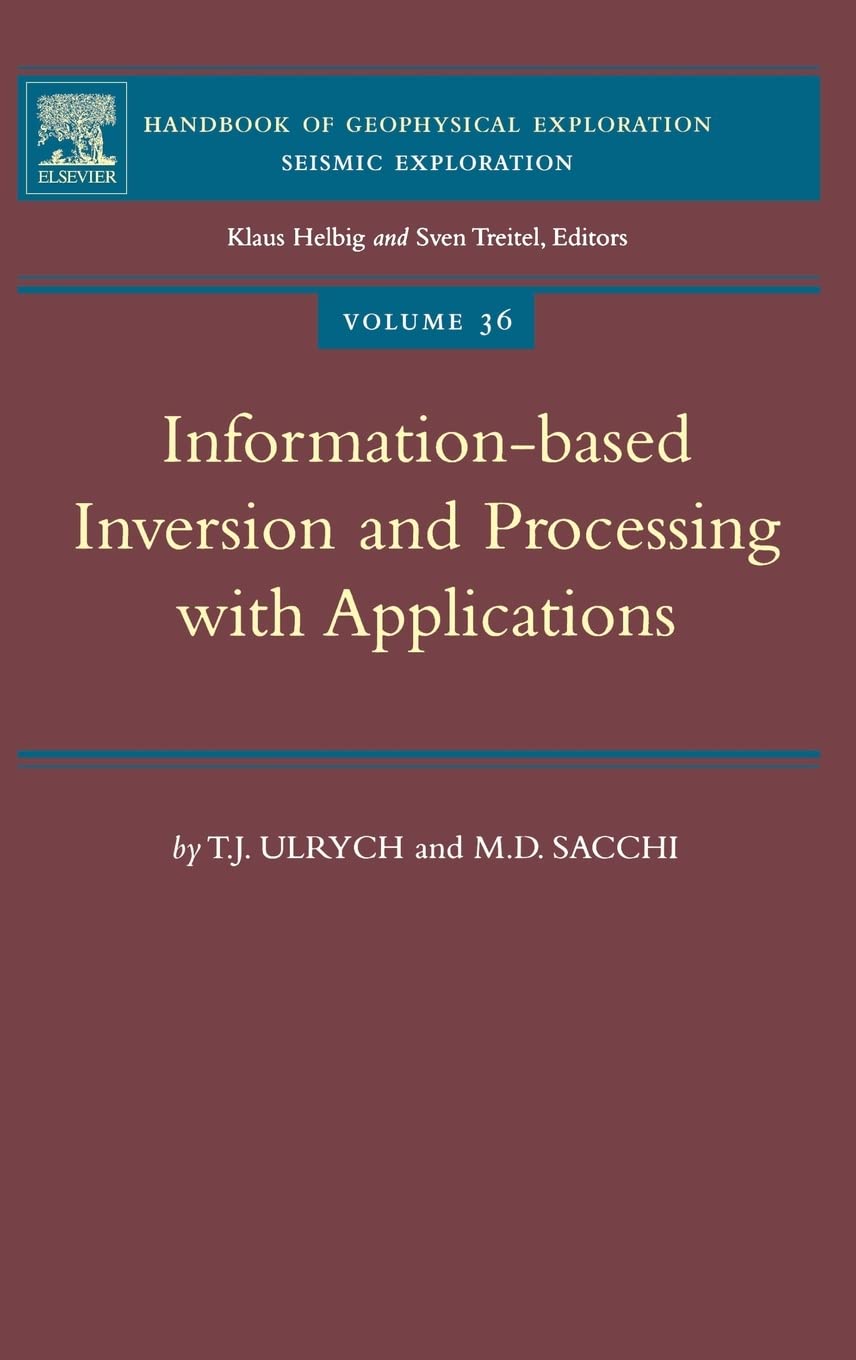
Informationbased Inversion And Processing With Applications (Volume 36) (Handbook Of Geophysical Exploration: Seismic Explorati
Sold by Ergodebooks, an authorized reseller.
Returns accepted within 30 days | support@ergodebooks.com
Shipping Information
- Free Standard Shipping — United States only
- Processing Time: 3–5 business days
- Estimated Delivery: 6–10 business days after dispatch
- Double-boxed, fully insured & discreetly packaged
- Tracking number sent via email once dispatched
Returns & Refund
Returns accepted within 30 days of delivery.
Damaged or Defective Item
Free return shipping + replacement or full refund
Wrong Item Received
Free return shipping + replacement or full refund
Change of Mind
Return shipping at customer's expense · 25% restocking fee applies
Payment Option

InformationBased Inversion and Processing with Applications examines different classical and modern aspects of geophysical data processing and inversion with emphasis on the processing of seismic records in applied seismology.Chapter 1 introduces basic concepts including: probability theory (expectation operator and ensemble statistics), elementary principles of parameter estimation, Fourier and ztransform essentials, and issues of orthogonality. In Chapter 2, the linear treatment of time series is provided. Particular attention is paid to Wold decomposition theorem and time series models (AR, MA, and ARMA) and their connection to seismic data analysis problems. Chapter 3 introduces concepts of Information theory and contains a synopsis of those topics that are used throughout the book. Examples are entropy, conditional entropy, Burg's maximum entropy spectral estimator, and mutual information. Chapter 4 provides a description of inverse problems first from a deterministic point of view, then from a probabilistic one. Chapter 5 deals with methods to improve the signaltonoise ratio of seismic records. Concepts from previous chapters are put in practice for designing prediction error filters for noise attenuation and highresolution Radon operators. Chapter 6 deals with the topic of deconvolution and the inversion of acoustic impedance. The first part discusses bandlimited extrapolation assuming a known wavelet and considers the issue of wavelet estimation. The second part deals with sparse deconvolution using various 'entropy' type norms. Finally, Chapter 7 introduces recent topics of interest to the authors.The emphasis of this book is on applied seismology but researchers in the area of global seismology, and geophysical signal processing and inversion will find material that is relevant to the ubiquitous problem of estimating complex models from a limited number of noisy observations. Nonconventional approaches to data processing and inversion are presented Important problems in the area of seismic resolution enhancement are discussed Contains research material that could inspire graduate students and their supervisors to undertake new research directions in applied seismology and geophysical signal processing
⚠️ WARNING (California Proposition 65):
This product may contain chemicals known to the State of California to cause cancer, birth defects, or other reproductive harm.
For more information, please visit www.P65Warnings.ca.gov.