If you have any questions, you are always welcome to contact us. We'll get back to you as soon as possible, withing 24 hours on weekdays.
Customer service
All questions about your order, return and delivery must be sent to our customer service team by e-mail at yourstore@yourdomain.com
Sale & Press
If you are interested in selling our products, need more information about our brand or wish to make a collaboration, please contact us at press@yourdomain.com
Help
If you have any questions, you are always welcome to contact us. We'll get back to you as soon as possible, withing 24 hours on weekdays.
Customer service
All questions about your order, return and delivery must be sent to our customer service team by e-mail at yourstore@yourdomain.com
Sale & Press
If you are interested in selling our products, need more information about our brand or wish to make a collaboration, please contact us at press@yourdomain.com
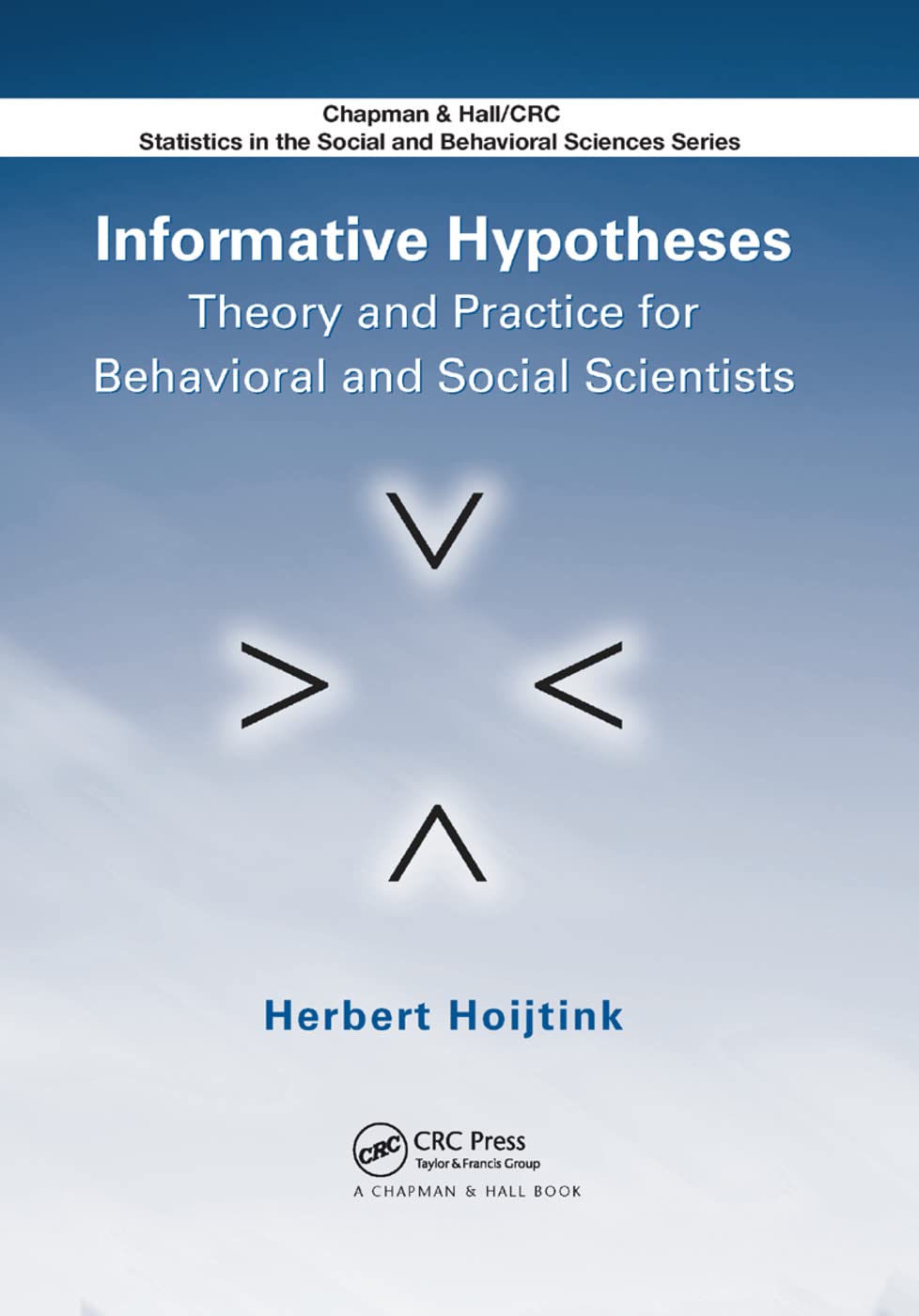
When scientists formulate their theories, expectations, and hypotheses, they often use statements like: I expect mean A to be bigger than means B and C'; I expect that the relation between Y and both X1 and X2 is positive'; and I expect the relation between Y and X1 to be stronger than the relation between Y and X2'. Stated otherwise, they formulate their expectations in terms of inequality constraints among the parameters in which they are interested, that is, they formulate Informative Hypotheses.There is currently a sound theoretical foundation for the evaluation of informative hypotheses using Bayes factors, pvalues and the generalized order restricted information criterion. Furthermore, software that is often free is available to enable researchers to evaluate the informative hypotheses using their own data. The road is open to challenge the dominance of the null hypothesis for contemporary research in behavioral, social, and other sciences.
⚠️ WARNING (California Proposition 65):
This product may contain chemicals known to the State of California to cause cancer,
birth defects, or other reproductive harm.
For MAP (Minimum Advertised Price) violations and Intellectual Property (IP) or Trademark concerns, please contact:
support@ergodebooks.com
⚠️ California Proposition 65 Warning: Some products sold on this website may expose you to chemicals known to the State of California to cause cancer, birth defects, or other reproductive harm. For more information, visit www.P65Warnings.ca.gov.