If you have any questions, you are always welcome to contact us. We'll get back to you as soon as possible, withing 24 hours on weekdays.
Customer service
All questions about your order, return and delivery must be sent to our customer service team by e-mail at yourstore@yourdomain.com
Sale & Press
If you are interested in selling our products, need more information about our brand or wish to make a collaboration, please contact us at press@yourdomain.com
Help
If you have any questions, you are always welcome to contact us. We'll get back to you as soon as possible, withing 24 hours on weekdays.
Customer service
All questions about your order, return and delivery must be sent to our customer service team by e-mail at yourstore@yourdomain.com
Sale & Press
If you are interested in selling our products, need more information about our brand or wish to make a collaboration, please contact us at press@yourdomain.com
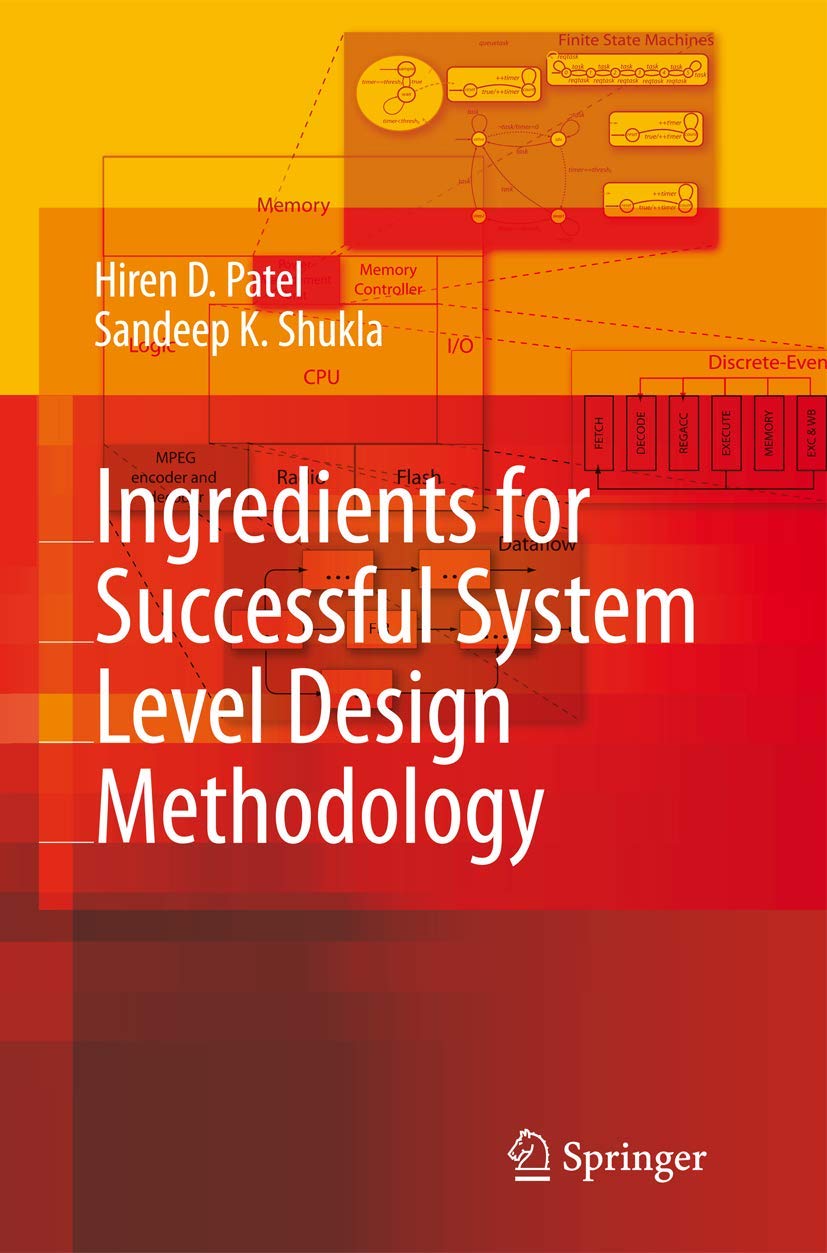
ESL or Electronic System Level is a buzz word these days, in the electronic design automation (EDA) industry, in design houses, and in the academia. Even though numerous trade magazine articles have been written, quite a few books have been published that have attempted to de?ne ESL, it is still not clear what exactly it entails. However, what seems clear to every one is that the Register Transfer Level (RTL) languages are not adequate any more to be the design entry point for todays and tomorrows complex electronic system design. There are multiple reasons for such thoughts. First, the c tinued progression of the miniaturization of the silicon technology has led to the ability of putting almost a billion transistors on a single chip. Second, applications are becoming more and more complex, and integrated with c munication, control, ubiquitous and pervasive computing, and hence the need for ever faster, ever more reliable, and more robust electronic systems is pu ing designers towards a productivity demand that is not sustainable without a fundamental change in the design methodologies. Also, the hardware and software functionalities are getting interchangeable and ability to model and design both in the same manner is gaining importance. Given this context, we assume that any methodology that allows us to model an entire electronic system from a system perspective, rather than just hardware with discreteevent or cycle based semantics is an ESL method ogy of some kind.
⚠️ WARNING (California Proposition 65):
This product may contain chemicals known to the State of California to cause cancer,
birth defects, or other reproductive harm.
For MAP (Minimum Advertised Price) violations and Intellectual Property (IP) or Trademark concerns, please contact:
support@ergodebooks.com
⚠️ California Proposition 65 Warning: Some products sold on this website may expose you to chemicals known to the State of California to cause cancer, birth defects, or other reproductive harm. For more information, visit www.P65Warnings.ca.gov.