
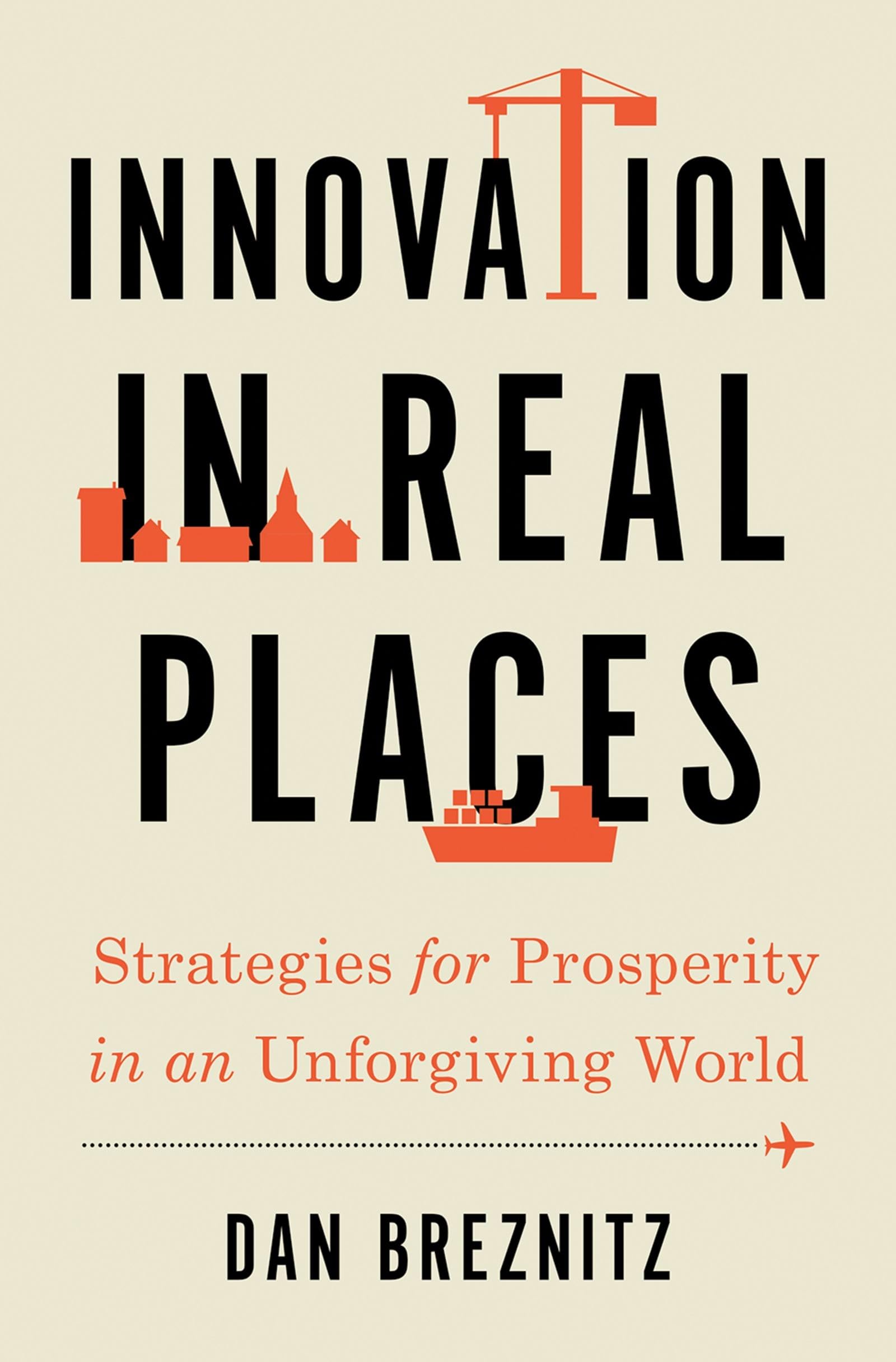
Title
Innovation in Real Places: Strategies for Prosperity in an Unforgiving World,New
Sold by Ergodebooks, an authorized reseller.
Returns accepted within 30 days | support@ergodebooks.com
Shipping Information
- Free Standard Shipping — United States only
- Processing Time: 3–5 business days
- Estimated Delivery: 6–10 business days after dispatch
- Double-boxed, fully insured & discreetly packaged
- Tracking number sent via email once dispatched
Returns & Refund
Returns accepted within 30 days of delivery.
Damaged or Defective Item
Free return shipping + replacement or full refund
Wrong Item Received
Free return shipping + replacement or full refund
Change of Mind
Return shipping at customer's expense · 25% restocking fee applies
Payment Option

Winner of Balsillie Prize for Public PolicyWinner of Donner PrizeA challenge to prevailing ideas about innovation and a guide to identifying the best growth strategy for your community.Across the world, cities and regions have wasted trillions of dollars on blindly copying the Silicon Valley model of growth creation. Since the early years of the information age, we've been told that economic growth derives from harnessing technological innovation. To do this, places must create good education systems, partner with local research universities, and attract innovative hitech firms. We have lived with this system for decades, and the result is clear: a small number of regions and cities at the top of the hightech industry but many more fighting a losing battle to retain economic dynamism.But are there other models that don't rely on a flourishing hightech industry? In Innovation in Real Places, Dan Breznitz argues that there are. The purveyors of the dominant ideas on innovation have a feeble understanding of the big picture on global production and innovation. They conflate innovation with invention and suffer from technofetishism. In their devotion to startups, they refuse to admit that the real obstacle to growth for most cities is the overwhelming power of the real hubs, which siphon up vast amounts of talent and money. Communities waste time, money, and energy pursuing this road to nowhere. Breznitz proposes that communities instead focus on where they fit in the four stages in the global production process. Some are at the highest end, and that is where the Clevelands, Sheffields, and Baltimores are being pushed toward. But that is bad advice. Success lies in understanding the changed structure of the global system of production and then using those insights to enable communities to recognize their own advantages, which in turn allows to them to foster surprising forms of specialized innovation. As he stresses, all localities have certain advantages relative to at least one stage of the global production process, and the trick is in recognizing it. Leaders might think the answer lies in hightech or highend manufacturing, but more often than not, they're wrong. Innovation in Real Places is an essential corrective to a mythology of innovation and growth that too many places have bought into in recent years. Best of all, it has the potential to prod local leaders into pursuing realistic and regionally appropriate models for growth and innovation.
⚠️ WARNING (California Proposition 65):
This product may contain chemicals known to the State of California to cause cancer, birth defects, or other reproductive harm.
For more information, please visit www.P65Warnings.ca.gov.
- Q: What is the page count of this book? A: This book has two hundred eighty pages. It provides an in-depth exploration of economic growth strategies tailored for communities.
- Q: What are the dimensions of this book? A: The book measures six point one inches in length, one point one inches in width, and nine point three inches in height. Its hardcover binding ensures durability.
- Q: Who is the author of this book? A: The author of this book is Dan Breznitz. He is recognized for his insights into innovation and economic development.
- Q: How do I apply the strategies discussed in the book? A: You can apply the strategies by assessing your community's unique strengths in the global production process. The book guides you in identifying realistic innovation paths.
- Q: Is this book suitable for community leaders? A: Yes, this book is ideal for community leaders. It offers practical advice on fostering innovation without relying solely on high-tech industries.
- Q: Can this book help in developing local economic strategies? A: Yes, the book provides guidance on creating effective local economic strategies. Breznitz emphasizes understanding your community's advantages within the global economy.
- Q: How should I care for this hardcover book? A: To care for this book, keep it in a dry place and avoid direct sunlight. Regularly dust the cover to maintain its appearance.
- Q: Is this book safe for young adults? A: Yes, the book is safe for young adults. It addresses complex topics that are suitable for high school and college-level readers.
- Q: What if my book arrives damaged? A: If your book arrives damaged, contact customer support for a return or exchange. Ensure you have your order details ready for a smoother process.
- Q: Does this book contain real-world examples? A: Yes, the book includes real-world examples of economic strategies. This helps illustrate the concepts and makes them more relatable.
- Q: Is there a specific audience for this book? A: Yes, the book targets policymakers, community leaders, and scholars interested in economic growth. It challenges traditional views on innovation.
- Q: How does this book compare to others in its genre? A: This book offers a unique perspective by focusing on regional strengths rather than high-tech dependency. It contrasts with other innovation literature.
- Q: What type of binding does this book have? A: This book has a hardcover binding. This type of binding enhances durability and longevity.
- Q: Are there any awards associated with this book? A: Yes, this book has won the Balsillie Prize for Public Policy and the Donner Prize. These awards highlight its significance in the field.
- Q: What themes are explored in this book? A: The book explores themes of innovation, economic growth, and community development. It critiques traditional growth models and offers alternative strategies.