If you have any questions, you are always welcome to contact us. We'll get back to you as soon as possible, withing 24 hours on weekdays.
Customer service
All questions about your order, return and delivery must be sent to our customer service team by e-mail at yourstore@yourdomain.com
Sale & Press
If you are interested in selling our products, need more information about our brand or wish to make a collaboration, please contact us at press@yourdomain.com
Help
If you have any questions, you are always welcome to contact us. We'll get back to you as soon as possible, withing 24 hours on weekdays.
Customer service
All questions about your order, return and delivery must be sent to our customer service team by e-mail at yourstore@yourdomain.com
Sale & Press
If you are interested in selling our products, need more information about our brand or wish to make a collaboration, please contact us at press@yourdomain.com
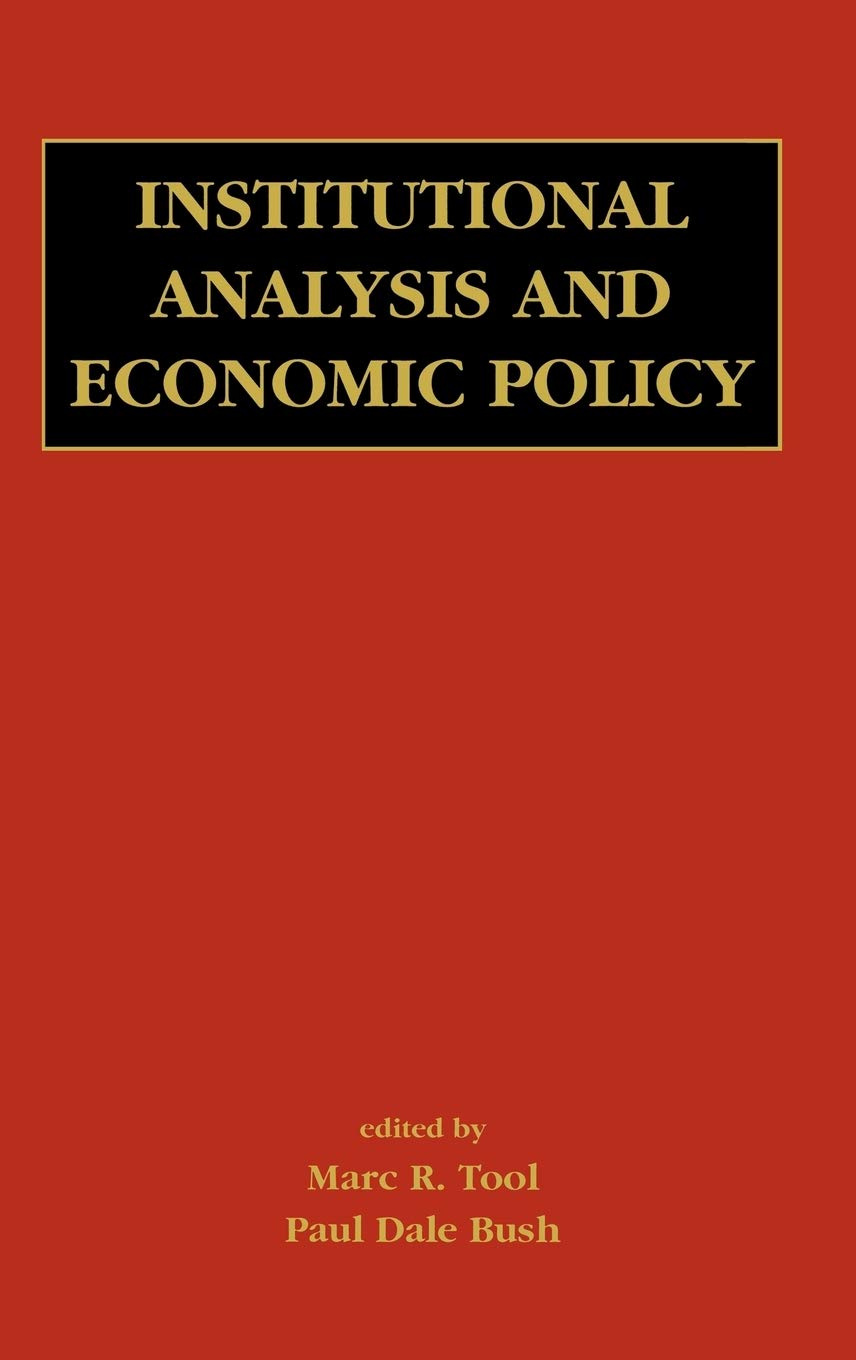
The purpose of this volume is to demonstrate how contemporary institutional economic analysis can be applied to the resolution of economic problems. All of the essays in this book challenge the conventional wisdom in the problem areas addressed. They advocate policy positions that often run contrary to views widely held by academic economists and policy makers alike. The general literature of institutional economics is unorthodox, beginning with its methodological foundations and continuing through the kind of policy analysis found in these pages. The orthodox tradition in economics is commonly characterized as "neoclassical economics." Neoclassical economics fosters the myth that only "the market" can efficiently allocate a society's economic resources and equitably distribute its income. It provides the intellectual defense for in which "free markets" are championed over democratic capitalist ideology policy formation, which it contends is neither efficient nor equitable. For both professional economists and policy makers of a conservative political persuasion, neoclassical economics writes the script for a morality play in which the market is the "good guy" and the government is the "bad guy." As such, it undermines the belief that free societies can enhance economic welfare through the use of democratic processes in the formulation of economic policies.
⚠️ WARNING (California Proposition 65):
This product may contain chemicals known to the State of California to cause cancer,
birth defects, or other reproductive harm.
For MAP (Minimum Advertised Price) violations and Intellectual Property (IP) or Trademark concerns, please contact:
support@ergodebooks.com
⚠️ California Proposition 65 Warning: Some products sold on this website may expose you to chemicals known to the State of California to cause cancer, birth defects, or other reproductive harm. For more information, visit www.P65Warnings.ca.gov.