
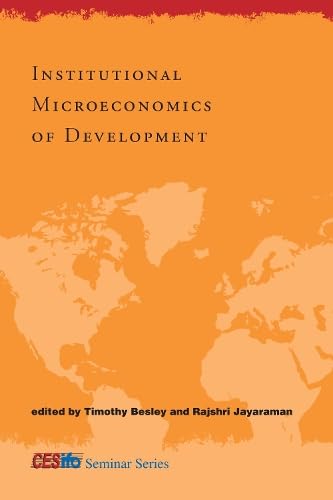
Title
Institutional Microeconomics Of Development (Cesifo Seminar Series),Used
Sold by Ergodebooks, an authorized reseller.
Returns accepted within 30 days | support@ergodebooks.com
Shipping Information
- Free Standard Shipping — United States only
- Processing Time: 3–5 business days
- Estimated Delivery: 6–10 business days after dispatch
- Double-boxed, fully insured & discreetly packaged
- Tracking number sent via email once dispatched
Returns & Refund
Returns accepted within 30 days of delivery.
Damaged or Defective Item
Free return shipping + replacement or full refund
Wrong Item Received
Free return shipping + replacement or full refund
Change of Mind
Return shipping at customer's expense · 25% restocking fee applies
Payment Option

Leading Scholars Examine Political, Legal, Social, And Market Institutions Through A Microeconomic Lens.The Narrative Of Development Economics Is Now Infused With Discussions Of Institutions. Economists Debate Whether Institutionsor Other Factors Altogether (Geography, Culture, Or Religion)Are Central To Development. In This Volume, Leading Scholars In Development Economics View Institutions From A Microeconomic Perspective, Offering Both Theoretical Overviews And Empirical Analyses Spanning Three Continents. After Substantial Introductory Chapters By Pranab Bardhan And Marcel Fafchamps, Two Scholars Who Have Published Important Work On This Topic, Each Of The Remaining Chapters Examines A Particular Set Of Institutions In A Unique Setting. These Chapters Treat The Effects Of Angola'S Violent Conflict On That Country'S Development; Institutional Accountability In Uganda; The Effect Of Indonesia'S Ethnic Diversity On The Distribution Of Public Goods; The Impact Of Trade Liberalization On India'S Investment Climate; Extended Family Networks In Mexico; And A Microeconomic Perspective On Land Rights In Ethiopia. The Chapters Demonstrate The Remarkable Heterogeneity Of Institutionspolicy Change Is Mediated Through Local Market Institutions, Government Institutions, And Familiesas Well As The Empirical And Methodological Ingenuity Of Current Research Into This Crucial Topic.Contributorsmanuela Angelucci, Oriana Bandiera, Pranab Bardhan, Timothy Besley, Martina Bjrkman, Robin Burgess, Giacomo De Giorgi, Stefan Dercon, Marcel Fafchamps, Rajshri Jayaraman, Pramila Krishnan, Eliana La Ferrara, Gilat Levy, Marcos A. Rangel, Imram Rasul, Ritva Reinikka, Jakob Svensson
⚠️ WARNING (California Proposition 65):
This product may contain chemicals known to the State of California to cause cancer, birth defects, or other reproductive harm.
For more information, please visit www.P65Warnings.ca.gov.
- Q: What is the page count of this book? A: This book has two hundred fifty pages. It provides a comprehensive exploration of microeconomic perspectives on development.
- Q: What are the dimensions of the book? A: The book measures six and a half inches by one inch by nine and a half inches. These dimensions make it a manageable size for reading.
- Q: What type of binding does this book have? A: This book features hardcover binding. This ensures durability and longevity for frequent readers.
- Q: Who is the author of this book? A: The author of this book is Timothy Besley. He is a well-known scholar in the field of economics, particularly development economics.
- Q: What topics are covered in this book? A: This book covers various topics related to political, legal, social, and market institutions. It examines their impact on development through a microeconomic lens.
- Q: Is this book suitable for beginners in economics? A: Yes, this book is suitable for beginners but may also appeal to advanced readers. It offers theoretical and empirical insights that can benefit various levels of understanding.
- Q: How can I best utilize this book for my studies? A: You can use this book as a primary reference for understanding microeconomic theories related to development. It is also helpful for essays and research.
- Q: What is the reading level of this book? A: This book is intended for an academic audience. It is best suited for university students and professionals in economics or development studies.
- Q: How should I store this book to keep it in good condition? A: Store this book upright in a cool, dry place. Avoid exposing it to direct sunlight to preserve the cover and pages.
- Q: Can I clean this book if it gets dirty? A: Yes, you can gently wipe the cover with a soft, dry cloth. Avoid using water or cleaning solutions that could damage the binding.
- Q: What if the book arrives damaged? A: If the book arrives damaged, you should contact the seller for a replacement. Many sellers have policies in place for damaged goods.
- Q: Is there a return policy for this book? A: Yes, there is typically a return policy. You should check the specific seller's terms for details on returns and refunds.
- Q: What if I have questions about the content of the book? A: You can reach out to academic forums or the publisher for inquiries about the content. Engaging with scholars can provide additional insights.
- Q: How does this book compare to others in the field? A: This book offers a unique microeconomic perspective on development, differentiating itself from others that may focus solely on macroeconomic factors.
- Q: Is this book relevant for current economic studies? A: Yes, this book is highly relevant for current economic studies. It addresses contemporary issues in development economics across various contexts.
- Q: What specific case studies are included in the book? A: The book includes case studies from Angola, Uganda, Indonesia, India, Mexico, and Ethiopia. Each case examines the influence of institutions on development.