
Title
Institutions And Investment: The Political Basis Of Industrialization In Mexico Before 1911,Used
Sold by Ergodebooks, an authorized reseller.
Returns accepted within 30 days | support@ergodebooks.com
Shipping Information
- Free Standard Shipping — United States only
- Processing Time: 3–5 business days
- Estimated Delivery: 6–10 business days after dispatch
- Double-boxed, fully insured & discreetly packaged
- Tracking number sent via email once dispatched
Returns & Refund
Returns accepted within 30 days of delivery.
Damaged or Defective Item
Free return shipping + replacement or full refund
Wrong Item Received
Free return shipping + replacement or full refund
Change of Mind
Return shipping at customer's expense · 25% restocking fee applies
Payment Option

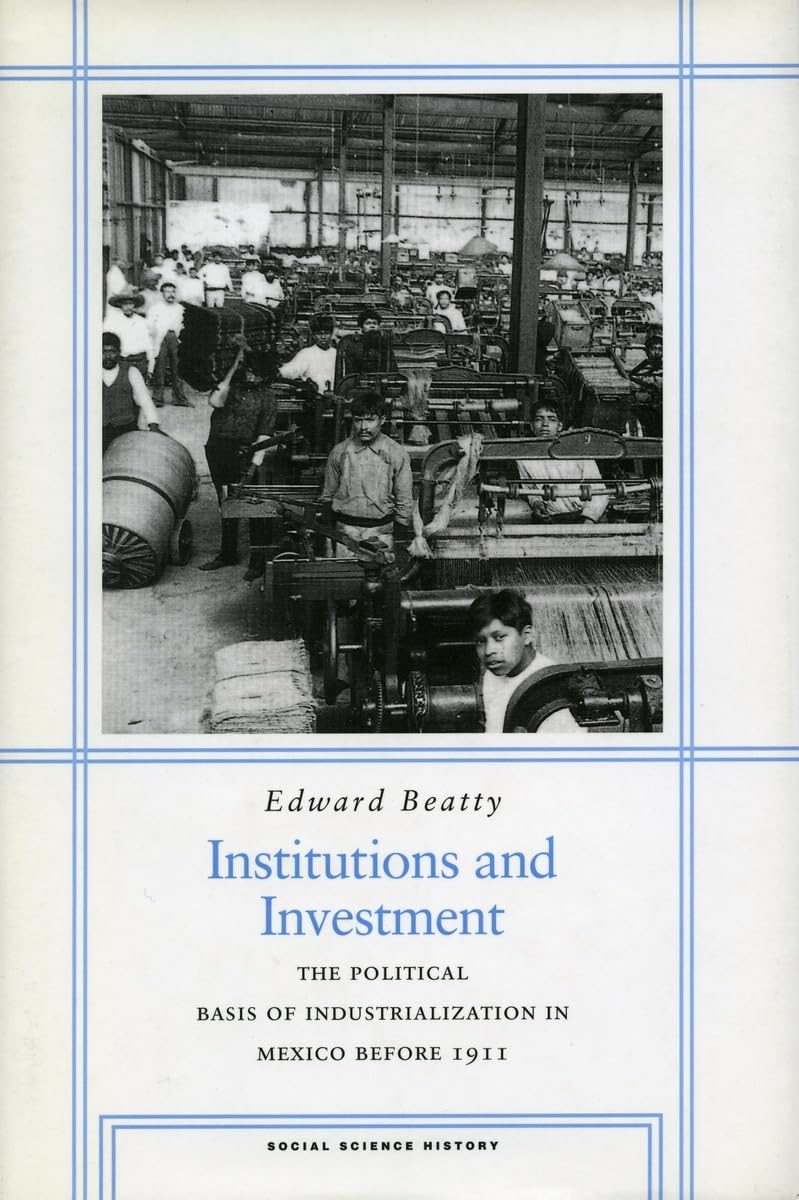
Mexico began its long and often painful transition from an agricultural and rural society to one largely industrial and urban during the late Porfiriato, the period between 1890 and 1910. Challenging the standard view of the Porfirian state as dominated by personalist politics, foreign financial interests, and a disadvantageous export economy, this book argues that beginning in the 1890s, the Mexican government adopted a coherent set of economic policies explicitly designed to foster Mexican industry, notably manufacturing.The author offers the first systematic explanation of why private investment came to Mexican domestic industry in an era when we would expect investors to prefer exportoriented activities, and when imported manufactures held every advantage in the domestic market. He shows that the government of Porfirio Daz encouraged the development of a domestic industrial sector through a planned and carefully administered set of laws and policies, including commercial policy (import tariffs), intellectual property law (patents), and the New Industries program (that provided tax incentives to entrepreneurs who set up new industries).This study also offers a case study of rapid institutional change in the context of a relatively backward and transitional economy. Within a historical context, it argues that Mexicos federal bureaucracy proved able to craft, administer, and adjudicate economic policy in relative freedom from political considerations, resulting in an increasingly diverse economic structure. Within a theoretical context, it argues that institutions play a crucial role in shaping investment behavior, but that understanding this relationship requires careful attention to the structure of policy, to patterns of its administration, to the response of entrepreneurs, and to the broader economic and historical context. This case thus suggests a more nuanced view of the theories of the New Institutional Economics.
⚠️ WARNING (California Proposition 65):
This product may contain chemicals known to the State of California to cause cancer, birth defects, or other reproductive harm.
For more information, please visit www.P65Warnings.ca.gov.