
Title

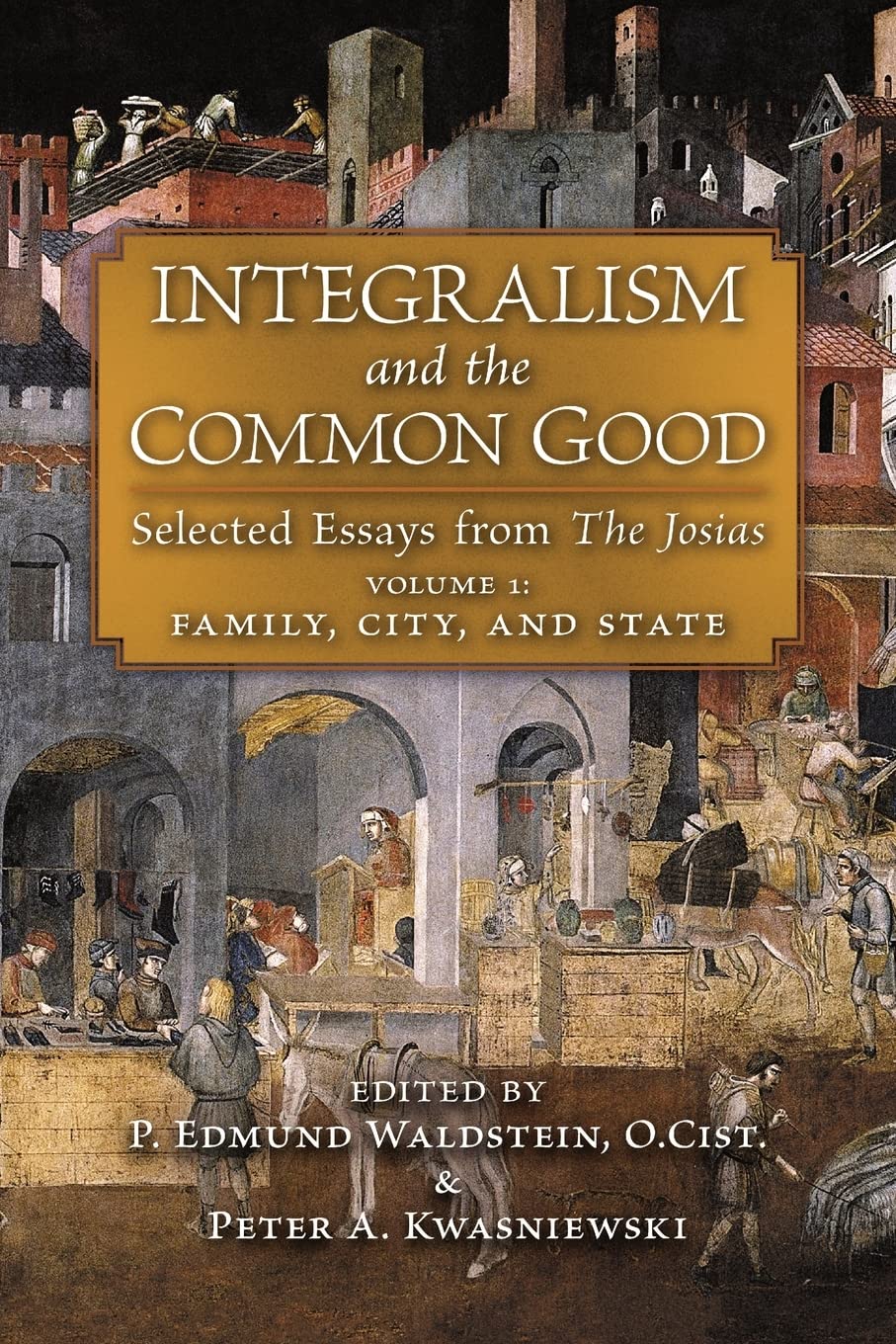
Integralism and the Common Good: Selected Essays from The Josias (Volume 1: Family, City, and State),Used
Sold by Ergodebooks, an authorized reseller.
Returns accepted within 30 days | support@ergodebooks.com
Shipping Information
- Free Standard Shipping — United States only
- Processing Time: 3–5 business days
- Estimated Delivery: 6–10 business days after dispatch
- Double-boxed, fully insured & discreetly packaged
- Tracking number sent via email once dispatched
Returns & Refund
Returns accepted within 30 days of delivery.
Damaged or Defective Item
Free return shipping + replacement or full refund
Wrong Item Received
Free return shipping + replacement or full refund
Change of Mind
Return shipping at customer's expense · 25% restocking fee applies
Payment Option

Wisdom, in the full sense, is a matter of knowing something that is not subject to political deliberation, that is, the First Principle and Last End of all things. It includes understanding the order of all things from that Principle and to that Endan order that we, as human beings, ought to reflect and embody in our own actions and in our common life in society. The political implications of this truth have been obscured in the modern era by the errors of liberalism, which, granting human reason a false supremacy, makes of man? own deliberation the only measure of the good, even its originator. The result is that every society comes to be seen and treated as a conventional, contractual, artificial, collective egoism.The authors whose writings appear in this volumemost of them first published at The Josiasshare the conviction that there is urgent need to combat the errors of liberalism, both in the world and in the Catholic Church itselffor men cannot be truly happy unless their lives are integrated into the greater order that emanates from God. To overcome modern errors, a ?roadening of reason?is necessary: we must draw upon the deepest sources of philosophical and theological wisdom, upon the deepest insights of human reason reflecting on the whole breadth of human experience, and upon the supernatural light of Divine Revelation.This first volume of essays treats the main questions of practical philosophy: the principles of human action and the common goods of natural human communities, ranging from the smallest and most fundamental (the household) to the greatest and most encompassing (the political community). The second volume will be devoted to the relations of those natural communities to the supernatural Kingdom established by Christ.?he good, the common good, the highest goodthese and other concepts have once more come to permeate political discourse in the West. While this is a salutary development, there is also much confusion in the air over what they really mean. No more: This lucid and learned anthology is a fantastic onestop primer for the perplexed layman.?SOHRAB AHMARI, author of From Fire, by Water and The Unbroken Thread?hile the world, in its flight from reality, rushes headlong into moral and political disorder, an extraordinary renaissance of Catholic social and political thought has also been taking place. Innocuous phrases like ?ommon good conservativism?and ?atholic integralism?now have a frisson about them, even enlivening geopolitical disputes about right order. In this extraordinary set of essays, we have some of the first fruits of a renaissance essential to the recovery of our sanity.?C.C. PECKNOLD, Catholic University of America?atholic Integralism and the Common Good collects refreshingly original essays by thinkers committed to an authentically Catholic view of our common life. It is a handbook for those eager to enter the public sphere with the intellectual resources to actualize the kingship of Christ in politics and culture. The longheralded death of liberalism is at hand. Emerging from its grave is a new tribalism in the form of identity politics. All the more necessary, then, is this volume? careful explication of the common good, which meets the intrinsic human desire for genuine community and a vibrant civil society ordered to our true spiritual ends.?DOMINIC A. AQUILA, University of St. Thomas?his stimulating collection of essays suggests what Catholic Social Teaching might look like today, had Pope Benedict? ?ermeneutic of continuity?been applied consistently throughout its course.?AIDAN NICHOLS, O.P., author of Redeeming Beauty and Lost in Wonder
⚠️ WARNING (California Proposition 65):
This product may contain chemicals known to the State of California to cause cancer, birth defects, or other reproductive harm.
For more information, please visit www.P65Warnings.ca.gov.
- Q: How many pages are in this book? A: This book contains three hundred fifty-six pages. It offers a comprehensive exploration of integralism and its implications for society.
- Q: What is the binding type of this book? A: The book is available in paperback binding. This makes it more flexible and lightweight for easy handling.
- Q: What are the dimensions of this book? A: The book measures six inches in length, nine inches in height, and zero point nine one inches in width. These dimensions make it convenient for reading and storage.
- Q: Who is the author of this book? A: The author of this book is Waldstein O.Cist, P. Edmund. His insights contribute significantly to the discussion on Catholic social and political thought.
- Q: What is the primary focus of this book? A: The book primarily focuses on the principles of human action and the common good. It delves into the relationship between natural communities and the supernatural Kingdom established by Christ.
- Q: How should I approach reading this book? A: You can start by reading the introduction to understand the main themes. The essays are designed to stimulate thought on integralism and its relevance today.
- Q: Is this book suitable for beginners in philosophy? A: Yes, this book is suitable for beginners. The essays provide clear explanations of complex ideas, making them accessible for readers new to the subject.
- Q: What age group is this book appropriate for? A: This book is appropriate for adults and mature teenagers. It discusses intricate philosophical and political concepts that require a certain level of maturity to fully grasp.
- Q: How do I care for this paperback book? A: To care for this book, keep it in a cool, dry place and avoid exposure to direct sunlight. This will help preserve its condition over time.
- Q: Can I return this book if I am not satisfied? A: Yes, you can return the book if you are not satisfied. Check the return policy of the retailer for specific details.
- Q: What if the book arrives damaged? A: If the book arrives damaged, you should contact customer service for a replacement. Most retailers offer assistance for damaged items.
- Q: Are there any special shipping options for this book? A: Yes, many retailers provide discreet shipping options. It's best to check with the specific retailer for their available shipping methods.
- Q: How does this book compare to other works on Catholic social teaching? A: This book offers fresh insights compared to other works. It emphasizes the need for a 'broadening of reason' to address modern errors in liberalism.
- Q: Is this book part of a series? A: Yes, this book is the first volume in a series. The subsequent volume will explore the relationships between natural communities and the supernatural.
- Q: What themes are explored in this book? A: The book explores themes like the common good, political philosophy, and the implications of liberalism. It seeks to clarify these concepts for contemporary readers.