If you have any questions, you are always welcome to contact us. We'll get back to you as soon as possible, withing 24 hours on weekdays.
Customer service
All questions about your order, return and delivery must be sent to our customer service team by e-mail at yourstore@yourdomain.com
Sale & Press
If you are interested in selling our products, need more information about our brand or wish to make a collaboration, please contact us at press@yourdomain.com
Help
If you have any questions, you are always welcome to contact us. We'll get back to you as soon as possible, withing 24 hours on weekdays.
Customer service
All questions about your order, return and delivery must be sent to our customer service team by e-mail at yourstore@yourdomain.com
Sale & Press
If you are interested in selling our products, need more information about our brand or wish to make a collaboration, please contact us at press@yourdomain.com
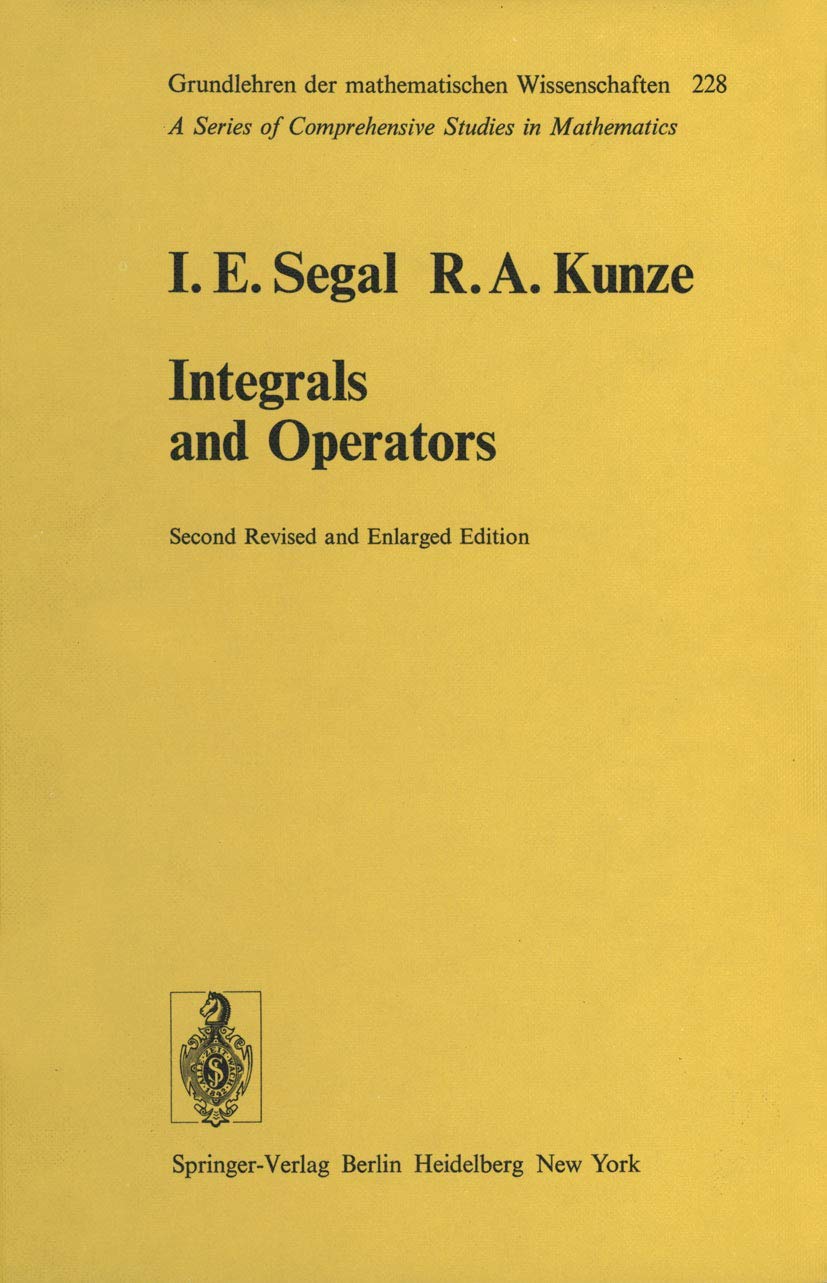
TO THE SECOND EDITION Since publication of the First Edition several excellent treatments of advanced topics in analysis have appeared. However, the concentration and penetration of these treatises naturally require much in the way of technical preliminaries and new terminology and notation. There consequently remains a need for an introduction to some of these topics which would mesh with the material of the First Edition. Such an introduction could serve to exemplify the material further, while using it to shorten and simplify its presentation. It seemed particularly important as well as practical to treat briefly but cogently some of the central parts of operator algebra and higher operator theory, as these are presently represented in book form only with a degree of specialization rather beyond the immediate needs or interests of many readers. Semigroup and perturbation theory provide connections with the theory of partial differential equations. C*algebras are important in har monic analysis and the mathematical foundations of quantum mechanics. W*algebras (or von Neumann rings) provide an approach to the theory of multiplicity of the spectrum and some simple but key elements of the gram mar of analysis, of use in group representation theory and elsewhere. The v vi Preface to the Second Edition theory of the trace for operators on Hilbert space is both important in itself and a natural extension of earlier integrationtheoretic ideas.
⚠️ WARNING (California Proposition 65):
This product may contain chemicals known to the State of California to cause cancer,
birth defects, or other reproductive harm.
For MAP (Minimum Advertised Price) violations and Intellectual Property (IP) or Trademark concerns, please contact:
support@ergodebooks.com
⚠️ California Proposition 65 Warning: Some products sold on this website may expose you to chemicals known to the State of California to cause cancer, birth defects, or other reproductive harm. For more information, visit www.P65Warnings.ca.gov.