
Title
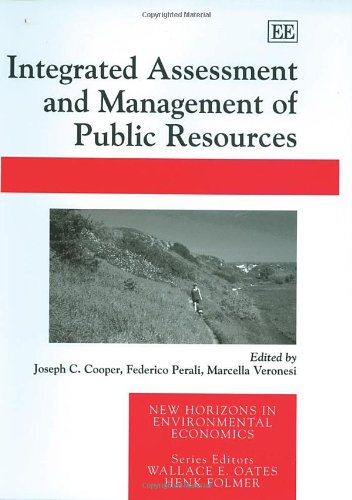
Integrated Assessment and Management of Public Resources (New Horizons in Environmental Economics series),Used
Sold by Ergodebooks, an authorized reseller.
Returns accepted within 30 days | support@ergodebooks.com
Shipping Information
- Free Standard Shipping — United States only
- Processing Time: 3–5 business days
- Estimated Delivery: 6–10 business days after dispatch
- Double-boxed, fully insured & discreetly packaged
- Tracking number sent via email once dispatched
Returns & Refund
Returns accepted within 30 days of delivery.
Damaged or Defective Item
Free return shipping + replacement or full refund
Wrong Item Received
Free return shipping + replacement or full refund
Change of Mind
Return shipping at customer's expense · 25% restocking fee applies
Payment Option

Product DescriptionThis multidisciplinary work explores ways of making environmental policy decisions in managing public goods and natural parks with the goal of maximizing economic benefits to society. The contributors to the volume seek the best strategies for improving the environmental sustainability and quality of a public resource by showing how to develop quantitative information about the natural area and how it interacts with the economy. Such an analysis can be used to define policies that encourage interactions among institutions, local economic agents and park users. At the same time, it provides a measure to account for the implications of those policies on the local economy.A public resource, such as a natural park, has many different functions the production of marketed goods, ecosystem protection and tourism and its management requires the knowledge of the physical, biological and ecological characteristics of the functions supplied by the resource, as well as the value of each function and the public resource as a whole. To ensure the implementation of the optimal practice, the contributors adopt a participative approach to establish a credible social contract between the area's public manager and its consumers. Balancing the interests of residents, visitors and local businesses, and coupling the development of both the natural potential of the area and the local economy, are necessary steps for the best strategy to be adopted.Economists and agriculturalenvironmental economists, forest and resource planners interested in practical guidance, and professors who teach environmental economics or forest planning courses will all find this collection invaluable and instructive.About the AuthorEdited by Joseph Cooper, Senior Economist, Economic Research Service, United States Department of Agriculture, Washington, DC, US. He served during 2005 to 2006 as a senior economist in charge of agriculture and natural resources at the Presidents Council of Economic Advisors, Federico Perali, Professor, Department of Economics, University of Verona, Italy and Marcella Veronesi, Department of Agricultural and Resource Economics, University of Maryland, College Park, US
⚠️ WARNING (California Proposition 65):
This product may contain chemicals known to the State of California to cause cancer, birth defects, or other reproductive harm.
For more information, please visit www.P65Warnings.ca.gov.