If you have any questions, you are always welcome to contact us. We'll get back to you as soon as possible, withing 24 hours on weekdays.
Customer service
All questions about your order, return and delivery must be sent to our customer service team by e-mail at yourstore@yourdomain.com
Sale & Press
If you are interested in selling our products, need more information about our brand or wish to make a collaboration, please contact us at press@yourdomain.com
Help
If you have any questions, you are always welcome to contact us. We'll get back to you as soon as possible, withing 24 hours on weekdays.
Customer service
All questions about your order, return and delivery must be sent to our customer service team by e-mail at yourstore@yourdomain.com
Sale & Press
If you are interested in selling our products, need more information about our brand or wish to make a collaboration, please contact us at press@yourdomain.com
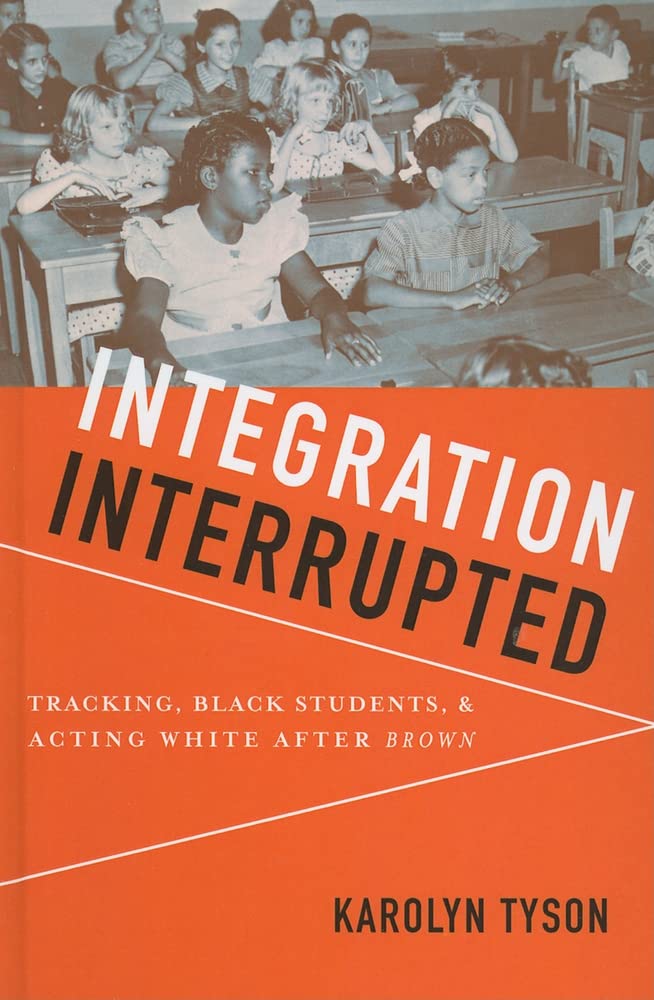
An alltoopopular explanation for why black students aren't doing better in school is their own use of the 'acting white' slur to ridicule fellow blacks for taking advanced classes, doing schoolwork, and striving to earn high grades. Carefully reconsidering how and why black students have come to equate school success with whiteness, Integration Interrupted argues that when students understand race to be connected with achievement, it is a powerful lesson conveyed by schools, not their peers. Drawing on over ten years of ethnographic research, Karolyn Tyson shows how equating school success with 'acting white' arose in the aftermath of Brown v. Board of Education through the practice of curriculum tracking, which separates students for instruction, ostensibly by ability and prior achievement. Only in very specific circumstances, when black students are drastically underrepresented in advanced and gifted classes, do anxieties about 'the burden of acting white' emerge. Racialized tracking continues to define the typical American secondary school, but it goes unremarked, except by the young people who experience its costs and consequences daily. The rich narratives in Integration Interrupted throw light on the complex relationships underlying school behaviors and convincingly demonstrate that the problem lies not with students, but instead with how we organize our schools.
⚠️ WARNING (California Proposition 65):
This product may contain chemicals known to the State of California to cause cancer,
birth defects, or other reproductive harm.
For MAP (Minimum Advertised Price) violations and Intellectual Property (IP) or Trademark concerns, please contact:
support@ergodebooks.com
⚠️ California Proposition 65 Warning: Some products sold on this website may expose you to chemicals known to the State of California to cause cancer, birth defects, or other reproductive harm. For more information, visit www.P65Warnings.ca.gov.