

Title

Intellectual Property Rights: Legal and Economic Challenges for Development (Initiative for Policy Dialogue),Used
Sold by Ergodebooks, an authorized reseller.
Returns accepted within 30 days | support@ergodebooks.com
Shipping Information
- Free Standard Shipping — United States only
- Processing Time: 3–5 business days
- Estimated Delivery: 6–10 business days after dispatch
- Double-boxed, fully insured & discreetly packaged
- Tracking number sent via email once dispatched
Returns & Refund
Returns accepted within 30 days of delivery.
Damaged or Defective Item
Free return shipping + replacement or full refund
Wrong Item Received
Free return shipping + replacement or full refund
Change of Mind
Return shipping at customer's expense · 25% restocking fee applies
Payment Option

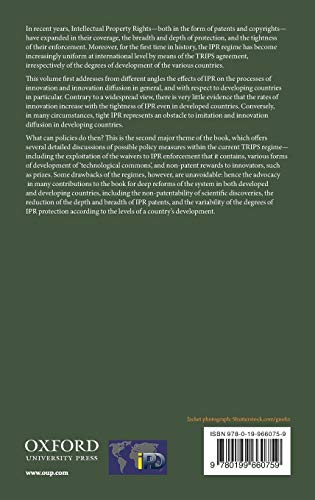
In recent years, Intellectual Property Rights both in the form of patents and copyrights have expanded in their coverage, the breadth and depth of protection, and the tightness of their enforcement. Moreover, for the first time in history, the IPR regime has become increasingly uniform at international level by means of the TRIPS agreement, irrespectively of the degrees of development of the various countries.This volume, first, addresses from different angles the effects of IPR on the processes of innovation and innovation diffusion in general, and with respect to developing countries in particular. Contrary to a widespread view, there is very little evidence that the rates of innovation increase with the tightness of IPR even in developed countries. Conversely, in many circumstances, tight IPR represents an obstacle to imitation and innovation diffusion in developing countries.What can policies do then? This is the second major theme of the book which offers several detailed discussions of possible policy measures even within the current TRIPS regime including the exploitation of the waivers to IPR enforcement that it contains, various forms of development of 'technological commons', and nonpatent rewards to innovators, such as prizes. Some drawbacks of the regimes, however, are unavoidable: hence the advocacy in many contributions to the book of deep reforms of the system in both developed and developing countries, including the nonpatentability of scientific discoveries, the reduction of the depth and breadth of IPR patents, and the variability of the degrees of IPR protection according to the levels of a country's development.
⚠️ WARNING (California Proposition 65):
This product may contain chemicals known to the State of California to cause cancer, birth defects, or other reproductive harm.
For more information, please visit www.P65Warnings.ca.gov.