
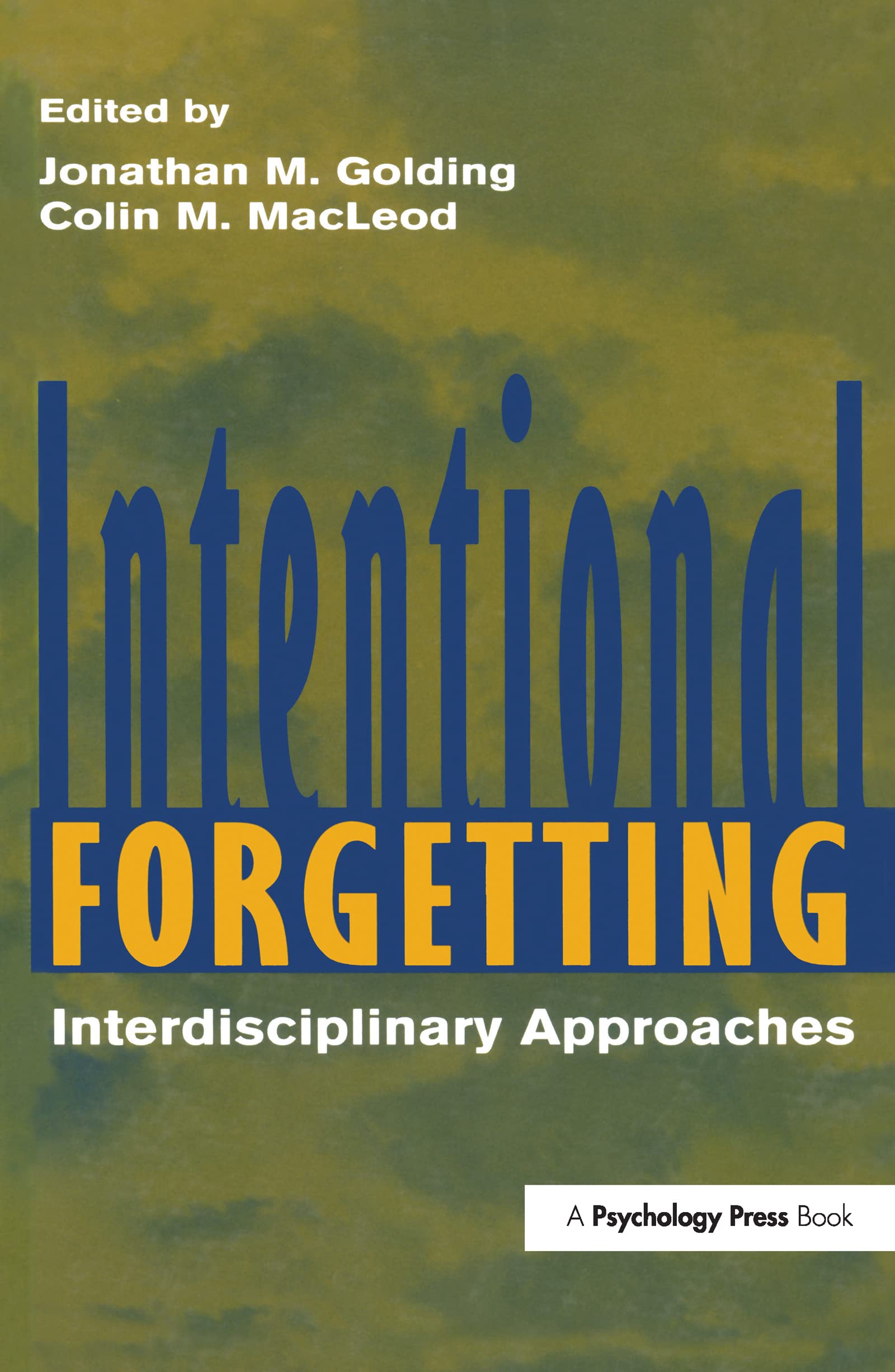
Title
Intentional Forgetting: Interdisciplinary Approaches,Used
Sold by Ergodebooks, an authorized reseller.
Returns accepted within 30 days | support@ergodebooks.com
Shipping Information
- Free Standard Shipping — United States only
- Processing Time: 3–5 business days
- Estimated Delivery: 6–10 business days after dispatch
- Double-boxed, fully insured & discreetly packaged
- Tracking number sent via email once dispatched
Returns & Refund
Returns accepted within 30 days of delivery.
Damaged or Defective Item
Free return shipping + replacement or full refund
Wrong Item Received
Free return shipping + replacement or full refund
Change of Mind
Return shipping at customer's expense · 25% restocking fee applies
Payment Option

Research on intentional forgetting has been conducted in various forms and under various names for at least 30 years, but until now no effort has been made to present these different perspectives in one place. Comprising both review chapters and new empirical studies, this book brings together the many research paradigms investigating intentional forgetting, thereby highlighting the commonalities that link these seemingly disparate areas of research. It serves as a 'case study' of one phenomenon in memorythe intention to forget or to modify memory.Why is research on intentional forgetting important? It helps to increase the understanding of how memory functions, especially with regard to its updating. In William James' 'booming, buzzing confusion,' we frequently are unable to adequately process all of the information that we experience; online forgetting of some information is necessary. Moreover, we must often replace existing information with new information, as when someone we know relocates and acquires a new address and telephone number. Investigating this updating ability has been the main thrust of research on intentional forgetting, specifically those studies on the directed forgetting phenomenon. Cognitive experiments on directed forgetting have shown that we are able to deal more effectively with large amounts of information by following instructions to treat some of the information as 'to be forgotten.' In this way, interference is reduced and we are able to devote all of our resources to the remaining toberemembered information. The mechanisms that lead to this reduction continue to promote new experiments, but over a quarter century of research maintains that the directed forgetting effect is robust.
⚠️ WARNING (California Proposition 65):
This product may contain chemicals known to the State of California to cause cancer, birth defects, or other reproductive harm.
For more information, please visit www.P65Warnings.ca.gov.