If you have any questions, you are always welcome to contact us. We'll get back to you as soon as possible, withing 24 hours on weekdays.
Customer service
All questions about your order, return and delivery must be sent to our customer service team by e-mail at yourstore@yourdomain.com
Sale & Press
If you are interested in selling our products, need more information about our brand or wish to make a collaboration, please contact us at press@yourdomain.com
Help
If you have any questions, you are always welcome to contact us. We'll get back to you as soon as possible, withing 24 hours on weekdays.
Customer service
All questions about your order, return and delivery must be sent to our customer service team by e-mail at yourstore@yourdomain.com
Sale & Press
If you are interested in selling our products, need more information about our brand or wish to make a collaboration, please contact us at press@yourdomain.com
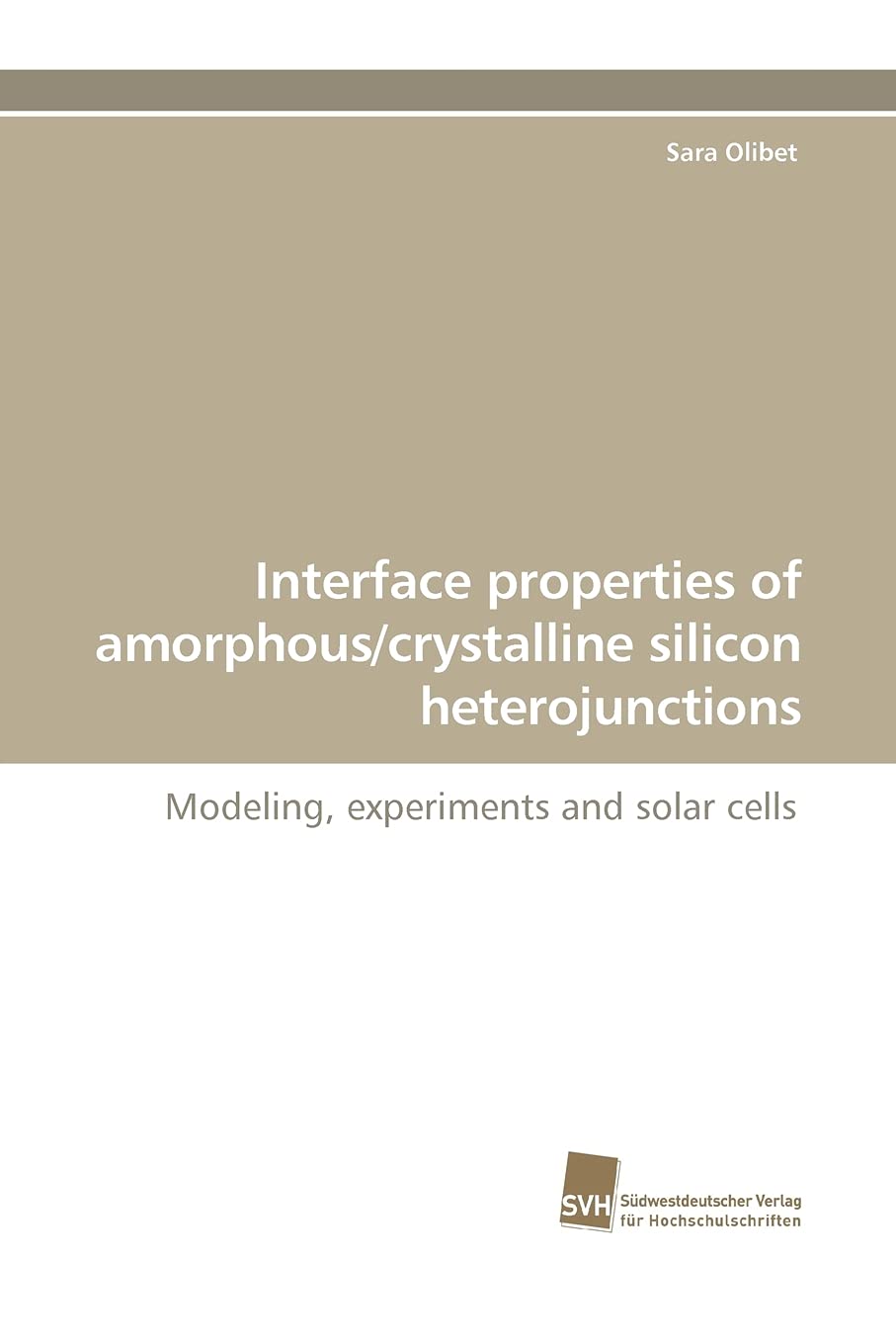
Solar cells based on monocrystalline silicon (cSi) can potentially achieve high sunlight energy conversion efficiencies and thus could reach grid parity despite the high cost of cSi. The efficiency of standard cSi solar cells featuring diffused emitters and aluminum back surface fields (BSF) is limited by interface recombination. Alternatively the growth of intrinsic/doped amorphous silicon (a Si:H) layer stacks on cSi effectively passivates the cSi surface and simultaneously forms the emitter and BSF. Such Si heterojunction (HJ) solar cells can use thin cSi wafers, benefit from low production cost of aSi:H layers and enable the highest efficiencies. The focus of this work is the study of interfaces in aSi:H/cSi heterostructures, particularly the electronic quality of the aSi:H/cSi heterointerface and its effect on the subsequent a Si:H/cSi HJ solar cell fabrication. Interface recombination modeling by considering the amphoteric nature of Si dangling bonds is in excellent agreement with measurements, and provides insight into the microscopic passivation mechanisms.
⚠️ WARNING (California Proposition 65):
This product may contain chemicals known to the State of California to cause cancer,
birth defects, or other reproductive harm.
For MAP (Minimum Advertised Price) violations and Intellectual Property (IP) or Trademark concerns, please contact:
support@ergodebooks.com
⚠️ California Proposition 65 Warning: Some products sold on this website may expose you to chemicals known to the State of California to cause cancer, birth defects, or other reproductive harm. For more information, visit www.P65Warnings.ca.gov.