
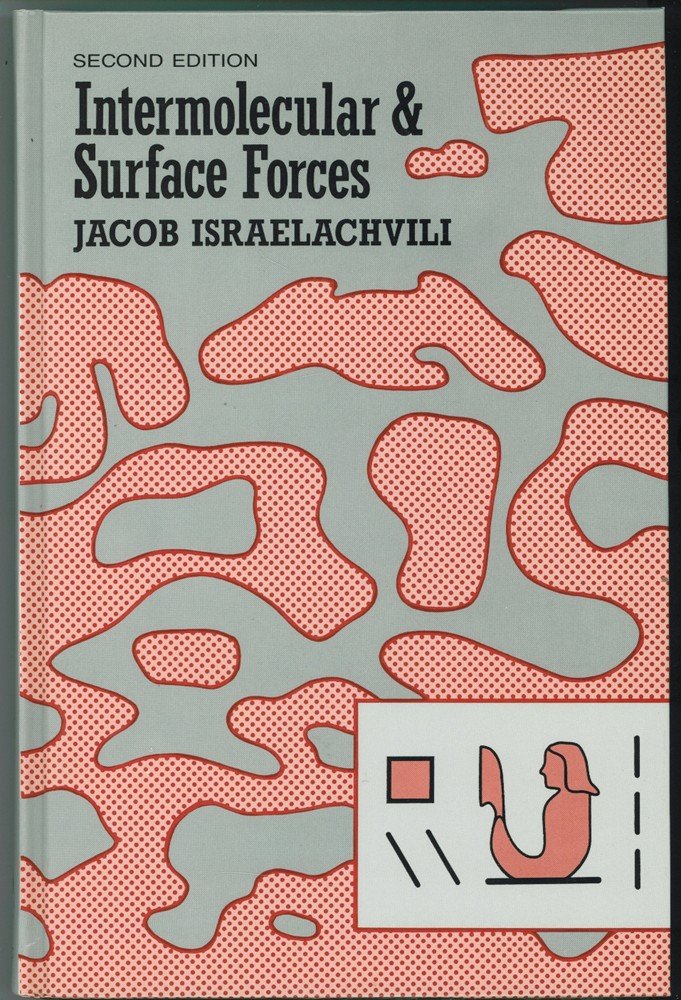
Title
Intermolecular And Surface Forces
Sold by Ergodebooks, an authorized reseller.
Returns accepted within 30 days | support@ergodebooks.com
Shipping Information
- Free Standard Shipping — United States only
- Processing Time: 3–5 business days
- Estimated Delivery: 6–10 business days after dispatch
- Double-boxed, fully insured & discreetly packaged
- Tracking number sent via email once dispatched
Returns & Refund
Returns accepted within 30 days of delivery.
Damaged or Defective Item
Free return shipping + replacement or full refund
Wrong Item Received
Free return shipping + replacement or full refund
Change of Mind
Return shipping at customer's expense · 25% restocking fee applies
Payment Option

This Book Describes The Roles Of Various Intermolecular And Interparticle Forces In Determining The Properties Of Simple Systems Such As Gases, Liquids, And Solids, Of More Complex Colloidal, Polymeric, And Biological Systems. The Book Provides A Thorough Grounding In Theories And Concepts Of Intermolecular Forces, Allowing Students And Researchers To Recognize Which Forces Are Important In Any Particular System And How To Control These Forces.Key Features* Surfaceforce Measurements* Solvation And Structural Forces* Hydration And Hydophobic Forces* Ioncorrelation Forces* Thermal Fluctuation (Steric And Undulation) Forces* Particle And Surface Interactions In Polymer Melts And Polymer Solutions* Contains Worked Examples, Discussion Topics, And More Than 100 Problems
⚠️ WARNING (California Proposition 65):
This product may contain chemicals known to the State of California to cause cancer, birth defects, or other reproductive harm.
For more information, please visit www.P65Warnings.ca.gov.
- Q: How many pages are in 'Intermolecular and Surface Forces'? A: This book contains four hundred eighty pages. It provides comprehensive coverage of intermolecular forces across various systems.
- Q: What is the binding type of this book? A: The book is bound in hardcover. This ensures durability and a professional appearance for academic use.
- Q: What are the dimensions of 'Intermolecular and Surface Forces'? A: The dimensions are six point five inches in length, one inch in width, and nine point two five inches in height. These measurements make it suitable for easy handling.
- Q: Who is the author of this book? A: The author is Jacob N. Israelachvili. He is renowned for his work in the field of intermolecular and surface forces.
- Q: What topics does this book cover? A: The book covers various intermolecular forces, including hydration and hydrophobic forces, as well as thermal fluctuation forces. This makes it suitable for both students and researchers.
- Q: Is 'Intermolecular and Surface Forces' suitable for beginners? A: Yes, this book is suitable for beginners. It provides foundational theories and concepts necessary for understanding intermolecular forces.
- Q: Can I use this book for advanced studies? A: Yes, it is appropriate for advanced studies. The text includes complex discussions and over one hundred problems for in-depth understanding.
- Q: Is this book relevant for my research in polymer chemistry? A: Yes, it is highly relevant. It discusses particle and surface interactions specifically in polymer melts and solutions.
- Q: How should I store this hardcover book? A: Store it upright on a bookshelf to prevent warping. Ensure it is kept in a dry environment to protect the binding and pages.
- Q: What if my book arrives damaged? A: Contact customer support immediately for assistance. They can guide you through the return or replacement process.
- Q: Is there a warranty on this book? A: Typically, there is no warranty on books. However, check with the seller for their specific return policy.
- Q: How can I clean the cover of this book? A: Wipe the cover gently with a slightly damp cloth. Avoid using cleaning solutions to preserve the integrity of the hardcover.
- Q: What kind of problems are included in the book? A: The book includes more than one hundred problems. These are designed to challenge the reader's understanding of intermolecular forces.
- Q: Are there examples or case studies in the book? A: Yes, the book contains worked examples and discussion topics. This enhances the learning experience for readers.
- Q: What is the main focus of 'Intermolecular and Surface Forces'? A: The main focus is on the roles of intermolecular and interparticle forces in various systems. It emphasizes their significance in understanding material properties.
- Q: Is this book suitable for non-chemistry majors? A: Yes, it is accessible to non-chemistry majors. The introductory sections provide sufficient background for readers from other disciplines.