If you have any questions, you are always welcome to contact us. We'll get back to you as soon as possible, withing 24 hours on weekdays.
Customer service
All questions about your order, return and delivery must be sent to our customer service team by e-mail at yourstore@yourdomain.com
Sale & Press
If you are interested in selling our products, need more information about our brand or wish to make a collaboration, please contact us at press@yourdomain.com
Help
If you have any questions, you are always welcome to contact us. We'll get back to you as soon as possible, withing 24 hours on weekdays.
Customer service
All questions about your order, return and delivery must be sent to our customer service team by e-mail at yourstore@yourdomain.com
Sale & Press
If you are interested in selling our products, need more information about our brand or wish to make a collaboration, please contact us at press@yourdomain.com
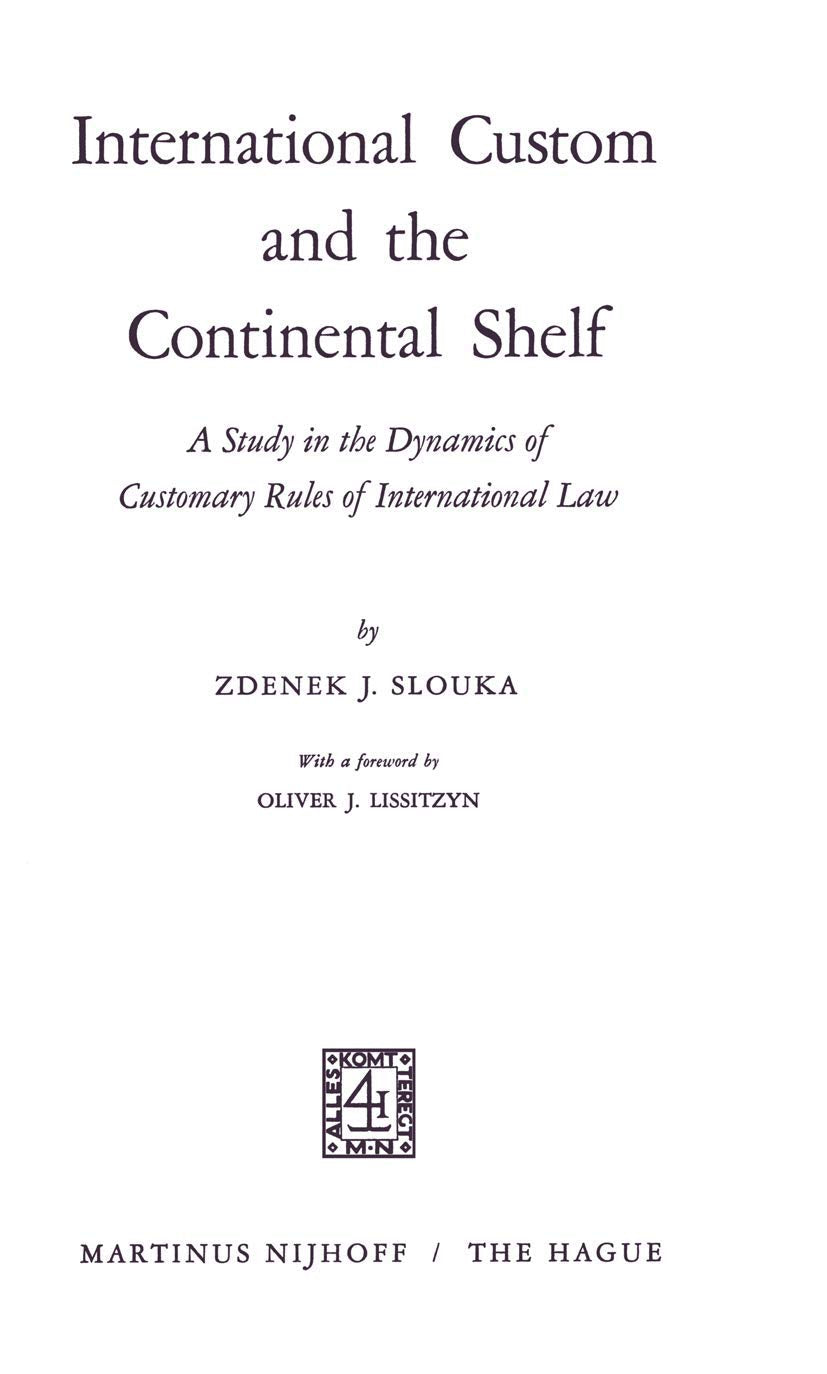
One of the reasons for the speed with which international law has been changing in recent years has been the acceleration in the development of technology. New technological capabilities create opportunities for new kinds of economic activities which in turn require new legal norms to regulate them. Many such norms are formulated by express agreement and embodied in multilateral treaties. Much of contemporary air and space law is being developed by this method. For various reasons, however, the treaty making process is not always adequate for the development of new law, at least in its initial stages. Express agreement of a substantial majority of states on norms formulated with some precision requires much time and effort. Eighteen years have passed, for example, since the United Nations International Law Commission began its work on the law of the sea which led to the formulation of four conventions at the Geneva Conference of 1958 on this subject. Ten years after this Conference, none of the four conventions has been ratified or acceded to by a majority of the states of the world. It is not surprising, therefore, that in some fie1ds new law first emerges as a set of customary norms of varying degrees of c1arity and general accep tance. But the nature of the process of development and change of customary norms has remained inadequately understood and explained in the theory of intemationallaw. Some eminent jurists have called it "a mystery.
⚠️ WARNING (California Proposition 65):
This product may contain chemicals known to the State of California to cause cancer,
birth defects, or other reproductive harm.
For MAP (Minimum Advertised Price) violations and Intellectual Property (IP) or Trademark concerns, please contact:
support@ergodebooks.com
⚠️ California Proposition 65 Warning: Some products sold on this website may expose you to chemicals known to the State of California to cause cancer, birth defects, or other reproductive harm. For more information, visit www.P65Warnings.ca.gov.