If you have any questions, you are always welcome to contact us. We'll get back to you as soon as possible, withing 24 hours on weekdays.
Customer service
All questions about your order, return and delivery must be sent to our customer service team by e-mail at yourstore@yourdomain.com
Sale & Press
If you are interested in selling our products, need more information about our brand or wish to make a collaboration, please contact us at press@yourdomain.com
Help
If you have any questions, you are always welcome to contact us. We'll get back to you as soon as possible, withing 24 hours on weekdays.
Customer service
All questions about your order, return and delivery must be sent to our customer service team by e-mail at yourstore@yourdomain.com
Sale & Press
If you are interested in selling our products, need more information about our brand or wish to make a collaboration, please contact us at press@yourdomain.com
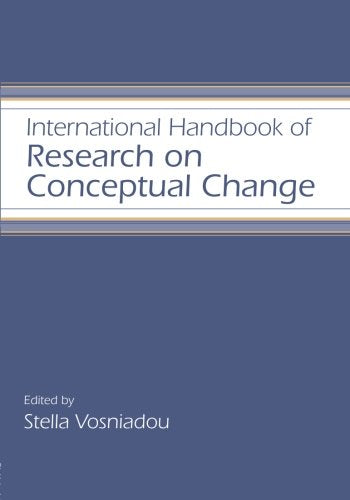
The study of conceptual change traces its heritage to the notions of paradigm (networks of shared beliefs, concepts, practices) and paradigm shift made famous by Thomas Kuhn in his book, The Structure of Scientific Revolutions. Kuhns work was quickly linked to developmental psychology (how knowledge develops) and to science education (teaching big, new ideas). This book is the first comprehensive review of the conceptual change movement and of the impressive research it has spawned on how knowledge develops and can be taught in different content areas. Because of its interdisciplinary focus chapter authors were instructed to write in a manner comprehensible to researchers and students from different fields.The International Handbook of Research on Conceptual Change consists of twentyseven chapters that clarify the nature of conceptual change research, describes its most important findings and demonstrates their importance for education. It is organized into six sections that include detailed discussions of key theoretical and methodological issues, the roots of conceptual change research in the philosophy and history of science, mechanisms of conceptual change, and learner characteristics. It also contains chapters that describe conceptual change research in the content areas such as physics, astronomy, biology, medicine and health, and history. A particular focus is given to students difficulties in learning more advanced and counterintuitive concepts.
⚠️ WARNING (California Proposition 65):
This product may contain chemicals known to the State of California to cause cancer,
birth defects, or other reproductive harm.
For MAP (Minimum Advertised Price) violations and Intellectual Property (IP) or Trademark concerns, please contact:
support@ergodebooks.com
⚠️ California Proposition 65 Warning: Some products sold on this website may expose you to chemicals known to the State of California to cause cancer, birth defects, or other reproductive harm. For more information, visit www.P65Warnings.ca.gov.