If you have any questions, you are always welcome to contact us. We'll get back to you as soon as possible, withing 24 hours on weekdays.
Customer service
All questions about your order, return and delivery must be sent to our customer service team by e-mail at yourstore@yourdomain.com
Sale & Press
If you are interested in selling our products, need more information about our brand or wish to make a collaboration, please contact us at press@yourdomain.com
Help
If you have any questions, you are always welcome to contact us. We'll get back to you as soon as possible, withing 24 hours on weekdays.
Customer service
All questions about your order, return and delivery must be sent to our customer service team by e-mail at yourstore@yourdomain.com
Sale & Press
If you are interested in selling our products, need more information about our brand or wish to make a collaboration, please contact us at press@yourdomain.com
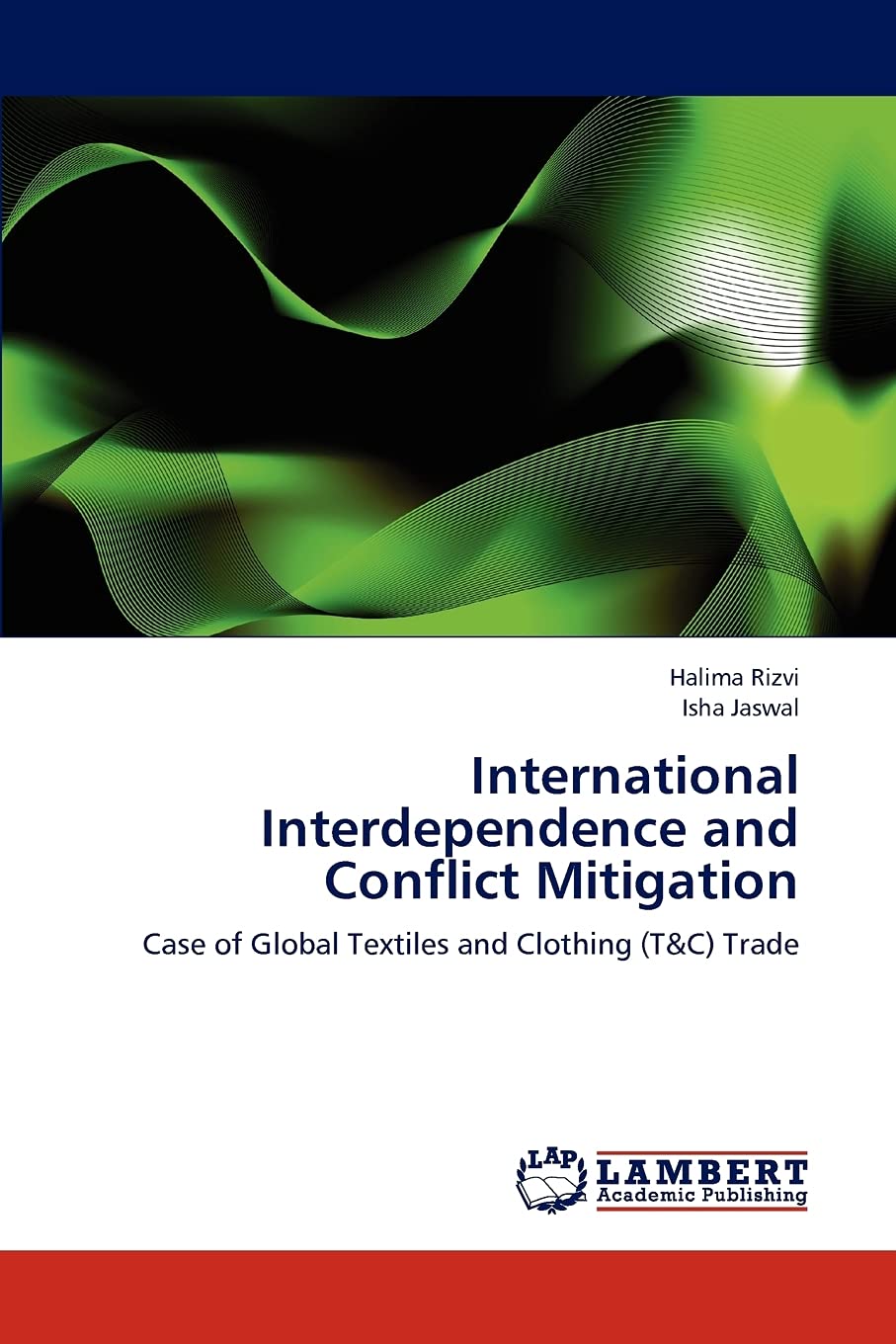
Industrial Revolution had its roots in production and trade of cotton textiles. With the advent of Industrial Revolution, in search of raw materials and expansion of markets, the industrialized countries plundered and colonized the backward nations. In the quest to expand trade, where on one hand canals, roads and railways were built, on the other hand, the resources, both, human and material, were gravely exploited. Moreover, prior to 1995, for over forty years, developed countries protected their Textile and Clothing (T&C) sector through stringent quota regime which meant outright rejection of the principle purpose of GATT of moving the global trading system towards liberalized trade. Owing to conflicting interests of its member nations, WTO is in a deadlock state today. Today, in fact, is the era of regional/preferential/free trade agreements which majorly influence the trade flows. The authors, thus, attempt to explore the effects of global T&C trade on conflict or viceversa wherein respective trade disputes between countries are considered as international conflicts.
⚠️ WARNING (California Proposition 65):
This product may contain chemicals known to the State of California to cause cancer,
birth defects, or other reproductive harm.
For MAP (Minimum Advertised Price) violations and Intellectual Property (IP) or Trademark concerns, please contact:
support@ergodebooks.com
⚠️ California Proposition 65 Warning: Some products sold on this website may expose you to chemicals known to the State of California to cause cancer, birth defects, or other reproductive harm. For more information, visit www.P65Warnings.ca.gov.