If you have any questions, you are always welcome to contact us. We'll get back to you as soon as possible, withing 24 hours on weekdays.
Customer service
All questions about your order, return and delivery must be sent to our customer service team by e-mail at yourstore@yourdomain.com
Sale & Press
If you are interested in selling our products, need more information about our brand or wish to make a collaboration, please contact us at press@yourdomain.com
Help
If you have any questions, you are always welcome to contact us. We'll get back to you as soon as possible, withing 24 hours on weekdays.
Customer service
All questions about your order, return and delivery must be sent to our customer service team by e-mail at yourstore@yourdomain.com
Sale & Press
If you are interested in selling our products, need more information about our brand or wish to make a collaboration, please contact us at press@yourdomain.com
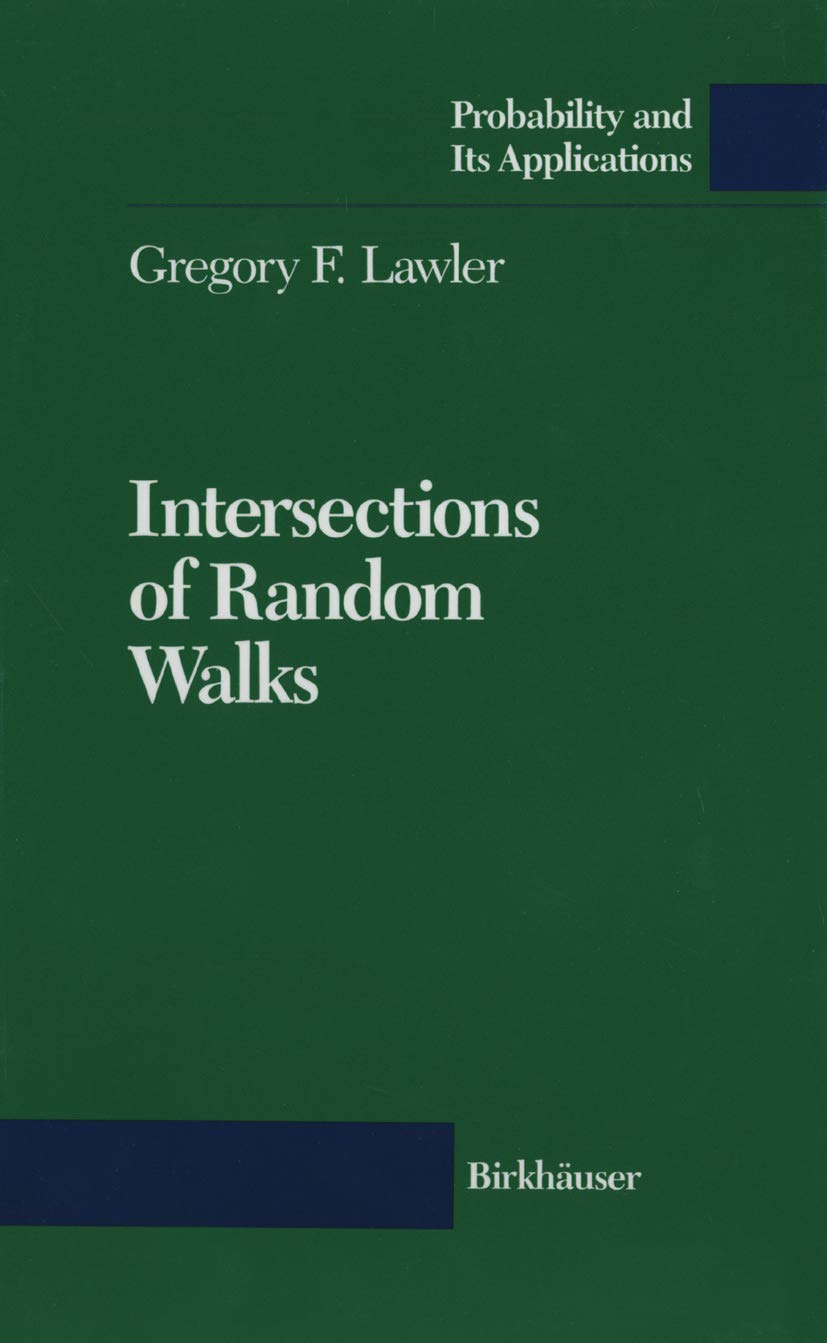
A more accurate title for this book would be "Problems dealing with the nonintersection of paths of random walks. " These include: harmonic measure, which can be considered as a problem of nonintersection of a random walk with a fixed set; the probability that the paths of independent random walks do not intersect; and selfavoiding walks, i. e. , random walks which have no selfintersections. The prerequisite is a standard measure theoretic course in probability including martingales and Brownian motion. The first chapter develops the facts about simple random walk that will be needed. The discussion is selfcontained although some previous expo sure to random walks would be helpful. Many of the results are standard, and I have made borrowed from a number of sources, especially the ex cellent book of Spitzer [65]. For the sake of simplicity I have restricted the discussion to simple random walk. Of course, many of the results hold equally well for more general walks. For example, the local central limit theorem can be proved for any random walk whose increments have mean zero and finite variance. Some of the later results, especially in Section 1. 7, have not been proved for very general classes of walks. The proofs here rely heavily on the fact that the increments of simple random walk are bounded and symmetric.
⚠️ WARNING (California Proposition 65):
This product may contain chemicals known to the State of California to cause cancer,
birth defects, or other reproductive harm.
For MAP (Minimum Advertised Price) violations and Intellectual Property (IP) or Trademark concerns, please contact:
support@ergodebooks.com
⚠️ California Proposition 65 Warning: Some products sold on this website may expose you to chemicals known to the State of California to cause cancer, birth defects, or other reproductive harm. For more information, visit www.P65Warnings.ca.gov.