If you have any questions, you are always welcome to contact us. We'll get back to you as soon as possible, withing 24 hours on weekdays.
Customer service
All questions about your order, return and delivery must be sent to our customer service team by e-mail at yourstore@yourdomain.com
Sale & Press
If you are interested in selling our products, need more information about our brand or wish to make a collaboration, please contact us at press@yourdomain.com
Help
If you have any questions, you are always welcome to contact us. We'll get back to you as soon as possible, withing 24 hours on weekdays.
Customer service
All questions about your order, return and delivery must be sent to our customer service team by e-mail at yourstore@yourdomain.com
Sale & Press
If you are interested in selling our products, need more information about our brand or wish to make a collaboration, please contact us at press@yourdomain.com
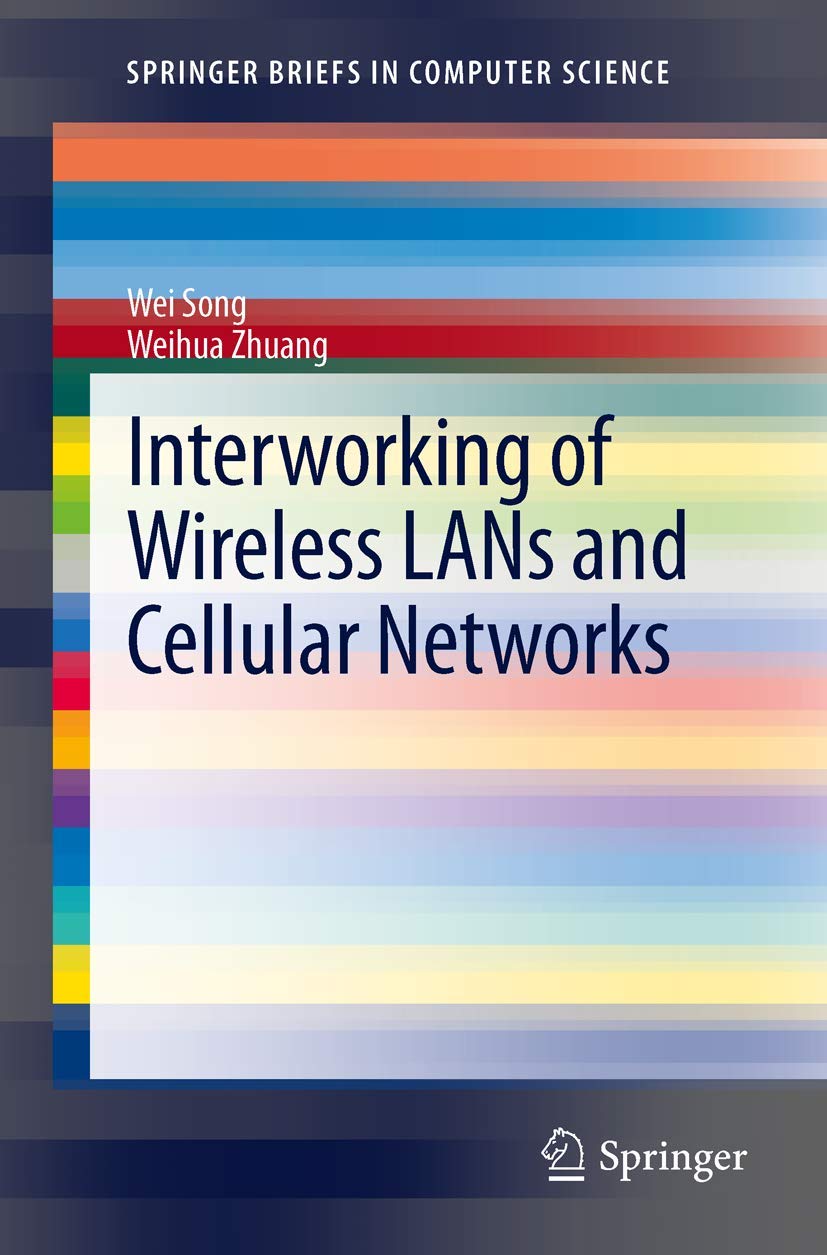
Product Description The nextgeneration of wireless communications are envisioned to be supported by heterogeneous networks by using various wireless access technologies. The popular cellular networks and wireless local area networks (WLANs) present perfectly complementary characteristics in terms of service capacity, mobility support, and qualityofservice (QoS) provisioning. The cellular/WLAN interworking is an effective way to promote the evolution of wireless networks. Interworking of Wireless LANs and Cellular Networksfocuses on three aspects, namely access selection, call admission control and load sharing to investigate heterogeneous interworking for cellular/WLAN integrated networks.It not only reveals important observations but also offers useful tools for performance evaluation. The unique traffic and network characteristics are exploited to enhance interworking effectiveness. Theoretical analysis and simulation validation demonstrate benefits of cellular/WLAN interworking in real networks. Last but not the least, this brief highlights promising future research directions to guide interested readers. Review From the reviews:This brief reviews the state of the art in research on the interworking of heterogeneous wireless local area networks (WLANs) and mobile (cellular) networks. The book requires the reader to have a solid knowledge of both WLAN and mobile network principles. The readers who are most likely to benefit from it are research specialists and graduate students interested in the topic. (Rita Puzmanova, ACM Computing Reviews, November, 2012)
⚠️ WARNING (California Proposition 65):
This product may contain chemicals known to the State of California to cause cancer,
birth defects, or other reproductive harm.
For MAP (Minimum Advertised Price) violations and Intellectual Property (IP) or Trademark concerns, please contact:
support@ergodebooks.com
⚠️ California Proposition 65 Warning: Some products sold on this website may expose you to chemicals known to the State of California to cause cancer, birth defects, or other reproductive harm. For more information, visit www.P65Warnings.ca.gov.