If you have any questions, you are always welcome to contact us. We'll get back to you as soon as possible, withing 24 hours on weekdays.
Customer service
All questions about your order, return and delivery must be sent to our customer service team by e-mail at yourstore@yourdomain.com
Sale & Press
If you are interested in selling our products, need more information about our brand or wish to make a collaboration, please contact us at press@yourdomain.com
Help
If you have any questions, you are always welcome to contact us. We'll get back to you as soon as possible, withing 24 hours on weekdays.
Customer service
All questions about your order, return and delivery must be sent to our customer service team by e-mail at yourstore@yourdomain.com
Sale & Press
If you are interested in selling our products, need more information about our brand or wish to make a collaboration, please contact us at press@yourdomain.com
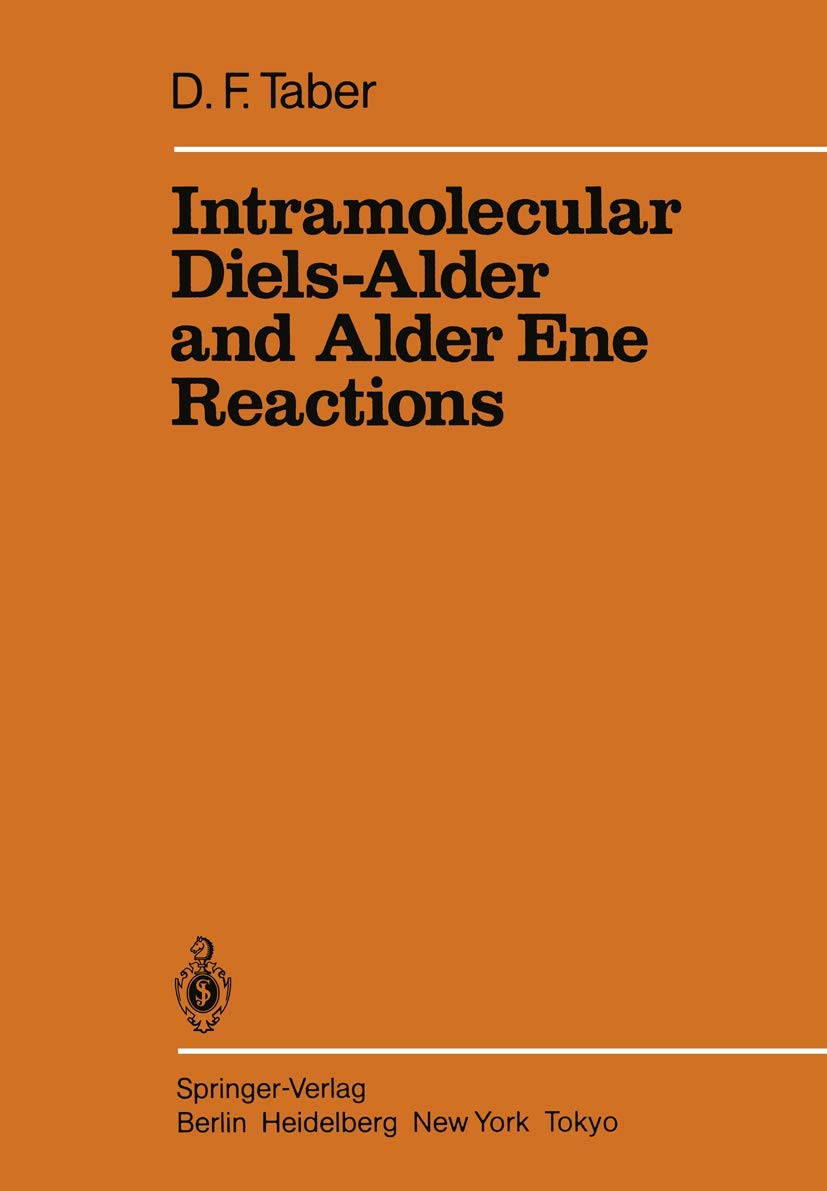
The DielsAlder reaction has long been a powerful tool in organic synthesis. In recent years, the Alder ene reaction has also achieved some prominence. From the beginning, it was apparent that the intramolecular variants of these reactions would be feasible. Many such have been reported, but the results are widely scattered in the chemical literature. This volume is an attempt to synthesize results observed to date, and to suggest directions for future development. One of the limiting factors in the application of the intramolecular Diels Alder reaction has been the development of methods for the preparation of the requisite trienes. The fIrst chapter of this volume summarizes methods for the preparation of dienes and dienophiles. Examples representative of every general approach to 1,3dienes and to dienophilic functional group combinations have been included. There are two questions one might ask in considering the prospective cyclization of a given triene: what are the factors that govern the rate of cyclization? and, for cyclizations that lead to the creation of one or more new chiral centers, what are the factors that govern diastereoselectivity? These questions are addressed in Chapter Two. The third chapter is devoted to the allcarbon intramolecular Alder ene reaction. The tables in that chapter summarize all examples that could be found in the literature through 1981, with several additional examples from 1982. Leading references to heterocyclic ene reactions are also included in this chapter.
⚠️ WARNING (California Proposition 65):
This product may contain chemicals known to the State of California to cause cancer,
birth defects, or other reproductive harm.
For MAP (Minimum Advertised Price) violations and Intellectual Property (IP) or Trademark concerns, please contact:
support@ergodebooks.com
⚠️ California Proposition 65 Warning: Some products sold on this website may expose you to chemicals known to the State of California to cause cancer, birth defects, or other reproductive harm. For more information, visit www.P65Warnings.ca.gov.