
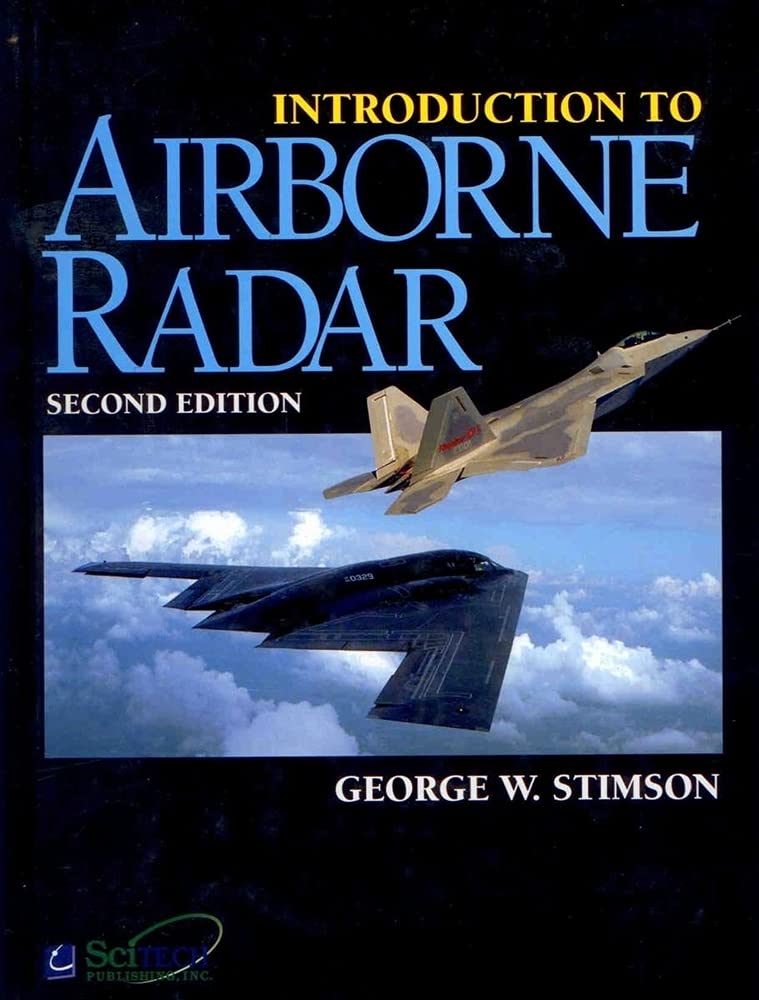
Title
Introduction To Airborne Radar
Sold by Ergodebooks, an authorized reseller.
Returns accepted within 30 days | support@ergodebooks.com
Shipping Information
- Free Standard Shipping — United States only
- Processing Time: 3–5 business days
- Estimated Delivery: 6–10 business days after dispatch
- Double-boxed, fully insured & discreetly packaged
- Tracking number sent via email once dispatched
Returns & Refund
Returns accepted within 30 days of delivery.
Damaged or Defective Item
Free return shipping + replacement or full refund
Wrong Item Received
Free return shipping + replacement or full refund
Change of Mind
Return shipping at customer's expense · 25% restocking fee applies
Payment Option

Available Until April 10Th!Introduction To Airborne Radar Is The Revision Of The Classic Book Privately Published By Hughes Aircraft Company In 1983. Lavishly Produced In Full Color, The Book Was Quite Unlike Any Commercially Published Radar Book Produced By The Major Technical Publishers. The Combination Of Clear, Understandable Writing And The Unparalleled Illustrations Established The Textreference As A 'Musthave' For Engineers, Technicians, Pilots, And Even Sales And Marketing People Within The Radar And Aerospace Industry. The Book Was Authored By Veteran Hughes Engineer And Technical Manager George W. Stimson, A Publications Specialist. Individual Chapters Were Thoroughly Reviewed By The Appropriate Experts Within The Hughes Radar Systems Group. The Book Was Initially Available 19831987 Only To Those Within The Hughes Family: Employees And Customers, Primarily The Military. Restriction Was Lifted In 1987. Hughes Went Through Three Printings And 40,000 Copies 19831993, Mostly By Wordofmouth Testimonials And Demand. Upon Retirement From Hughes, George Stimson Successfully Negotiated For The Rights To The Book And Made An Agreement With Scitech Publishing To Do A Major Revision Of The Text To Update It. The Resulting Second Edition Has Been Overwhelmingly Positive And A Bestseller. Second Edition The Revision Is Extensive: Thirteen Entirely New Chapters Cover The Technological Advances Over The Fifteen Years Since Publication, Two Chapters Considered Obsolete Have Been Deleted Entirely, Three Chapters Are Extensively Rewritten And Updated, Two Chapters Have Been Given New Sections, And Fourteen Chapters Have Been Given Minor Tweaks, Corrections, And Polishing. The Book Has Grown From 32 Chapters To 44 Chapters In 584 Efficientlydesigned Pages. Efforts Have Been Made To Bring More Evenhanded Coverage To Radars Developed Outside Of Hughes Aircraft, While Older And Less Important Hughes Radars Have Been Deleted Or Abbreviated. Chapter 44 Catalogs Many Of The Cutting Edge Radars In Functioning Aircraft And Nearservice Aircraft In Early Stages Of Production. The Book'S Appeal Is To A Diverse Audience: From Military Pilots And Radar Officers Eager To Gain A Sound Technical Understanding Of The Complex Systems That Their Lives Depend Upon, On Up Through Technicians, Marketing, And Sales People, To The Radar System Design Specialists, Who May 'Know All That Stuff' But Who Deeply Admire The Expression And Thus Use The Book To Teach Others Who Have Questions. The Market Encompasses Companies Directly Involved In The Radar Business And Those On The Periphery, College Professors Of Engineering And Physics Themselves, Along With Students In Aviation, Aeronautics, And Electromagnetics And Radar Courses. The Crossdisciplinary And Multilevel Demand For The Book Shows That The Book Should Not Be Pigeonholed As Just A Radar Book For Electrical Engineers. Virtually Anybody With A Knowledge Of High School Algebra, Trigonometry, And Physics Will Be Able To Read And Absorb Most Of The Material.
⚠️ WARNING (California Proposition 65):
This product may contain chemicals known to the State of California to cause cancer, birth defects, or other reproductive harm.
For more information, please visit www.P65Warnings.ca.gov.
- Q: What is the main focus of 'Introduction to Airborne Radar'? A: The book focuses on providing a comprehensive understanding of airborne radar technology, covering both historical context and modern advancements in the field.
- Q: Who is the author of 'Introduction to Airborne Radar'? A: The book is authored by George W. Stimson, a veteran engineer and Technical Manager at Hughes Aircraft Company.
- Q: What are the key features of this book? A: This book features clear writing, extensive illustrations, and a thorough revision that includes new chapters and updated information on technological advances in radar systems.
- Q: Is 'Introduction to Airborne Radar' suitable for beginners? A: Yes, the book is designed to be accessible to a wide audience, including those with a basic understanding of algebra and physics.
- Q: How many pages does 'Introduction to Airborne Radar' have? A: The book contains 584 pages, which include detailed chapters on various aspects of airborne radar.
- Q: What type of binding does this book have? A: The book is available in hardcover binding, ensuring durability for frequent use.
- Q: When was the second edition of 'Introduction to Airborne Radar' published? A: The second edition was published on December 1, 1998.
- Q: What topics are covered in the book? A: The book covers a range of topics, including technological advances in radar, the operational principles of radar systems, and applications in military and civilian aviation.
- Q: Can this book be useful for professionals in the aerospace industry? A: Yes, it is a valuable resource for engineers, technicians, pilots, and marketing professionals within the radar and aerospace industry.
- Q: What makes this book different from other radar textbooks? A: Unlike many commercial radar textbooks, this book combines technical depth with accessible writing and high-quality illustrations, making it a unique reference for a diverse audience.