
Title


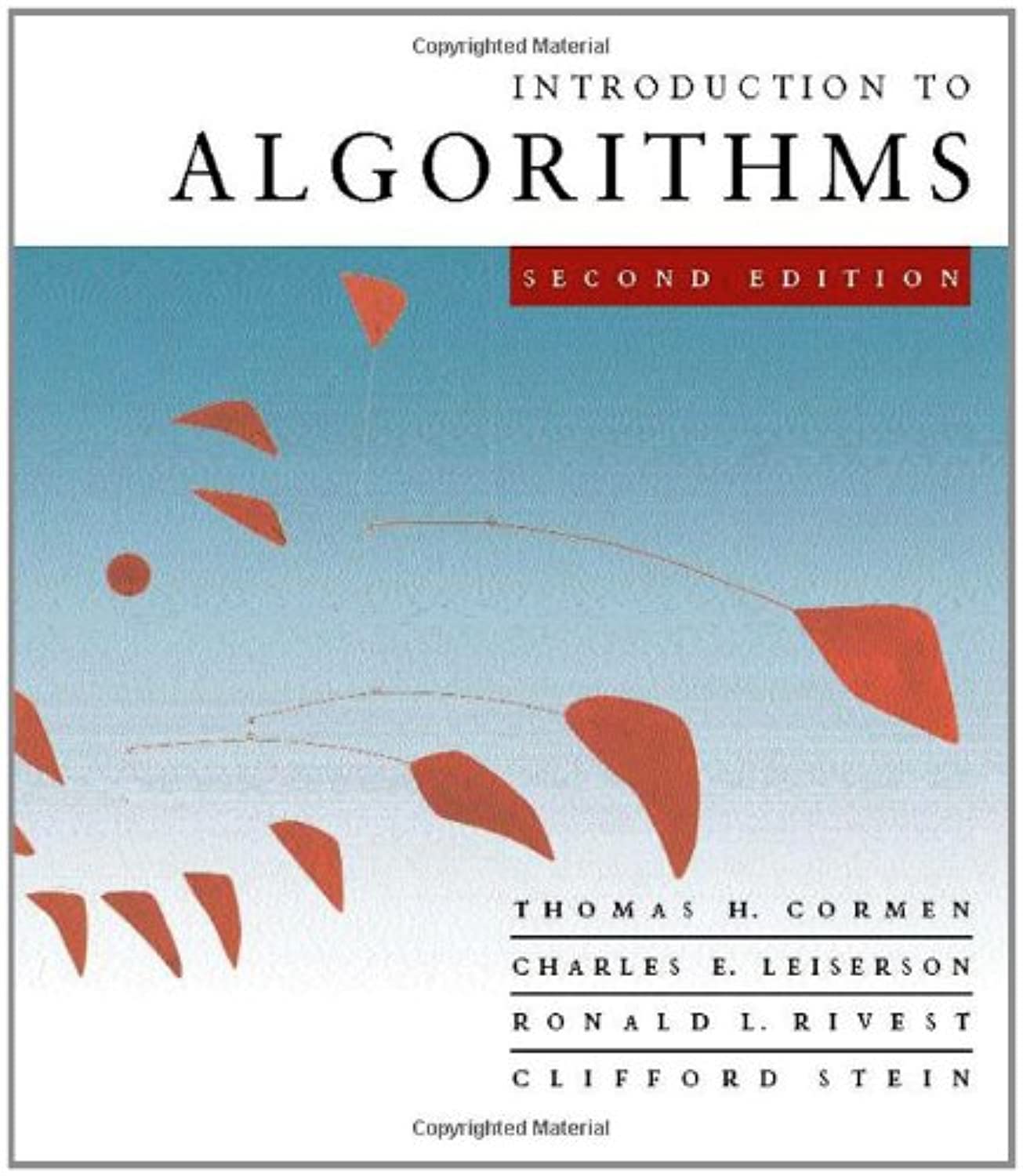
Introduction To Algorithms, Second Edition
Sold by Ergodebooks, an authorized reseller.
Returns accepted within 30 days | support@ergodebooks.com
Shipping Information
- Free Standard Shipping — United States only
- Processing Time: 3–5 business days
- Estimated Delivery: 6–10 business days after dispatch
- Double-boxed, fully insured & discreetly packaged
- Tracking number sent via email once dispatched
Returns & Refund
Returns accepted within 30 days of delivery.
Damaged or Defective Item
Free return shipping + replacement or full refund
Wrong Item Received
Free return shipping + replacement or full refund
Change of Mind
Return shipping at customer's expense · 25% restocking fee applies
Payment Option

The First Edition Won The Award For Best 1990 Professional And Scholarly Book In Computer Science And Data Processing By The Association Of American Publishers.There Are Books On Algorithms That Are Rigorous But Incomplete And Others That Cover Masses Of Material But Lack Rigor. Introduction To Algorithms Combines Rigor And Comprehensiveness.The Book Covers A Broad Range Of Algorithms In Depth, Yet Makes Their Design And Analysis Accessible To All Levels Of Readers. Each Chapter Is Relatively Selfcontained And Can Be Used As A Unit Of Study. The Algorithms Are Described In English And In A Pseudocode Designed To Be Readable By Anyone Who Has Done A Little Programming. The Explanations Have Been Kept Elementary Without Sacrificing Depth Of Coverage Or Mathematical Rigor.The First Edition Became The Standard Reference For Professionals And A Widely Used Text In Universities Worldwide. The Second Edition Features New Chapters On The Role Of Algorithms, Probabilistic Analysis And Randomized Algorithms, And Linear Programming, As Well As Extensive Revisions To Virtually Every Section Of The Book. In A Subtle But Important Change, Loop Invariants Are Introduced Early And Used Throughout The Text To Prove Algorithm Correctness. Without Changing The Mathematical And Analytic Focus, The Authors Have Moved Much Of The Mathematical Foundations Material From Part I To An Appendix And Have Included Additional Motivational Material At The Beginning.
⚠️ WARNING (California Proposition 65):
This product may contain chemicals known to the State of California to cause cancer, birth defects, or other reproductive harm.
For more information, please visit www.P65Warnings.ca.gov.
- Q: What is the page count of this book? A: This book has one thousand one hundred eighty-four pages. It provides a comprehensive exploration of algorithms suitable for various readers.
- Q: What are the dimensions of this book? A: The book measures eight point two seven inches in length, two point two five inches in width, and nine point zero two inches in height. Its size makes it a substantial reference text.
- Q: What type of binding does this book have? A: This book is bound in hardcover. Hardcover binding enhances durability and provides a professional appearance.
- Q: Is this book suitable for beginners? A: Yes, this book is suitable for beginners. It covers algorithm design and analysis in an accessible manner for all levels.
- Q: What age group is this book appropriate for? A: This book is appropriate for high school students and above. It is widely used in university courses worldwide.
- Q: How can I use this book for studying? A: You can use each chapter as a self-contained unit for study. The clear pseudocode and explanations can help reinforce learning.
- Q: How should I care for this book? A: Keep the book in a cool, dry place and avoid exposing it to direct sunlight. This will help preserve its condition over time.
- Q: Can this book be used as a reference for professionals? A: Yes, this book is an established reference for professionals. Its rigorous approach and comprehensive coverage make it valuable.
- Q: What if the book arrives damaged? A: If the book arrives damaged, check the return policy for instructions. Most retailers will allow you to return or exchange it.
- Q: Is this book updated from the first edition? A: Yes, this second edition includes new chapters and extensive revisions. It reflects the latest developments in algorithms.
- Q: What topics are covered in this book? A: Topics include algorithm design, analysis, probabilistic analysis, randomized algorithms, and linear programming. It offers a broad range of algorithmic concepts.
- Q: Does this book include exercises or problems? A: Yes, the book includes exercises at the end of each chapter. These help reinforce the concepts discussed throughout the text.
- Q: Is there a specific author for this book? A: The author of this book is Charles E. Leiserson. He is a well-known figure in the field of computer science.
- Q: What is the publisher of this book? A: This book is published by MIT Press. It is known for its high-quality academic publications.
- Q: How does this book compare to others in its field? A: This book combines rigor with comprehensiveness, making it stand out among other algorithm texts. It is often used as a standard reference.