
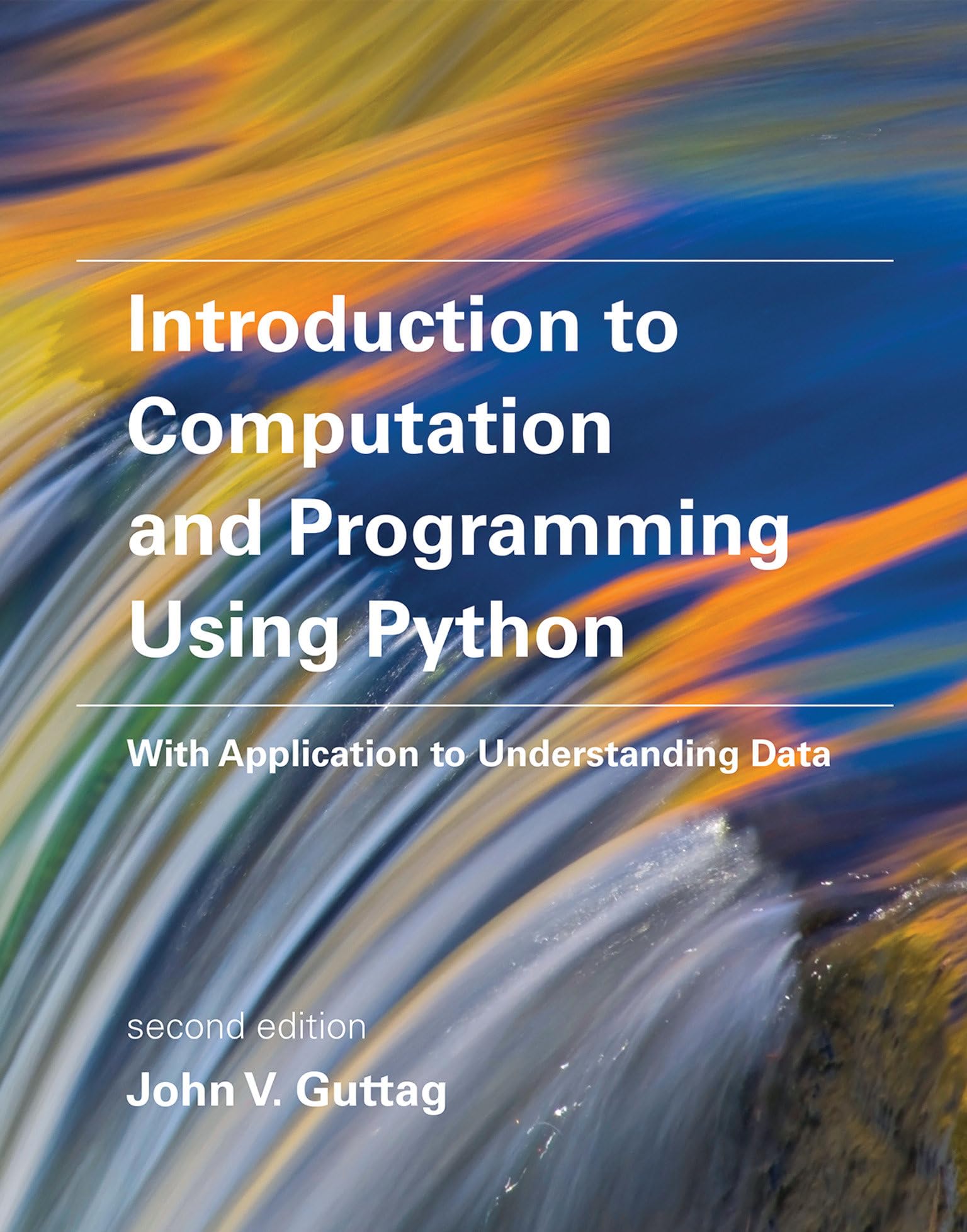
Title
Introduction to Computation and Programming Using Python, second edition: With Application to Understanding Data,New
Sold by Ergodebooks, an authorized reseller.
Returns accepted within 30 days | support@ergodebooks.com
Shipping Information
- Free Standard Shipping — United States only
- Processing Time: 3–5 business days
- Estimated Delivery: 6–10 business days after dispatch
- Double-boxed, fully insured & discreetly packaged
- Tracking number sent via email once dispatched
Returns & Refund
Returns accepted within 30 days of delivery.
Damaged or Defective Item
Free return shipping + replacement or full refund
Wrong Item Received
Free return shipping + replacement or full refund
Change of Mind
Return shipping at customer's expense · 25% restocking fee applies
Payment Option

The new edition of an introductory text that teaches students the art of computational problem solving, covering topics ranging from simple algorithms to information visualization.This book introduces students with little or no prior programming experience to the art of computational problem solving using Python and various Python libraries, including PyLab. It provides students with skills that will enable them to make productive use of computational techniques, including some of the tools and techniques of data science for using computation to model and interpret data. The book is based on an MIT course (which became the most popular course offered through MIT's OpenCourseWare) and was developed for use not only in a conventional classroom but in in a massive open online course (MOOC). This new edition has been updated for Python 3, reorganized to make it easier to use for courses that cover only a subset of the material, and offers additional material including five new chapters.Students are introduced to Python and the basics of programming in the context of such computational concepts and techniques as exhaustive enumeration, bisection search, and efficient approximation algorithms. Although it covers such traditional topics as computational complexity and simple algorithms, the book focuses on a wide range of topics not found in most introductory texts, including information visualization, simulations to model randomness, computational techniques to understand data, and statistical techniques that inform (and misinform) as well as two related but relatively advanced topics: optimization problems and dynamic programming. This edition offers expanded material on statistics and machine learning and new chapters on Frequentist and Bayesian statistics.
⚠️ WARNING (California Proposition 65):
This product may contain chemicals known to the State of California to cause cancer, birth defects, or other reproductive harm.
For more information, please visit www.P65Warnings.ca.gov.
- Q: What is the main focus of 'Introduction to Computation and Programming Using Python'? A: The book teaches computational problem solving using Python, covering topics from basic algorithms to information visualization and data science techniques.
- Q: Is this book suitable for beginners with no programming experience? A: Yes, this book is designed for students with little or no prior programming experience, making it accessible for beginners.
- Q: What programming language is primarily used in this book? A: The book primarily uses Python, specifically Python 3 in this second edition.
- Q: How many pages does this book contain? A: The book contains a total of 466 pages.
- Q: Who is the author of this book? A: The author of the book is John V. Guttag.
- Q: When was the second edition published? A: The second edition was published on August 12, 2016.
- Q: Does this book include any new chapters compared to the first edition? A: Yes, the second edition includes five new chapters and expanded material on statistics and machine learning.
- Q: What is the binding type of this book? A: The book is available in paperback binding.
- Q: Can this book be used for online courses? A: Yes, the book was developed for use in both conventional classrooms and massive open online courses (MOOCs).
- Q: What topics does the book cover beyond basic programming? A: In addition to basic programming, the book covers computational complexity, optimization problems, dynamic programming, and various statistical techniques.