
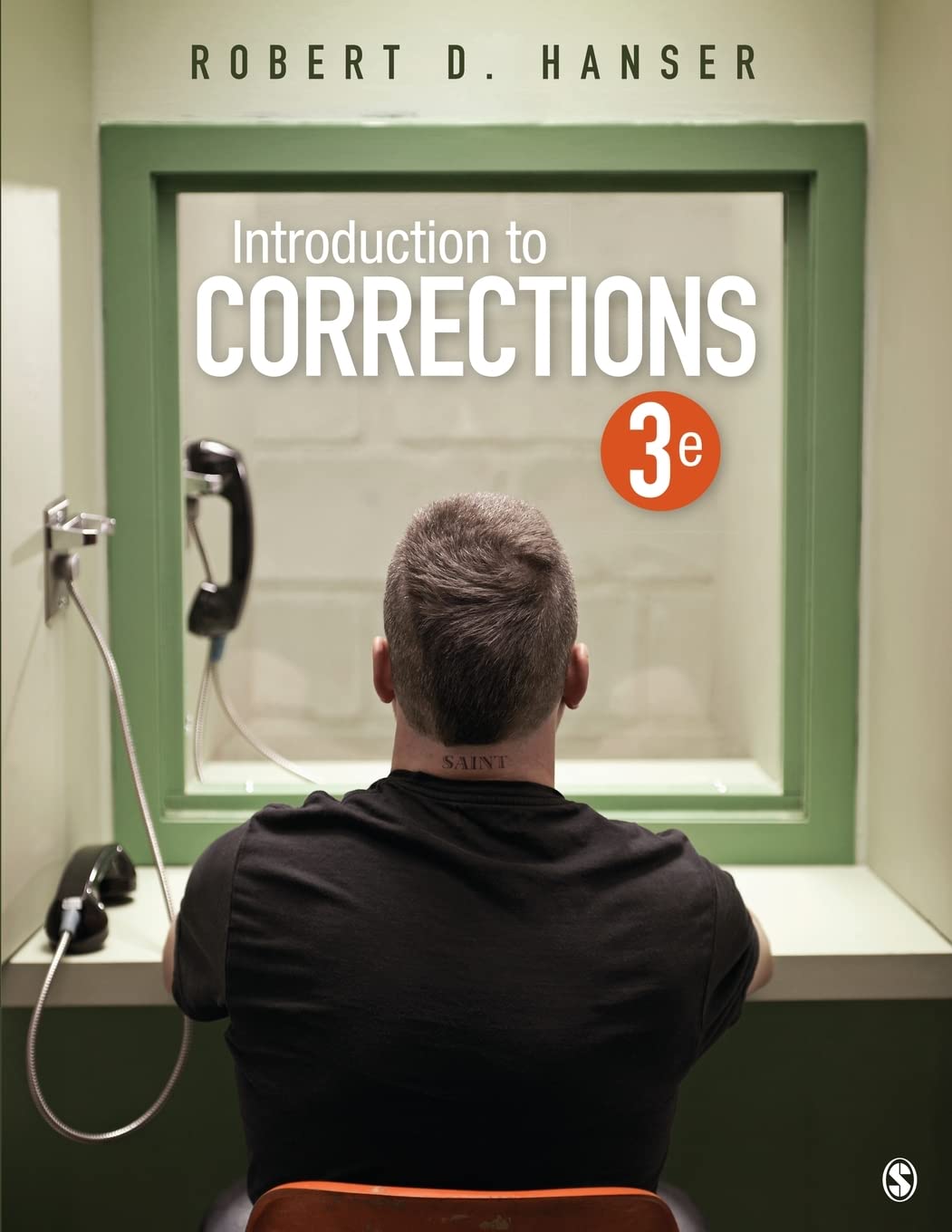
Title
Introduction To Corrections
Sold by Ergodebooks, an authorized reseller.
Returns accepted within 30 days | support@ergodebooks.com
Shipping Information
- Free Standard Shipping — United States only
- Processing Time: 3–5 business days
- Estimated Delivery: 6–10 business days after dispatch
- Double-boxed, fully insured & discreetly packaged
- Tracking number sent via email once dispatched
Returns & Refund
Returns accepted within 30 days of delivery.
Damaged or Defective Item
Free return shipping + replacement or full refund
Wrong Item Received
Free return shipping + replacement or full refund
Change of Mind
Return shipping at customer's expense · 25% restocking fee applies
Payment Option

Introduction To Corrections Provides A Comprehensive Foundation Of Corrections That Is Practitionerdriven And Grounded In Modern Research And Theoretical Origins. This Text Uniquely Illustrates How The Daytoday Practitioner Conducts Business In The Field Of Corrections In Both Institutional And Community Settings. Experienced Correctional Practitioner, Scholar, And Author Robert D. Hanser Shows Readers How The Corrections System Actually Works, From Classification, To Security, To Treatment, To Demonstrating How And Why Correctional Practices Are Implemented. Furthering The Reality Of The Modern Correctional Experience, The Third Edition Includes A New Chapter On Immigration Detention Centers.Also Available As A Digital Option (Courseware). Learn More About Introduction To Corrections Vantage Digital Option, Third Edition [Isbn: 9781071828311]
⚠️ WARNING (California Proposition 65):
This product may contain chemicals known to the State of California to cause cancer, birth defects, or other reproductive harm.
For more information, please visit www.P65Warnings.ca.gov.
- Q: How many pages does 'Introduction to Corrections' have? A: This book has six hundred pages. It provides a detailed examination of corrections through various themes and practices.
- Q: What is the binding type of this book? A: The binding type is paperback. This makes it lightweight and portable for easy reading.
- Q: What are the dimensions of the book? A: The dimensions are eight inches in length, one inch in width, and ten point five one inches in height. This size is standard for a comprehensive textbook.
- Q: Who is the author of 'Introduction to Corrections'? A: The author is Robert D. Hanser. He is an experienced correctional practitioner and scholar.
- Q: Is 'Introduction to Corrections' suitable for beginners? A: Yes, it is suitable for beginners. The book provides foundational knowledge relevant to both students and practitioners.
- Q: What topics are covered in 'Introduction to Corrections'? A: The book covers topics like classification, security, treatment, and immigration detention centers. It illustrates real-world applications within the corrections system.
- Q: Can I access a digital version of the book? A: Yes, a digital option is available. You can learn more about the Vantage Digital Option for the Third Edition.
- Q: What is the focus of 'Introduction to Corrections'? A: The focus is on providing a practitioner-driven view of corrections. It emphasizes modern research and theoretical origins.
- Q: Are there any features included in the book? A: There are no specific features listed for this book. However, it contains comprehensive content on corrections.
- Q: Is this book appropriate for adult readers? A: Yes, it is appropriate for adult readers. It addresses complex issues within the corrections system.
- Q: What is the target audience for 'Introduction to Corrections'? A: The target audience includes students and professionals in criminology and corrections. It serves as both a textbook and a reference guide.
- Q: How should I store 'Introduction to Corrections'? A: Store the book in a cool, dry place. Avoid exposure to excessive moisture to maintain its condition.
- Q: What if my copy arrives damaged? A: If your copy arrives damaged, contact customer support for assistance. They will guide you through the return process.
- Q: Can this book be used for academic courses? A: Yes, it is commonly used for academic courses in criminology. Its content aligns well with curriculum standards.
- Q: Does this book discuss contemporary issues in corrections? A: Yes, it includes a new chapter on immigration detention centers. This addresses current trends and challenges in the field.