
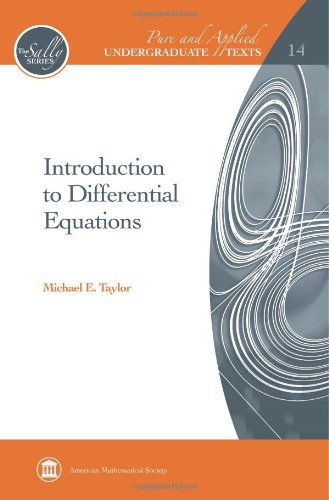
Title
Introduction to Differential Equations (Pure and Applied Undergraduate Texts, 14),New
Sold by Ergodebooks, an authorized reseller.
Returns accepted within 30 days | support@ergodebooks.com
Shipping Information
- Free Standard Shipping — United States only
- Processing Time: 3–5 business days
- Estimated Delivery: 6–10 business days after dispatch
- Double-boxed, fully insured & discreetly packaged
- Tracking number sent via email once dispatched
Returns & Refund
Returns accepted within 30 days of delivery.
Damaged or Defective Item
Free return shipping + replacement or full refund
Wrong Item Received
Free return shipping + replacement or full refund
Change of Mind
Return shipping at customer's expense · 25% restocking fee applies
Payment Option

The mathematical formulations of problems in physics, economics, biology, and other sciences are usually embodied in differential equations. The analysis of the resulting equations then provides new insight into the original problems. This book describes the tools for performing that analysis. The first chapter treats single differential equations, emphasizing linear and nonlinear first order equations, linear second order equations, and a class of nonlinear second order equations arising from Newton's laws. The first order linear theory starts with a selfcontained presentation of the exponential and trigonometric functions, which plays a central role in the subsequent development of this chapter. Chapter 2 provides a minicourse on linear algebra, giving detailed treatments of linear transformations, determinants and invertibility, eigenvalues and eigenvectors, and generalized eigenvectors. This treatment is more detailed than that in most differential equations texts, and provides a solid foundation for the next two chapters. Chapter 3 studies linear systems of differential equations. It starts with the matrix exponential, melding material from Chapters 1 and 2, and uses this exponential as a key tool in the linear theory. Chapter 4 deals with nonlinear systems of differential equations. This uses all the material developed in the first three chapters and moves it to a deeper level. The chapter includes theoretical studies, such as the fundamental existence and uniqueness theorem, but also has numerous examples, arising from Newtonian physics, mathematical biology, electrical circuits, and geometrical problems. These studies bring in variational methods, a fertile source of nonlinear systems of differential equations. The reader who works through this book will be well prepared for advanced studies in dynamical systems, mathematical physics, and partial differential equations.
⚠️ WARNING (California Proposition 65):
This product may contain chemicals known to the State of California to cause cancer, birth defects, or other reproductive harm.
For more information, please visit www.P65Warnings.ca.gov.