
Title
Introduction to HighPerformance Scientific Computing (Scientific and Engineering Computation),Used
Sold by Ergodebooks, an authorized reseller.
Returns accepted within 30 days | support@ergodebooks.com
Shipping Information
- Free Standard Shipping — United States only
- Processing Time: 3–5 business days
- Estimated Delivery: 6–10 business days after dispatch
- Double-boxed, fully insured & discreetly packaged
- Tracking number sent via email once dispatched
Returns & Refund
Returns accepted within 30 days of delivery.
Damaged or Defective Item
Free return shipping + replacement or full refund
Wrong Item Received
Free return shipping + replacement or full refund
Change of Mind
Return shipping at customer's expense · 25% restocking fee applies
Payment Option

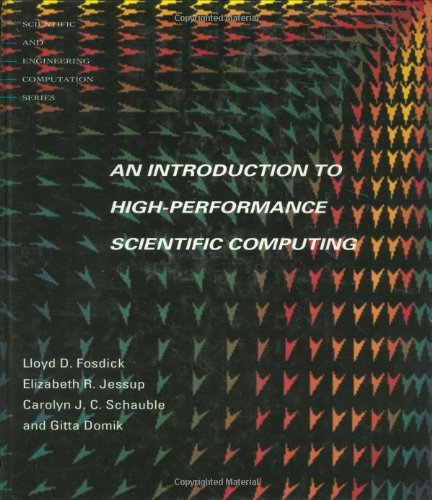
Designed for undergraduates, An Introduction to HighPerformance Scientific Computing assumes a basic knowledge of numerical computation and proficiency in Fortran or C programming and can be used in any science, computer science, applied mathematics, or engineering department or by practicing scientists and engineers, especially those associated with one of the national laboratories or supercomputer centers.This text evolved from a new curriculum in scientific computing that was developed to teach undergraduate science and engineering majors how to use highperformance computing systems (supercomputers) in scientific and engineering applications. Designed for undergraduates, An Introduction to HighPerformance Scientific Computing assumes a basic knowledge of numerical computation and proficiency in Fortran or C programming and can be used in any science, computer science, applied mathematics, or engineering department or by practicing scientists and engineers, especially those associated with one of the national laboratories or supercomputer centers. The authors begin with a survey of scientific computing and then provide a review of background (numerical analysis, IEEE arithmetic, Unix, Fortran) and tools (elements of MATLAB, IDL, AVS). Next, full coverage is given to scientific visualization and to the architectures (scientific workstations and vector and parallel supercomputers) and performance evaluation needed to solve largescale problems. The concluding section on applications includes three problems (molecular dynamics, advection, and computerized tomography) that illustrate the challenge of solving problems on a variety of computer architectures as well as the suitability of a particular architecture to solving a particular problem. Finally, since this can only be a handson course with extensive programming and experimentation with a variety of architectures and programming paradigms, the authors have provided a laboratory manual and supporting software via anonymous ftp. Scientific and Engineering Computation series
⚠️ WARNING (California Proposition 65):
This product may contain chemicals known to the State of California to cause cancer, birth defects, or other reproductive harm.
For more information, please visit www.P65Warnings.ca.gov.