
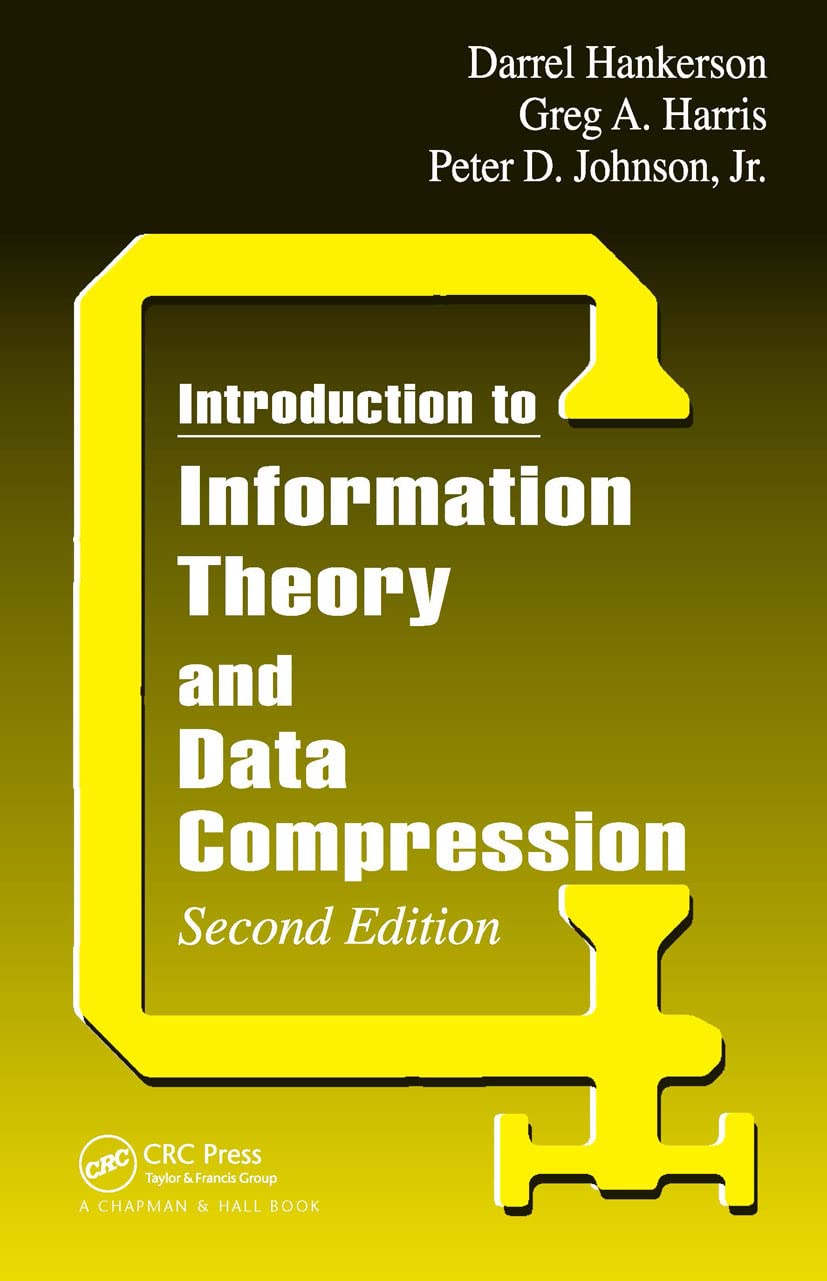
Title
Introduction to Information Theory and Data Compression (Applied Mathematics),New
Sold by Ergodebooks, an authorized reseller.
Returns accepted within 30 days | support@ergodebooks.com
Shipping Information
- Free Standard Shipping — United States only
- Processing Time: 3–5 business days
- Estimated Delivery: 6–10 business days after dispatch
- Double-boxed, fully insured & discreetly packaged
- Tracking number sent via email once dispatched
Returns & Refund
Returns accepted within 30 days of delivery.
Damaged or Defective Item
Free return shipping + replacement or full refund
Wrong Item Received
Free return shipping + replacement or full refund
Change of Mind
Return shipping at customer's expense · 25% restocking fee applies
Payment Option

An effective blend of carefully explained theory and practical applications, this text imparts the fundamentals of both information theory and data compression. Although the two topics are related, this unique text allows either topic to be presented independently, and it was specifically designed so that the data compression section requires no prior knowledge of information theory.The treatment of information theory, while theoretical and abstract, is quite elementary, making this text less daunting than many others. After presenting the fundamental definitions and results of the theory, the authors then apply the theory to memoryless, discrete channels with zerothorder, onestate sources.The chapters on data compression acquaint students with a myriad of lossless compression methods and then introduce two lossy compression methods. Students emerge from this study competent in a wide range of techniques. The authors' presentation is highly practical but includes some important proofs, either in the text or in the exercises, so instructors can, if they choose, place more emphasis on the mathematics.Introduction to Information Theory and Data Compression, Second Edition is ideally suited for an upperlevel or graduate course for students in mathematics, engineering, and computer science.Features: Expanded discussion of the historical and theoretical basis of information theory that builds a firm, intuitive grasp of the subjectReorganization of theoretical results along with new exercises, ranging from the routine to the more difficult, that reinforce students' ability to apply the definitions and results in specific situations.Simplified treatment of the algorithm(s) of Gallager and KnuthDiscussion of the information rate of a code and the tradeoff between error correction and information rateTreatment of probabilistic finite state source automata, including basic resul
⚠️ WARNING (California Proposition 65):
This product may contain chemicals known to the State of California to cause cancer, birth defects, or other reproductive harm.
For more information, please visit www.P65Warnings.ca.gov.