
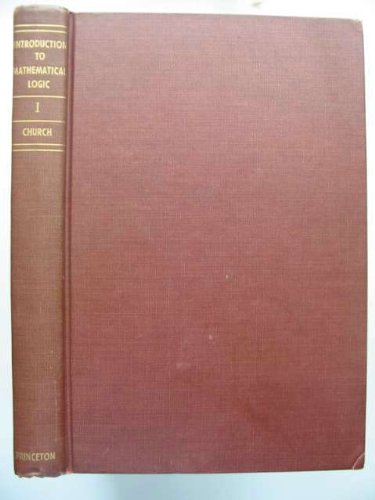
Title
Introduction to Mathematical Logic, Volume 1. Princeton Mathematical Series,New
Sold by Ergodebooks, an authorized reseller.
Returns accepted within 30 days | support@ergodebooks.com
Shipping Information
- Free Standard Shipping — United States only
- Processing Time: 3–5 business days
- Estimated Delivery: 6–10 business days after dispatch
- Double-boxed, fully insured & discreetly packaged
- Tracking number sent via email once dispatched
Returns & Refund
Returns accepted within 30 days of delivery.
Damaged or Defective Item
Free return shipping + replacement or full refund
Wrong Item Received
Free return shipping + replacement or full refund
Change of Mind
Return shipping at customer's expense · 25% restocking fee applies
Payment Option

Logic is sometimes called the foundation of mathematics: the logician studies the kinds of reasoning used in the individual steps of a proof. Alonzo Church was a pioneer in the field of mathematical logic, whose contributions to number theory and the theories of algorithms and computability laid the theoretical foundations of computer science. His first Princeton book, The Calculi of LambdaConversion (1941), established an invaluable tool that computer scientists still use today.Even beyond the accomplishment of that book, however, his second Princeton book, Introduction to Mathematical Logic, defined its subject for a generation. Originally published in Princeton's Annals of Mathematics Studies series, this book was revised in 1956 and reprinted a third time, in 1996, in the Princeton Landmarks in Mathematics series. Although new results in mathematical logic have been developed and other textbooks have been published, it remains, sixty years later, a basic source for understanding formal logic.Church was one of the principal founders of the Association for Symbolic Logic; he founded the Journal of Symbolic Logic in 1936 and remained an editor until 1979 At his death in 1995, Church was still regarded as the greatest mathematical logician in the world.
⚠️ WARNING (California Proposition 65):
This product may contain chemicals known to the State of California to cause cancer, birth defects, or other reproductive harm.
For more information, please visit www.P65Warnings.ca.gov.
- Q: What is the main focus of 'Introduction to Mathematical Logic'? A: 'Introduction to Mathematical Logic' primarily focuses on the foundational aspects of logic as it relates to mathematics, exploring various types of reasoning used in proofs.
- Q: Who is the author of this book? A: The author of 'Introduction to Mathematical Logic' is Alonzo Church, a prominent figure in the field of mathematical logic.
- Q: What edition of the book is available? A: This listing is for the First Edition of 'Introduction to Mathematical Logic', which was published on June 10, 1991.
- Q: How many pages does the book contain? A: 'Introduction to Mathematical Logic' contains a total of 378 pages.
- Q: What is the condition of the book being sold? A: The book is listed as being in 'Very Good' condition, indicating it has been well cared for with minimal wear.
- Q: Is this book suitable for beginners in mathematical logic? A: Yes, 'Introduction to Mathematical Logic' serves as a foundational text and is suitable for those new to the subject, although some prior knowledge of logic may be beneficial.
- Q: What type of binding does the book have? A: This book is bound in hardcover, providing durability and a professional appearance.
- Q: What topics are covered in this book? A: 'Introduction to Mathematical Logic' covers essential topics in formal logic, including reasoning, proofs, and the theoretical foundations of computer science.
- Q: Can I find this book in digital format? A: This listing is for a physical copy of 'Introduction to Mathematical Logic'. Availability in digital format would need to be checked separately.
- Q: What are the key contributions of Alonzo Church in this field? A: Alonzo Church's contributions include foundational work in mathematical logic and computability, which laid the groundwork for modern computer science.