
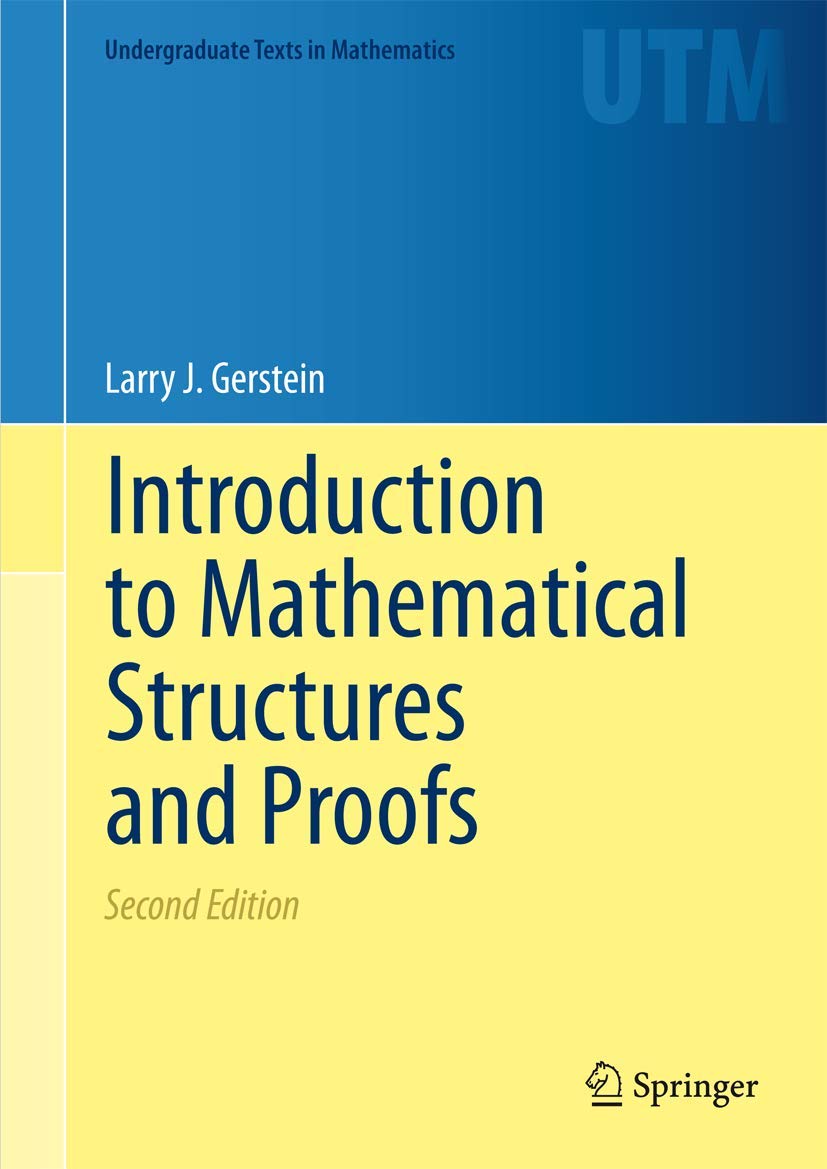
Title
Introduction to Mathematical Structures and Proofs (Undergraduate Texts in Mathematics),Used
Sold by Ergodebooks, an authorized reseller.
Returns accepted within 30 days | support@ergodebooks.com
Shipping Information
- Free Standard Shipping — United States only
- Processing Time: 3–5 business days
- Estimated Delivery: 6–10 business days after dispatch
- Double-boxed, fully insured & discreetly packaged
- Tracking number sent via email once dispatched
Returns & Refund
Returns accepted within 30 days of delivery.
Damaged or Defective Item
Free return shipping + replacement or full refund
Wrong Item Received
Free return shipping + replacement or full refund
Change of Mind
Return shipping at customer's expense · 25% restocking fee applies
Payment Option

As a student moves from basic calculus courses into upperdivision courses in linear and abstract algebra, real and complex analysis, number theory, topology, and so on, a 'bridge' course can help ensure a smooth transition. Introduction to Mathematical Structures and Proofs is a textbook intended for such a course, or for selfstudy. This book introduces an array of fundamental mathematical structures. It also explores the delicate balance of intuition and rigorand the flexible thinkingrequired to prove a nontrivial result. In short, this book seeks to enhance the mathematical maturity of the reader.The new material in this second edition includes a section on graph theory, several new sections on number theory (including primitive roots, with an application to cardshuffling), and a brief introduction to the complex numbers (including a section on the arithmetic of the Gaussian integers). Solutions for even numbered exercises are available on springer.com for instructors adopting the text for a course.
⚠️ WARNING (California Proposition 65):
This product may contain chemicals known to the State of California to cause cancer, birth defects, or other reproductive harm.
For more information, please visit www.P65Warnings.ca.gov.
- Q: How many pages does the book have? A: This book has four hundred fourteen pages. It offers a comprehensive introduction to mathematical structures and proofs.
- Q: What is the binding type of this book? A: The book features a hardcover binding. This ensures durability for both classroom use and self-study.
- Q: What are the dimensions of this book? A: The book measures seven point zero one inches in length, zero point nine four inches in width, and ten inches in height. These dimensions make it easy to handle and read.
- Q: Who is the author of this book? A: The author of this book is Larry J. Gerstein. He is known for his expertise in mathematics education and proof techniques.
- Q: Is this book suitable for self-study? A: Yes, this book is suitable for self-study. It is designed to enhance mathematical maturity, making it ideal for independent learners.
- Q: What topics does this book cover? A: The book covers topics such as linear and abstract algebra, real and complex analysis, number theory, and topology. This broad range helps in transitioning to upper-division courses.
- Q: How should I care for this hardcover book? A: To care for this hardcover book, keep it in a dry environment and avoid exposing it to direct sunlight. This will help maintain its condition over time.
- Q: Can I find solutions to exercises in this book? A: Yes, solutions for even-numbered exercises are available online. This resource is especially helpful for instructors using the textbook.
- Q: Is this book appropriate for beginners? A: Yes, this book is appropriate for beginners transitioning from basic calculus. It serves as a bridge course to advanced mathematical concepts.
- Q: What category does this book fall under? A: This book falls under the category of Mathematical Analysis. It is targeted at undergraduate students in mathematics.
- Q: What is the new material included in the second edition? A: The second edition includes new sections on graph theory and number theory, as well as an introduction to complex numbers. This enhances the learning experience.
- Q: Does the book include illustrations or examples? A: Yes, the book includes various examples and illustrations to support the concepts discussed. This helps in understanding complex ideas.
- Q: Is this book suitable for high school students? A: While primarily aimed at undergraduates, motivated high school students may also benefit from this book. It introduces advanced mathematical thinking.
- Q: What can I expect to learn from this book? A: You can expect to learn about fundamental mathematical structures and the balance between intuition and rigor in proofs. This knowledge is essential for advanced studies.
- Q: Where is this book published? A: This book is published by Springer, a well-known publisher in the field of academic and professional literature. Their publications are recognized for quality.
- Q: Are there any prerequisites for reading this book? A: While there are no strict prerequisites, a background in basic calculus is recommended. This will help you grasp the advanced concepts presented.