
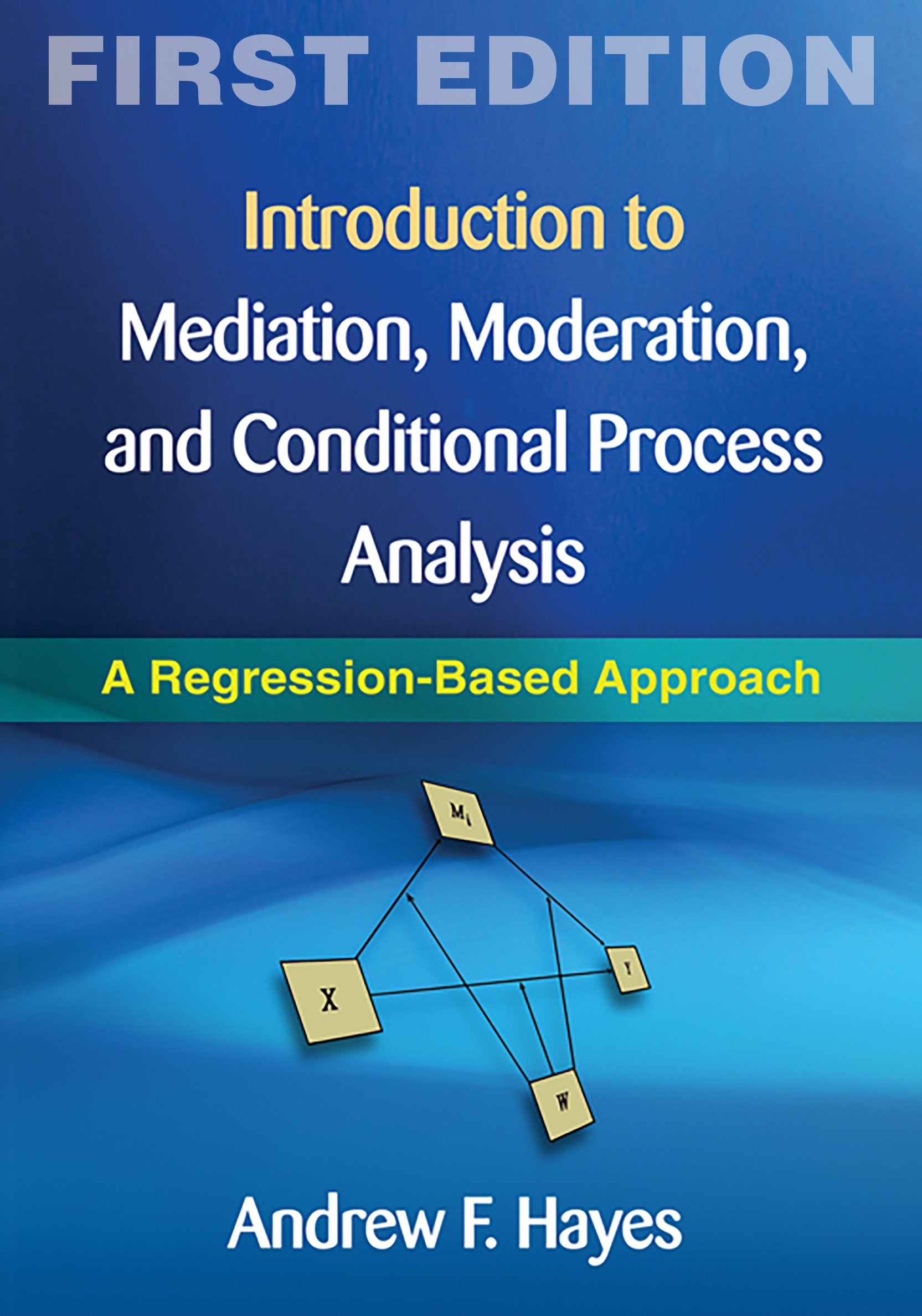
Title


Introduction To Mediation, Moderation, And Conditional Process Analysis, First Edition: A Regressionbased Approach (Methodology
Sold by Ergodebooks, an authorized reseller.
Returns accepted within 30 days | support@ergodebooks.com
Shipping Information
- Free Standard Shipping — United States only
- Processing Time: 3–5 business days
- Estimated Delivery: 6–10 business days after dispatch
- Double-boxed, fully insured & discreetly packaged
- Tracking number sent via email once dispatched
Returns & Refund
Returns accepted within 30 days of delivery.
Damaged or Defective Item
Free return shipping + replacement or full refund
Wrong Item Received
Free return shipping + replacement or full refund
Change of Mind
Return shipping at customer's expense · 25% restocking fee applies
Payment Option

Explaining The Fundamentals Of Mediation And Moderation Analysis, This Engaging Book Also Shows How To Integrate The Two Using An Innovative Strategy Known As Conditional Process Analysis. Procedures Are Described For Testing Hypotheses About The Mechanisms By Which Causal Effects Operate, The Conditions Under Which They Occur, And The Moderation Of Mechanisms. Relying On The Principles Of Ordinary Least Squares Regression, Andrew Hayes Carefully Explains The Estimation And Interpretation Of Direct And Indirect Effects, Probing And Visualization Of Interactions, And Testing Of Questions About Moderated Mediation. Examples Using Data From Published Studies Illustrate How To Conduct And Report The Analyses Described In The Book. Of Special Value, The Book Introduces And Documents Process, A Macro For Spss And Sas That Does All The Computations Described In The Book. The Companion Website (Www.Afhayes.Com) Offers Free Downloads Of Process Plus Data Files For The Book'S Examples.Unique Features Include:*Compelling Examples (Presumed Media Influence, Sex Discrimination In The Workplace, And More) With Real Data; Boxes With Sas, Spss, And Process Code; And Loads Of Tips, Including How To Report Mediation, Moderation And Conditional Process Analyses.*Appendix That Presents Documentation On Use And Features Of Process.*Online Supplement Providing Data, Code, And Syntax For The Book'S Examples.
⚠️ WARNING (California Proposition 65):
This product may contain chemicals known to the State of California to cause cancer, birth defects, or other reproductive harm.
For more information, please visit www.P65Warnings.ca.gov.
- Q: How many pages does this book have? A: This book has five hundred pages. It provides comprehensive coverage of mediation, moderation, and conditional process analysis.
- Q: What is the binding type of this book? A: This book is hardcover. This binding offers durability and a professional look, making it suitable for academic use.
- Q: What are the dimensions of this book? A: The book measures seven point twenty-five inches in length, one point twenty-six inches in width, and ten point twenty-five inches in height. These dimensions make it a manageable size for reading and referencing.
- Q: Who is the author of this book? A: The author is Andrew F. Hayes. He is known for his expertise in statistics and research methodology.
- Q: What topics are covered in this book? A: This book covers mediation, moderation, and conditional process analysis. It includes practical examples and methodologies used in social sciences.
- Q: Can beginners understand this book? A: Yes, beginners can understand this book. It explains complex statistical concepts in an accessible way, with ample examples.
- Q: What is conditional process analysis? A: Conditional process analysis is a strategy that integrates both mediation and moderation analysis. It helps to understand how causal effects operate under different conditions.
- Q: Is this book suitable for graduate-level courses? A: Yes, this book is suitable for graduate-level courses. It is often used in advanced research methodology classes in the social sciences.
- Q: Does the book include practical examples? A: Yes, the book includes compelling examples using real data. These examples help illustrate the methodologies discussed throughout the text.
- Q: How can I access the companion website? A: You can access the companion website at www.afhayes.com. It offers free downloads of the PROCESS macro and data files for the book's examples.
- Q: What is PROCESS in relation to this book? A: PROCESS is a macro for SPSS and SAS that performs the computations described in the book. It simplifies the analysis of mediation and moderation.
- Q: Are there tips for reporting analyses in this book? A: Yes, the book provides numerous tips on how to report mediation, moderation, and conditional process analyses effectively.
- Q: Does the book have an appendix? A: Yes, the book includes an appendix. It presents documentation on the use and features of the PROCESS macro.
- Q: What is the main focus of the methodologies discussed? A: The main focus is on ordinary least squares regression. This approach is fundamental for estimating and interpreting direct and indirect effects.
- Q: Is there a focus on visualization in the analyses? A: Yes, the book emphasizes the probing and visualization of interactions. This helps in understanding the relationships between variables.
- Q: Are statistical codes provided in the book? A: Yes, the book includes boxes with SAS, SPSS, and PROCESS code. This aids readers in conducting their analyses.