
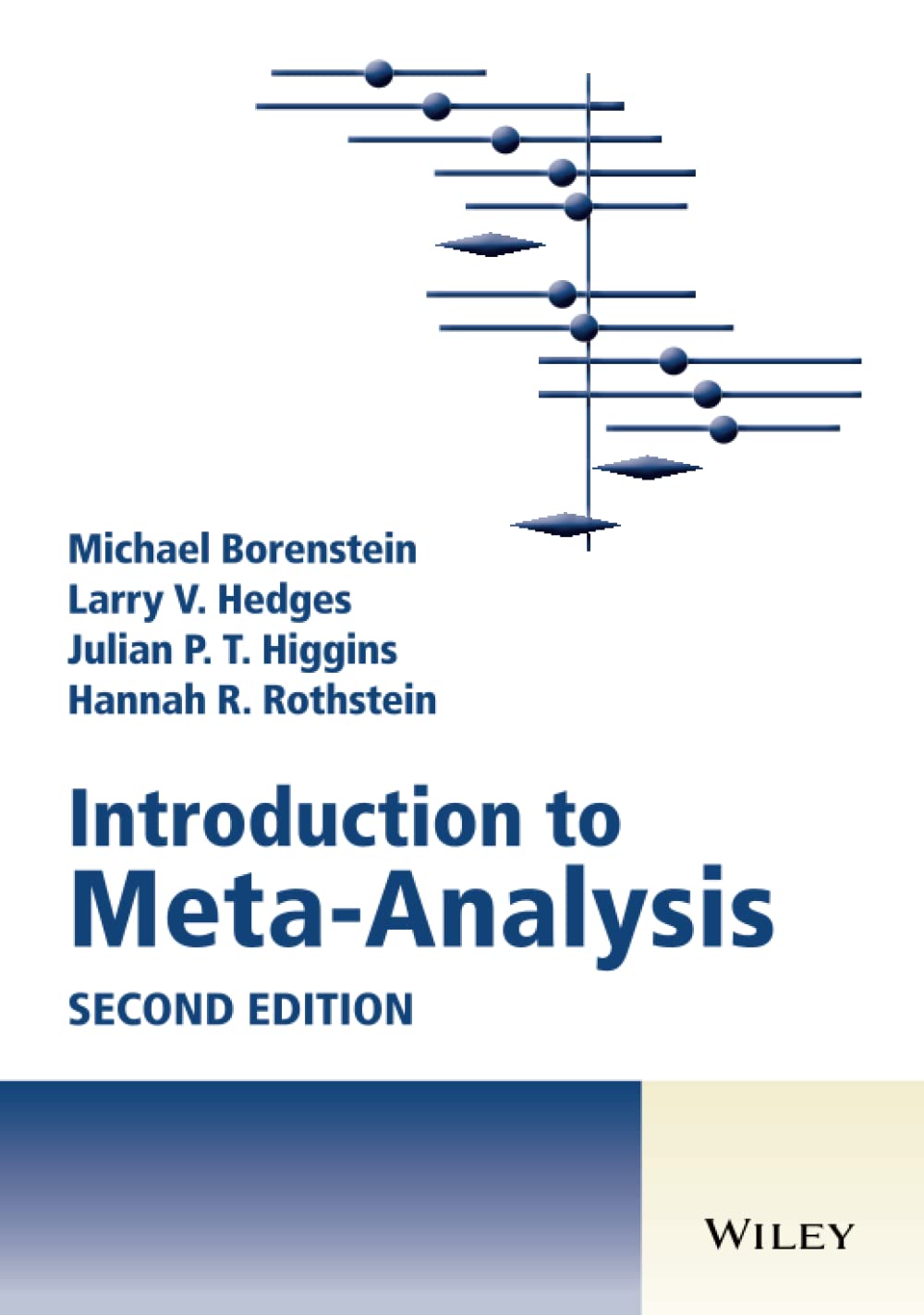
Title
Introduction to MetaAnalysis,Used
Sold by Ergodebooks, an authorized reseller.
Returns accepted within 30 days | support@ergodebooks.com
Shipping Information
- Free Standard Shipping — United States only
- Processing Time: 3–5 business days
- Estimated Delivery: 6–10 business days after dispatch
- Double-boxed, fully insured & discreetly packaged
- Tracking number sent via email once dispatched
Returns & Refund
Returns accepted within 30 days of delivery.
Damaged or Defective Item
Free return shipping + replacement or full refund
Wrong Item Received
Free return shipping + replacement or full refund
Change of Mind
Return shipping at customer's expense · 25% restocking fee applies
Payment Option

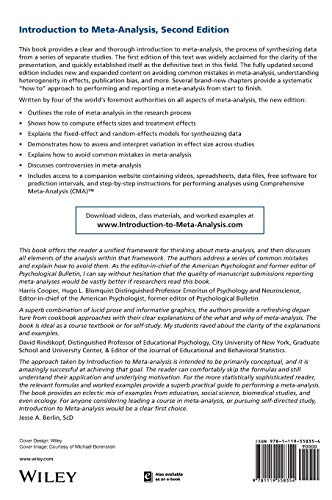
A clear and thorough introduction to metaanalysis, the process of synthesizing data from a series of separate studiesThe first edition of this text was widely acclaimed for the clarity of the presentation, and quickly established itself as the definitive text in this field. The fully updated second edition includes new and expanded content on avoiding common mistakes in metaanalysis, understanding heterogeneity in effects, publication bias, and more. Several brandnew chapters provide a systematic "how to" approach to performing and reporting a metaanalysis from start to finish.Written by four of the world's foremost authorities on all aspects of metaanalysis, the new edition: Outlines the role of metaanalysis in the research process Shows how to compute effects sizes and treatment effects Explains the fixedeffect and randomeffects models for synthesizing data Demonstrates how to assess and interpret variation in effect size across studies Explains how to avoid common mistakes in metaanalysis Discusses controversies in metaanalysis Includes access to a companion website containing videos, spreadsheets, data files, free software for prediction intervals, and stepbystep instructions for performing analyses using Comprehensive MetaAnalysis (CMA)Download videos, class materials, and worked examples at www.IntroductiontoMetaAnalysis.com"This book offers the reader a unified framework for thinking about metaanalysis, and then discusses all elements of the analysis within that framework. The authors address a series of common mistakes and explain how to avoid them. As the editorinchief of the American Psychologist and former editor of Psychological Bulletin, I can say without hesitation that the quality of manuscript submissions reporting metaanalyses would be vastly better if researchers read this book."Harris Cooper, Hugo L. Blomquist Distinguished Professor Emeritus of Psychology and Neuroscience, Editorinchief of the American Psychologist, former editor of Psychological Bulletin"A superb combination of lucid prose and informative graphics, the authors provide a refreshing departure from cookbook approaches with their clear explanations of the what and why of metaanalysis. The book is ideal as a course textbook or for selfstudy. My students raved about the clarity of the explanations and examples."David Rindskopf, Distinguished Professor of Educational Psychology, City University of New York, Graduate School and University Center, & Editor of the Journal of Educational and Behavioral Statistics"The approach taken by Introduction to Metaanalysis is intended to be primarily conceptual, and it is amazingly successful at achieving that goal. The reader can comfortably skip the formulas and still understand their application and underlying motivation. For the more statistically sophisticated reader, the relevant formulas and worked examples provide a superb practical guide to performing a metaanalysis. The book provides an eclectic mix of examples from education, social science, biomedical studies, and even ecology. For anyone considering leading a course in metaanalysis, or pursuing selfdirected study, Introduction to Metaanalysis would be a clear first choice."Jesse A. Berlin, ScD
⚠️ WARNING (California Proposition 65):
This product may contain chemicals known to the State of California to cause cancer, birth defects, or other reproductive harm.
For more information, please visit www.P65Warnings.ca.gov.