
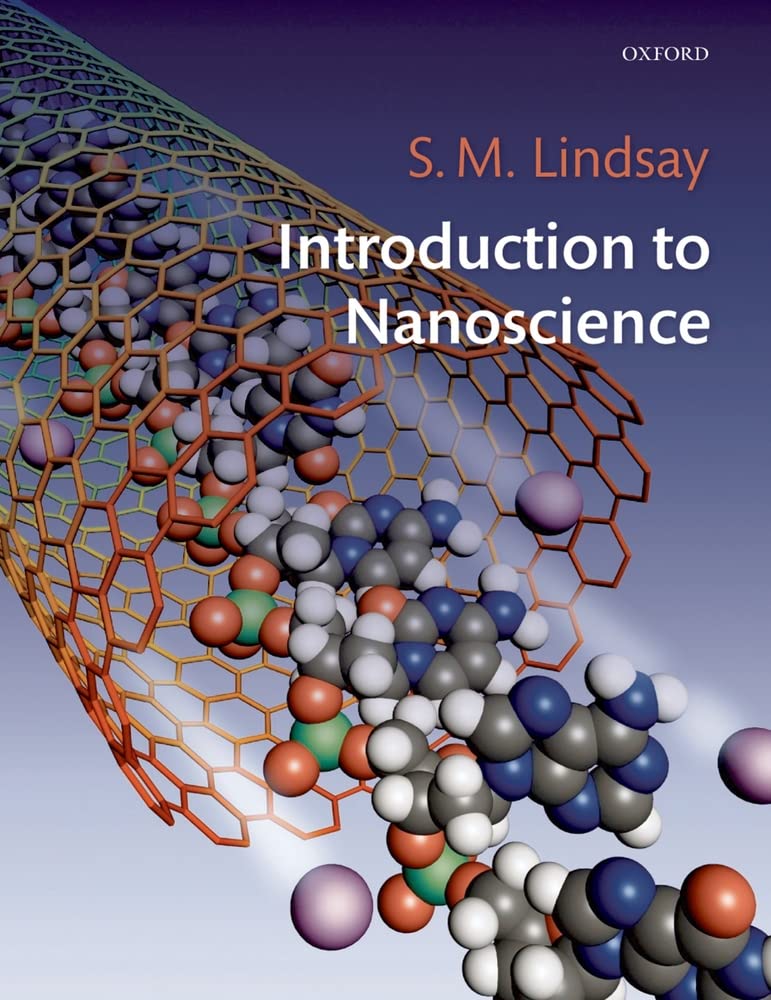
Title
Introduction To Nanoscience,New
Sold by Ergodebooks, an authorized reseller.
Returns accepted within 30 days | support@ergodebooks.com
Shipping Information
- Free Standard Shipping — United States only
- Processing Time: 3–5 business days
- Estimated Delivery: 6–10 business days after dispatch
- Double-boxed, fully insured & discreetly packaged
- Tracking number sent via email once dispatched
Returns & Refund
Returns accepted within 30 days of delivery.
Damaged or Defective Item
Free return shipping + replacement or full refund
Wrong Item Received
Free return shipping + replacement or full refund
Change of Mind
Return shipping at customer's expense · 25% restocking fee applies
Payment Option

Nanoscience Is Not Just Physics, Chemistry, Engineering, Or Biology, But Rather An Integration Of All Of These Disciplines. The First Comprehensive And Interdisciplinary Text Of Its Kind, Introduction To Nanoscience Is An Ideal Handbook For Advanced Undergraduates And Beginning Graduate Students In Physics, Chemistry, Electrical Engineering, Materials Engineering, Chemical Engineering, Bioengineering, And Biology.Written From The Ground Up For A Diverse Audience, The Book Is Divided Into Three Parts. Part I (The Basics) Offers A Selfcontained Introduction To Quantum Mechanics, Statistical Mechanics, And Chemical Kinetics That Requires No More Than A Basic Background In College Calculus. The Author'S Conceptual Approach And An Array Of Examples And Conceptual Exercises Enable Even Those Students With Limited Mathematical Knowledge To Grasp The Majority Of The Essential Material. Part Ii (Tools) Covers Microscopy, Single Molecule Manipulation And Measurement, Nanofabrication, And Selfassembly. Part Iii (Applications) Covers Electrons In Nanostructures, Molecular Electronics, Nanomaterials And Nanobiology. Each Chapter Starts With A Survey Of The Required Basics And Ends By Making Contact With Current Research Literature.Introduction To Nanoscience Is Also The First Text To Incorporate The Oftenneglected Topic Of Complexity In Nanosystems, Dealing Explicity With Emergent Phenomena From Chemistry To Biology. Examples Include Kramer'S Theory Of Reactions (Chapter 3); The Marcus Theory Of Electron Transfer (Chapter 8); And Enzyme Catalysis, Molecular Motors, And Fluctuations In Gene Expression And Splicing, All Covered In Chapter 9. In Addition, The Book Includes Richard Feynman'S Visionary Essay, 'There'S Plenty Of Room At The Bottom,' Which Describes The Consequences Of Smallness And Quantum Behavior.
⚠️ WARNING (California Proposition 65):
This product may contain chemicals known to the State of California to cause cancer, birth defects, or other reproductive harm.
For more information, please visit www.P65Warnings.ca.gov.
- Q: How many pages does the book have? A: This book has four hundred eighty pages. It provides a comprehensive overview of nanoscience across various disciplines.
- Q: What are the dimensions of the book? A: The book measures nine point seven six inches in length, zero point nine four inches in width, and seven point five two inches in height.
- Q: What type of binding does this book use? A: The book is available in paperback binding. This makes it lightweight and easy to handle for students.
- Q: Who is the author of 'Introduction to Nanoscience'? A: The author is Stuart Lindsay. He is recognized for his work in the field of nanoscience and engineering.
- Q: What subjects does this book cover? A: This book covers physics, chemistry, engineering, and biology. It integrates multiple disciplines for a comprehensive understanding.
- Q: Is this book suitable for beginners? A: Yes, this book is suitable for advanced undergraduates and beginning graduate students. It provides a self-contained introduction to essential concepts.
- Q: How do I approach reading this book? A: You can start by reading Part I for the basics. Each chapter begins with fundamental concepts and builds up to current research.
- Q: Is there a glossary or index in the book? A: Yes, the book includes an index for easy navigation. This helps readers find specific topics or terms quickly.
- Q: How should I store this book to keep it in good condition? A: Store the book in a cool, dry place away from direct sunlight. This prevents damage to the binding and pages.
- Q: Can I highlight or take notes in this book? A: Yes, you can highlight or take notes in the book. This can enhance your understanding and retention of the material.
- Q: What if the book arrives damaged? A: If the book arrives damaged, you should contact the seller for a return or exchange. Most sellers have policies for damaged items.
- Q: Is this book appropriate for high school students? A: While it's primarily aimed at undergraduates and graduates, motivated high school students may find it beneficial with proper guidance.
- Q: Does the book include real-world applications? A: Yes, the book discusses various applications of nanoscience. It includes examples from current research to illustrate concepts.
- Q: Are there any online resources associated with this book? A: Yes, supplementary online resources may be available. Check the publisher's website for additional materials and updates.
- Q: How often should I reference this book during my studies? A: You should reference this book frequently during your studies. It serves as a comprehensive guide on nanoscience topics.
- Q: What makes this book unique compared to others on nanoscience? A: This book uniquely integrates multiple disciplines and discusses complexity in nanosystems, making it a comprehensive resource.