
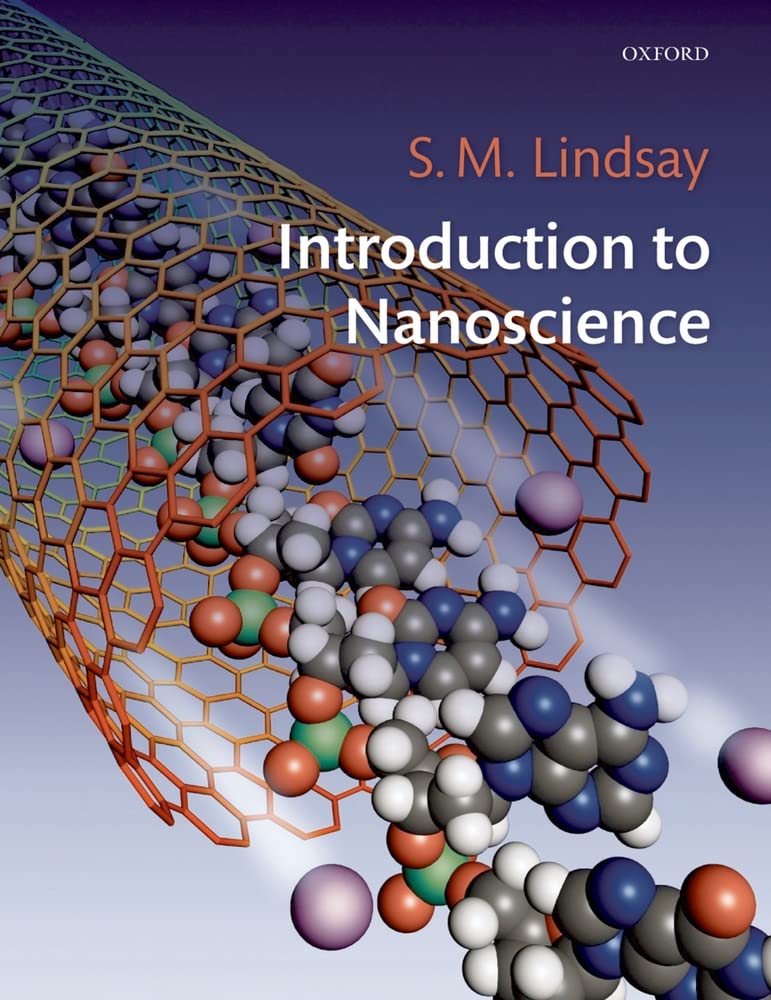
Title
Introduction to Nanoscience,Used
Sold by Ergodebooks, an authorized reseller.
Returns accepted within 30 days | support@ergodebooks.com
Shipping Information
- Free Standard Shipping — United States only
- Processing Time: 3–5 business days
- Estimated Delivery: 6–10 business days after dispatch
- Double-boxed, fully insured & discreetly packaged
- Tracking number sent via email once dispatched
Returns & Refund
Returns accepted within 30 days of delivery.
Damaged or Defective Item
Free return shipping + replacement or full refund
Wrong Item Received
Free return shipping + replacement or full refund
Change of Mind
Return shipping at customer's expense · 25% restocking fee applies
Payment Option

Nanoscience is not just physics, chemistry, engineering, or biology, but rather an integration of all of these disciplines. The first comprehensive and interdisciplinary text of its kind, Introduction to Nanoscience is an ideal handbook for advanced undergraduates and beginning graduate students in physics, chemistry, electrical engineering, materials engineering, chemical engineering, bioengineering, and biology.Written from the ground up for a diverse audience, the book is divided into three parts. Part I (The Basics) offers a selfcontained introduction to quantum mechanics, statistical mechanics, and chemical kinetics that requires no more than a basic background in college calculus. The author's conceptual approach and an array of examples and conceptual exercises enable even those students with limited mathematical knowledge to grasp the majority of the essential material. Part II (Tools) covers microscopy, single molecule manipulation and measurement, nanofabrication, and selfassembly. Part III (Applications) covers electrons in nanostructures, molecular electronics, nanomaterials and nanobiology. Each chapter starts with a survey of the required basics and ends by making contact with current research literature.Introduction to Nanoscience is also the first text to incorporate the oftenneglected topic of complexity in nanosystems, dealing explicity with emergent phenomena from chemistry to biology. Examples include Kramer's theory of reactions (Chapter 3); the Marcus theory of electron transfer (Chapter 8); and enzyme catalysis, molecular motors, and fluctuations in gene expression and splicing, all covered in Chapter 9. In addition, the book includes Richard Feynman's visionary essay, 'There's Plenty of Room at the Bottom,' which describes the consequences of smallness and quantum behavior.
⚠️ WARNING (California Proposition 65):
This product may contain chemicals known to the State of California to cause cancer, birth defects, or other reproductive harm.
For more information, please visit www.P65Warnings.ca.gov.
- Q: What is the main focus of 'Introduction to Nanoscience'? A: 'Introduction to Nanoscience' focuses on the integration of disciplines such as physics, chemistry, engineering, and biology, providing a comprehensive overview of nanoscience concepts and applications.
- Q: Who is the intended audience for this book? A: The book is ideal for advanced undergraduates and beginning graduate students in fields such as physics, chemistry, electrical engineering, materials engineering, chemical engineering, bioengineering, and biology.
- Q: What topics are covered in the book? A: The book covers a range of topics including quantum mechanics, statistical mechanics, chemical kinetics, microscopy, nanofabrication, molecular electronics, nanobiology, and the complexity of nanosystems.
- Q: Is prior knowledge in mathematics required to understand the material? A: No, the book is designed to be accessible and requires only a basic background in college calculus, along with a conceptual approach to understanding the material.
- Q: How is the book structured? A: The book is divided into three parts: The Basics, Tools, and Applications, with each chapter beginning with foundational concepts and concluding with current research literature.
- Q: Does the book include real-world applications of nanoscience? A: Yes, it includes discussions on real-world applications and emergent phenomena in nanosystems, making connections to current research in the field.
- Q: What is the format of the book? A: 'Introduction to Nanoscience' is available in paperback with 480 pages.
- Q: Who is the author of this book? A: The author of 'Introduction to Nanoscience' is Stuart Lindsay.
- Q: When was 'Introduction to Nanoscience' published? A: The book was published on December 20, 2009.
- Q: What makes this book unique in its approach to nanoscience? A: This book is unique in its interdisciplinary approach, incorporating often-overlooked topics such as complexity in nanosystems and emergent phenomena across various scientific fields.