
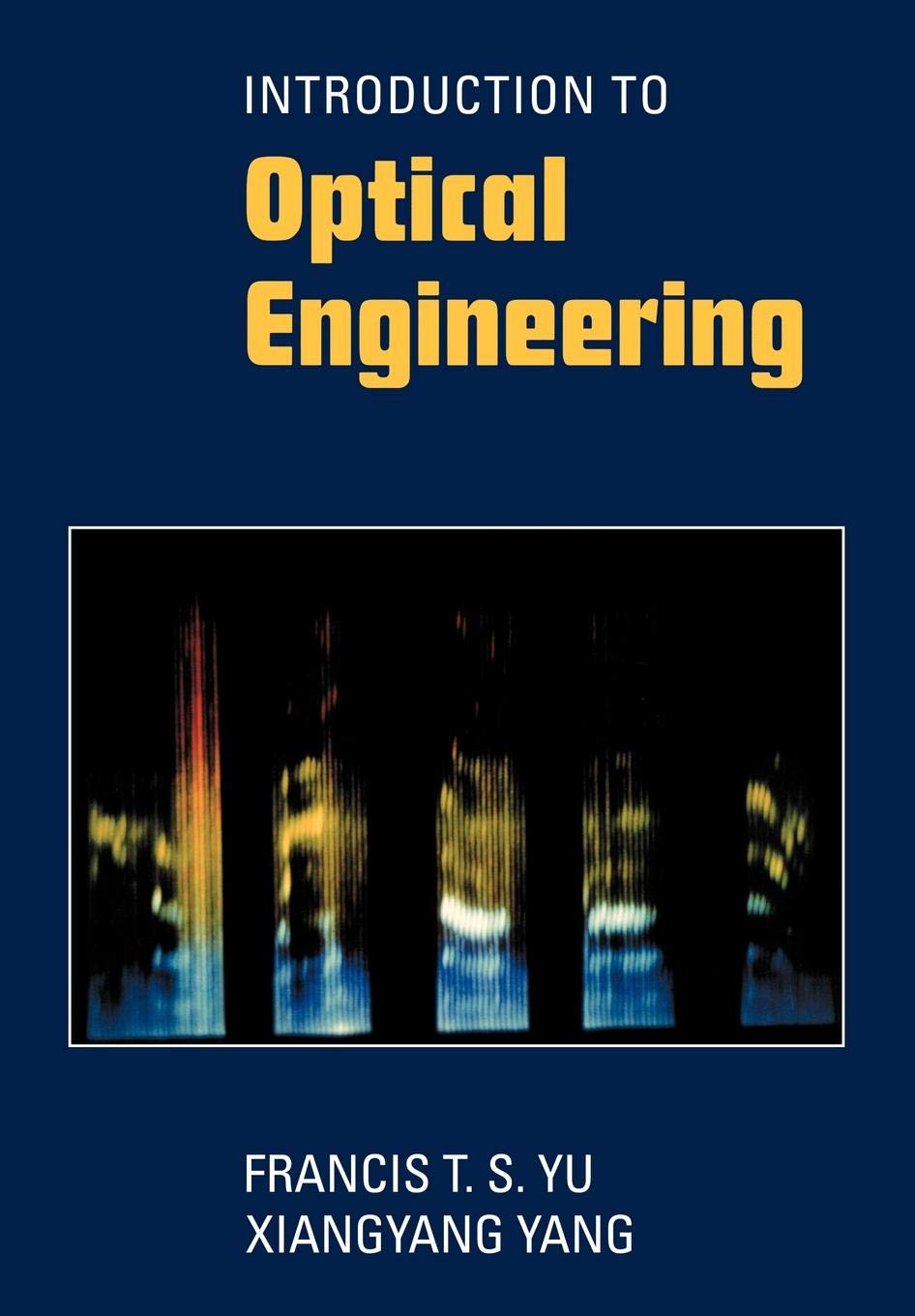
Title
Introduction To Optical Engineering-new,New
Sold by Ergodebooks, an authorized reseller.
Returns accepted within 30 days | support@ergodebooks.com
Shipping Information
- Free Standard Shipping — United States only
- Processing Time: 3–5 business days
- Estimated Delivery: 6–10 business days after dispatch
- Double-boxed, fully insured & discreetly packaged
- Tracking number sent via email once dispatched
Returns & Refund
Returns accepted within 30 days of delivery.
Damaged or Defective Item
Free return shipping + replacement or full refund
Wrong Item Received
Free return shipping + replacement or full refund
Change of Mind
Return shipping at customer's expense · 25% restocking fee applies
Payment Option

The Authors Present Basic Optical Principles, Particularly Reflection, Refraction, Aberrations, Diffraction And Interference. Building On This Foundation, They Then Discuss A Wide Variety Of Optical Devices And Processes, Including Simple Optical Instruments, Photodetectors, Spatial Light Modulators, Holography And Lasers. They Devote Two Chapters To Linear System Transforms And Signal Processing, And The Book Concludes With A Chapter On Fiber Optics. The Book Contains Many Worked Examples And Over 250 Problems.
⚠️ WARNING (California Proposition 65):
This product may contain chemicals known to the State of California to cause cancer, birth defects, or other reproductive harm.
For more information, please visit www.P65Warnings.ca.gov.
- Q: How many pages does this book have? A: This book has four hundred twenty-four pages. It provides extensive coverage of optical engineering principles and applications.
- Q: What is the size of the book? A: The book measures six point six nine inches in length, zero point nine six inches in width, and nine point six one inches in height. This makes it a convenient size for reading and reference.
- Q: What is the binding type of this book? A: This book is paperback bound. Paperback bindings are flexible and lightweight, making them portable.
- Q: Who is the author of 'Introduction to Optical Engineering'? A: The author of this book is Francis T. S. Yu. He presents fundamental concepts in optical engineering throughout the text.
- Q: Is this book suitable for beginners? A: Yes, this book is suitable for beginners. It starts with basic optical principles and gradually introduces more complex topics.
- Q: Can this book be used as a reference for advanced studies? A: Yes, this book can serve as a reference for advanced studies. It includes detailed discussions on optical devices and processes.
- Q: How do I best utilize this book for studying? A: To utilize this book effectively, read each chapter thoroughly and complete the over two hundred fifty problems provided. This practice reinforces understanding.
- Q: Is this book appropriate for college students? A: Yes, this book is appropriate for college students. It covers essential topics in optical engineering that are relevant for various engineering curricula.
- Q: What are the main topics covered in the book? A: The main topics include reflection, refraction, aberrations, diffraction, interference, and optical devices. The book also delves into fiber optics and signal processing.
- Q: How should I store this book to keep it in good condition? A: Store this book in a cool, dry place away from direct sunlight. Keeping it on a bookshelf upright will help maintain its shape.
- Q: Can I clean the pages if they get dirty? A: No, it's not recommended to clean the pages. Instead, handle the book with clean hands to prevent dirt from accumulating.
- Q: Is there a warranty or return policy for this book? A: The book typically does not come with a warranty, but return policies depend on the retailer. Check with your seller for specific return options.
- Q: What if the book arrives damaged? A: If the book arrives damaged, contact the retailer immediately for a return or exchange. Most retailers have policies in place for such issues.
- Q: How can I find additional resources to complement this book? A: You can find additional resources online, such as academic journals and websites dedicated to optical engineering topics. Libraries may also offer supplementary texts.
- Q: Does this book include worked examples? A: Yes, this book includes many worked examples throughout the chapters. These examples help clarify concepts and demonstrate application.