
Title
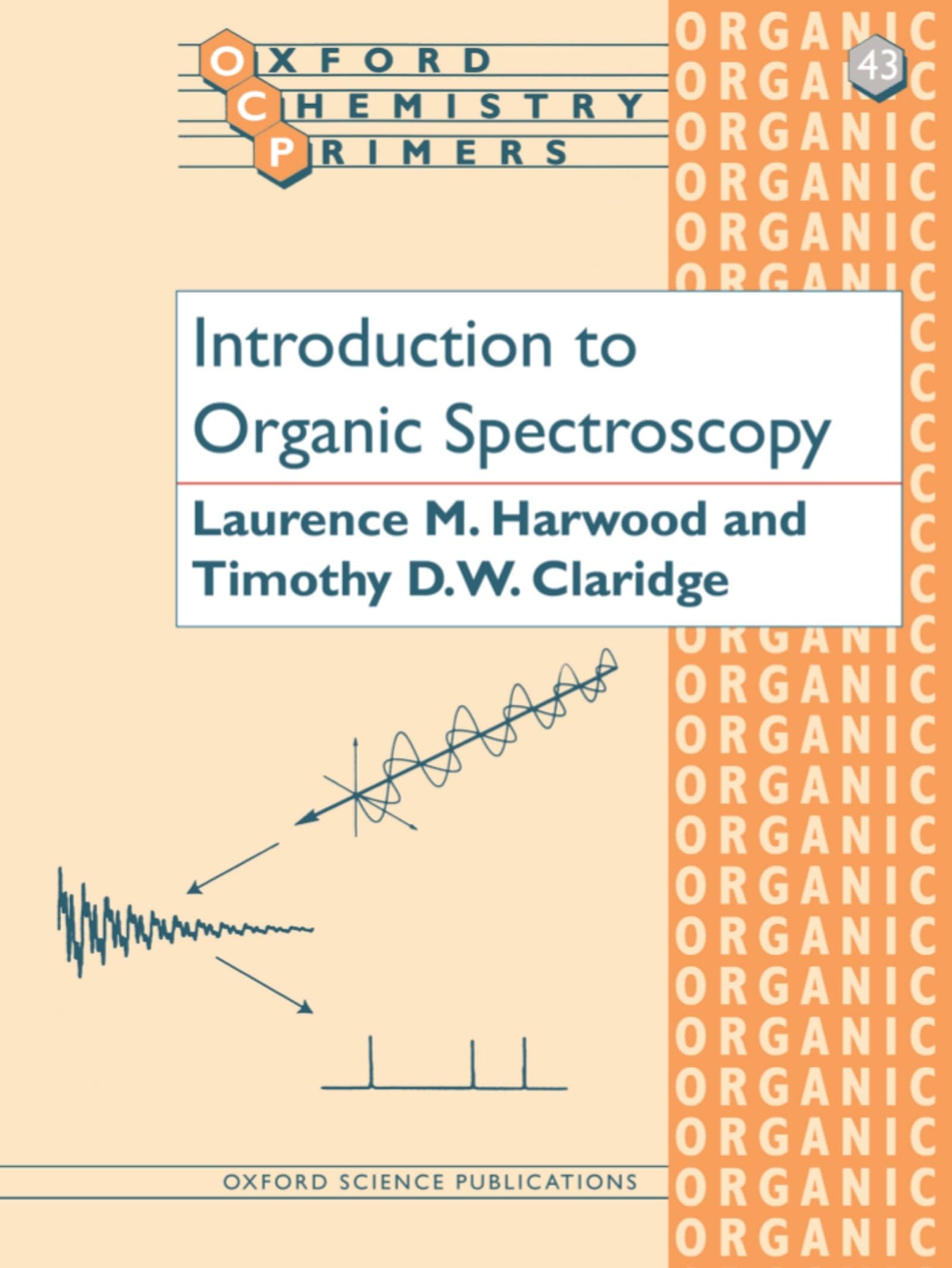
Introduction To Organic Spectroscopy (Oxford Chemistry Primers)
Sold by Ergodebooks, an authorized reseller.
Returns accepted within 30 days | support@ergodebooks.com
Shipping Information
- Free Standard Shipping — United States only
- Processing Time: 3–5 business days
- Estimated Delivery: 6–10 business days after dispatch
- Double-boxed, fully insured & discreetly packaged
- Tracking number sent via email once dispatched
Returns & Refund
Returns accepted within 30 days of delivery.
Damaged or Defective Item
Free return shipping + replacement or full refund
Wrong Item Received
Free return shipping + replacement or full refund
Change of Mind
Return shipping at customer's expense · 25% restocking fee applies
Payment Option

This Uptodate Account Of Key Areas In Modern Organic Spectroscopy Describes The Four Major Instrumental Methods Used Routinely By Organic Chemists: Ultraviolet/Visible, Infrared, Nuclear Magnetic Resonance Spectroscopy, And Mass Spectroscopy. It Provides A Concise Introduction To The Physical Background Of Each, Describing How Molecules Interact With Electromagnetic Radiation Or How They Fragment When Excited Sufficiently, And How This Information May Be Applied To The Determination Of Chemical Structures. It Also Includes Simple Descriptions Of Instrumentation And Emphasizes Modern Methodology Throughout, Such As The Fouriertransform Approach To Data Analysis. Each Chapter Concludes With Problems To Test Readers' Understanding Of Organic Spectroscopy.
⚠️ WARNING (California Proposition 65):
This product may contain chemicals known to the State of California to cause cancer, birth defects, or other reproductive harm.
For more information, please visit www.P65Warnings.ca.gov.
- Q: What topics are covered in 'Introduction to Organic Spectroscopy'? A: The book covers key areas in modern organic spectroscopy, including ultra-violet/visible, infra-red, nuclear magnetic resonance, and mass spectroscopy, emphasizing their application in determining chemical structures.
- Q: Who is the author of 'Introduction to Organic Spectroscopy'? A: The author of the book is Laurence M. Harwood.
- Q: What is the publication date of this book? A: The book was published on December 5, 1996.
- Q: How many pages does 'Introduction to Organic Spectroscopy' have? A: The book contains a total of 96 pages.
- Q: Is 'Introduction to Organic Spectroscopy' suitable for beginners? A: Yes, the book provides a concise introduction, making it suitable for beginners as well as those looking to refresh their knowledge.
- Q: What type of binding does this book have? A: The book is available in paperback binding.
- Q: Does the book include practice problems? A: Yes, each chapter concludes with problems designed to test the reader's understanding of the material.
- Q: Can this book be used for self-study? A: Absolutely, the book is structured to facilitate self-study, with clear explanations and problems to enhance understanding.
- Q: What is the edition of 'Introduction to Organic Spectroscopy'? A: This book is the first edition.
- Q: Is the book in new condition? A: Yes, the book is described as being in new condition.