
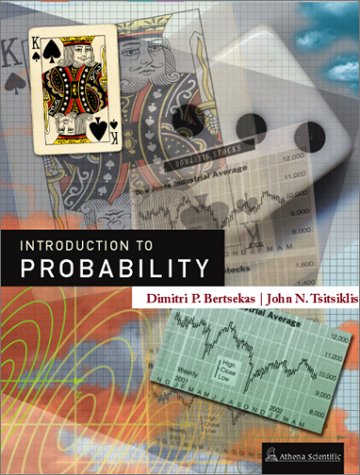
Title

Introduction To Probability
Sold by Ergodebooks, an authorized reseller.
Returns accepted within 30 days | support@ergodebooks.com
Shipping Information
- Free Standard Shipping — United States only
- Processing Time: 3–5 business days
- Estimated Delivery: 6–10 business days after dispatch
- Double-boxed, fully insured & discreetly packaged
- Tracking number sent via email once dispatched
Returns & Refund
Returns accepted within 30 days of delivery.
Damaged or Defective Item
Free return shipping + replacement or full refund
Wrong Item Received
Free return shipping + replacement or full refund
Change of Mind
Return shipping at customer's expense · 25% restocking fee applies
Payment Option

An Intuitive, Yet Precise Introduction To Probability Theory, Stochastic Processes, And Probabilistic Models Used In Science, Engineering, Economics, And Related Fields. This Is The Currently Used Textbook For Probabilistic Systems Analysis, An Introductory Probability Course At The Massachusetts Institute Of Technology, Attended By A Large Number Of Undergraduate And Graduate Students. The Book Covers The Fundamentals Of Probability Theory (Probabilistic Models, Discrete And Continuous Random Variables, Multiple Random Variables, And Limit Theorems), Which Are Typically Part Of A First Course On The Subject. It Also Contains, A Number Of More Advanced Topics, From Which An Instructor Can Choose To Match The Goals Of A Particular Course. These Topics Include Transforms, Sums Of Random Variables, Least Squares Estimation, The Bivariate Normal Distribution, And A Fairly Detailed Introduction To Bernoulli, Poisson, And Markov Processes. The Book Strikes A Balance Between Simplicity In Exposition And Sophistication In Analytical Reasoning. Some Of The More Mathematically Rigorous Analysis Has Been Just Intuitively Explained In The Text, But Is Developed In Detail (At The Level Of Advanced Calculus) In The Numerous Solved Theoretical Problems. The Book Has Been Widely Adopted For Classroom Use In Introductory Probability Courses Within The Usa And Abroad.
⚠️ WARNING (California Proposition 65):
This product may contain chemicals known to the State of California to cause cancer, birth defects, or other reproductive harm.
For more information, please visit www.P65Warnings.ca.gov.
- Q: What is the size of 'Introduction to Probability'? A: The book measures seven point five two inches in length, one inch in width, and nine point two five inches in height.
- Q: How many pages does 'Introduction to Probability' have? A: This textbook contains four hundred sixteen pages, providing a comprehensive overview of probability theory.
- Q: What type of binding does this book have? A: The book is bound in hardcover, ensuring durability for classroom use.
- Q: Who is the author of 'Introduction to Probability'? A: The author is Dimitri P. Bertsekas, a respected figure in the field of probability and statistics.
- Q: What topics can I expect to learn from this book? A: You will learn about probabilistic models, random variables, limit theorems, and more advanced topics like Markov processes.
- Q: Is 'Introduction to Probability' suitable for beginners? A: Yes, this book is designed for both undergraduate and graduate students, making it appropriate for beginners.
- Q: Can I use this book for self-study? A: Yes, it is ideal for self-study as it balances intuitive explanations with rigorous problem-solving.
- Q: Is this textbook used in universities? A: Yes, it is currently used in the introductory probability course at the Massachusetts Institute of Technology.
- Q: How do I keep the book in good condition? A: Store the book in a dry place and avoid exposure to direct sunlight to prevent fading and wear.
- Q: Is there a warranty for this book? A: Typically, textbooks do not come with a warranty, but check with the seller for their return policy.
- Q: What if the book arrives damaged? A: If it arrives damaged, contact the seller immediately to discuss return or replacement options.
- Q: Does the book cover advanced topics? A: Yes, it includes advanced topics like least squares estimation and the bivariate normal distribution.
- Q: Is there a glossary of terms in the book? A: Yes, it provides a glossary for key terms to help readers understand complex concepts.
- Q: Is the book suitable for professional development? A: Yes, it is a valuable resource for professionals looking to enhance their understanding of probability theory.
- Q: Are there exercises in the book? A: Yes, the book includes numerous solved theoretical problems to reinforce learning.
- Q: What is the level of mathematical rigor in this book? A: The book maintains a balance between intuitive explanations and rigorous analysis at the advanced calculus level.