
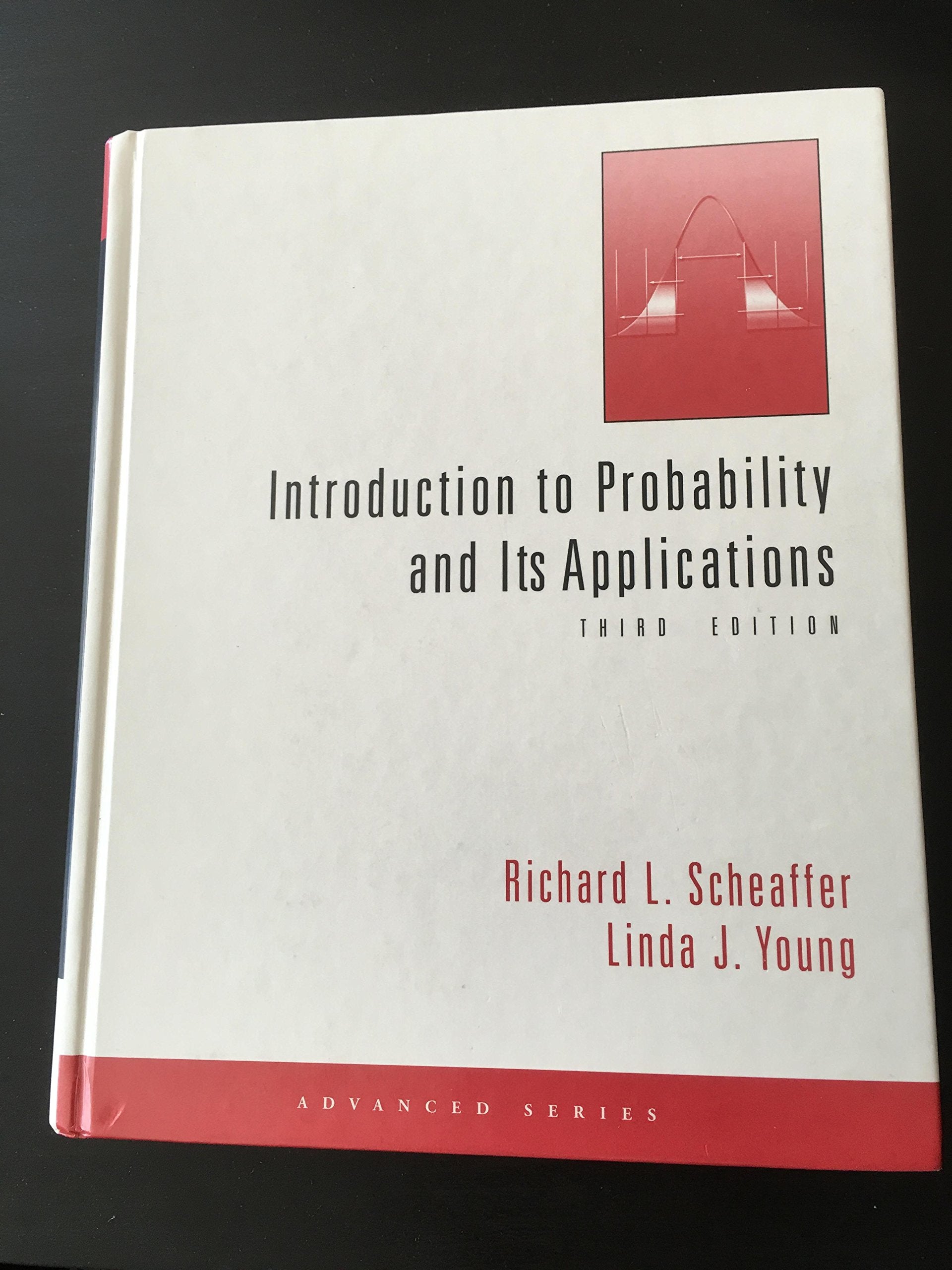
Title
Introduction to Probability and Its Applications,New
Sold by Ergodebooks, an authorized reseller.
Returns accepted within 30 days | support@ergodebooks.com
Shipping Information
- Free Standard Shipping — United States only
- Processing Time: 3–5 business days
- Estimated Delivery: 6–10 business days after dispatch
- Double-boxed, fully insured & discreetly packaged
- Tracking number sent via email once dispatched
Returns & Refund
Returns accepted within 30 days of delivery.
Damaged or Defective Item
Free return shipping + replacement or full refund
Wrong Item Received
Free return shipping + replacement or full refund
Change of Mind
Return shipping at customer's expense · 25% restocking fee applies
Payment Option

This text focuses on the utility of probability in solving realworld problems for students in a onesemester calculusbased probability course. Theory is developed to a practical degree and grounded in discussion of its practical uses in solving realworld problems. Numerous applications using uptodate real data in engineering and the life, social, and physical sciences illustrate and motivate the many ways probability affects our lives. The text's accessible presentation carefully progresses from routine to more difficult problems to suit students of different backgrounds, and carefully explains how and where to apply methods. Students going on to more advanced courses in probability and statistics will gain a solid background in fundamental concepts and theory, while students who must apply probability to their courses engineering and the sciences will develop a working knowledge of the subject and appreciation of its practical power.
⚠️ WARNING (California Proposition 65):
This product may contain chemicals known to the State of California to cause cancer, birth defects, or other reproductive harm.
For more information, please visit www.P65Warnings.ca.gov.
- Q: What is the page count of this book? A: This book has four hundred eighty pages. It provides a comprehensive overview of probability and its applications in various fields.
- Q: What type of binding does this book have? A: This book is bound in hardcover. The durable binding ensures it can withstand frequent use in an academic setting.
- Q: What are the dimensions of this book? A: The book measures seven point seventy-six inches in length, zero point seventy-five inches in width, and nine point five inches in height. These dimensions make it portable for students.
- Q: What level of students is this book suitable for? A: This book is suitable for undergraduate students. It is designed for a one-semester calculus-based probability course.
- Q: Can this book help with advanced courses? A: Yes, it provides a solid foundation for students entering advanced courses in probability and statistics. It covers fundamental concepts effectively.
- Q: Is this book appropriate for self-study? A: Yes, this book is appropriate for self-study. Its accessible presentation guides students through various topics at their own pace.
- Q: How should I care for this book? A: To keep this book in good condition, store it upright on a shelf and avoid exposure to moisture. Regularly dust the cover to maintain its appearance.
- Q: Is this book safe for children? A: Yes, this book is safe for children. However, it’s primarily aimed at college students and may be complex for younger readers.
- Q: What is the condition of used copies of this book? A: Used copies of this book are typically in good condition. They may show minor signs of wear but are generally well-maintained.
- Q: What subjects does this book cover? A: This book covers probability and its applications in engineering, life sciences, social sciences, and physical sciences. It emphasizes real-world problem-solving.
- Q: What is the author’s background? A: The author is Richard L. Scheaffer. He is a well-respected figure in the field of statistics and probability education.
- Q: Does this book include real-world applications? A: Yes, the book includes numerous applications using real data. It illustrates how probability affects various aspects of life.
- Q: What is the publisher of this book? A: The book is published by Cengage Learning. This publisher is known for high-quality educational resources.
- Q: Can I return this book if I am not satisfied? A: Yes, you can typically return this book if you are not satisfied, depending on the seller's return policy. Always check the specific terms before purchasing.
- Q: Is this book suitable for beginners? A: Yes, this book is suitable for beginners. It carefully explains methods and concepts, making it accessible for those new to probability.