
Title

Introduction To Probability,New
Sold by Ergodebooks, an authorized reseller.
Returns accepted within 30 days | support@ergodebooks.com
Shipping Information
- Free Standard Shipping — United States only
- Processing Time: 3–5 business days
- Estimated Delivery: 6–10 business days after dispatch
- Double-boxed, fully insured & discreetly packaged
- Tracking number sent via email once dispatched
Returns & Refund
Returns accepted within 30 days of delivery.
Damaged or Defective Item
Free return shipping + replacement or full refund
Wrong Item Received
Free return shipping + replacement or full refund
Change of Mind
Return shipping at customer's expense · 25% restocking fee applies
Payment Option

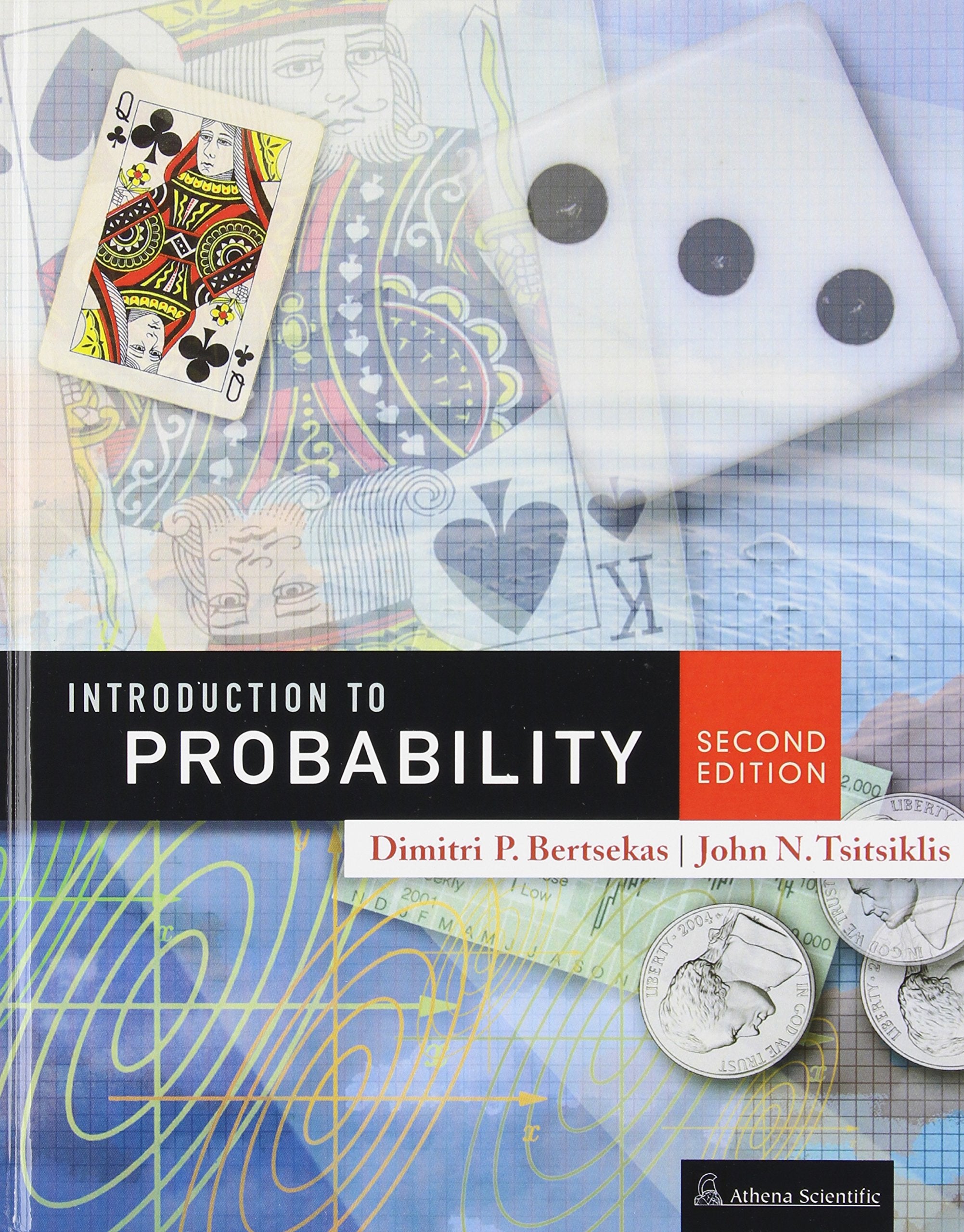
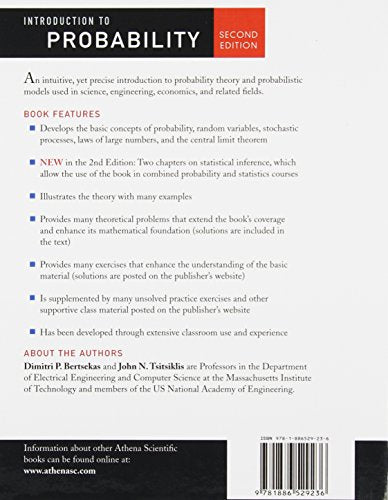
An intuitive, yet precise introduction to probability theory, stochastic processes, and probabilistic models used in science, engineering, economics, and related fields. The 2nd edition is a substantial revision of the 1st edition, involving a reorganization of old material and the addition of new material. The length of the book has increased by about 25 percent. The main new feature of the 2nd edition is thorough introduction to Bayesian and classical statistics. The book is the currently used textbook for 'Probabilistic Systems Analysis,' an introductory probability course at the Massachusetts Institute of Technology, attended by a large number of undergraduate and graduate students. The book covers the fundamentals of probability theory (probabilistic models, discrete and continuous random variables, multiple random variables, and limit theorems), which are typically part of a first course on the subject, as well as the fundamental concepts and methods of statistical inference, both Bayesian and classical. It also contains, a number of more advanced topics, from which an instructor can choose to match the goals of a particular course. These topics include transforms, sums of random variables, a fairly detailed introduction to Bernoulli, Poisson, and Markov processes. The book strikes a balance between simplicity in exposition and sophistication in analytical reasoning. Some of the more mathematically rigorous analysis has been just intuitively explained in the text, but is developed in detail (at the level of advanced calculus) in the numerous solved theoretical problems. Written by two professors of the Department of Electrical Engineering and Computer Science at the Massachusetts Institute of Technology, and members of the prestigious US National Academy of Engineering, the book has been widely adopted for classroom use in introductory probability courses within the USA and abroad.From a Review of the 1st Edition:...it trains the intuition to acquire probabilistic feeling. This book explains every single concept it enunciates. This is its main strength, deep explanation, and not just examples that happen to explain. Bertsekas and Tsitsiklis leave nothing to chance. The probability to misinterpret a concept or not understand it is just... zero. Numerous examples, figures, and endofchapter problems strengthen the understanding. Also of invaluable help is the book's web site, where solutions to the problems can be foundas well as much more information pertaining to probability, and also more problem sets. Vladimir Botchev, Analog Dialogue Several other reviews can be found in the listing of the first edition of this book. Contents, preface, and more info at publisher's website (Athena Scientific, athenasc com)
⚠️ WARNING (California Proposition 65):
This product may contain chemicals known to the State of California to cause cancer, birth defects, or other reproductive harm.
For more information, please visit www.P65Warnings.ca.gov.
- Q: How many pages does 'Introduction To Probability' have? A: This book has five hundred twenty-eight pages. It provides a comprehensive introduction to probability theory and its applications.
- Q: What is the binding type of this book? A: The book is bound in hardcover. This durable binding is designed to withstand frequent use in classroom settings.
- Q: What are the dimensions of the book? A: The dimensions are seven point five two inches in length, one point two six inches in width, and nine point five inches in height. These measurements make it easy to handle and store.
- Q: Who is the author of 'Introduction To Probability'? A: The author is Dimitri P. Bertsekas. He is a respected professor at the Massachusetts Institute of Technology and known for his expertise in probability.
- Q: What subjects does this book cover? A: It covers probability theory, stochastic processes, and statistical inference. The book is suitable for students in science, engineering, and economics.
- Q: Is this book appropriate for beginners? A: Yes, it is suitable for beginners. The text strikes a balance between intuitive explanations and rigorous analysis, making it accessible.
- Q: Can I use this book for self-study? A: Yes, it is ideal for self-study. The book includes numerous examples, figures, and problems to enhance understanding.
- Q: Is this book used in academic courses? A: Yes, it is widely adopted in introductory probability courses. It is currently used at the Massachusetts Institute of Technology.
- Q: What advanced topics are included in the book? A: The book includes advanced topics such as Bernoulli, Poisson, and Markov processes. These topics allow instructors to tailor the content to their course goals.
- Q: How should I care for this hardcover book? A: To care for the book, keep it in a dry place and avoid exposure to direct sunlight. This will help preserve its condition over time.
- Q: What is the return policy for this book? A: The return policy allows returns within thirty days of purchase. Ensure the book is in its original condition for a full refund.
- Q: What if the book arrives damaged? A: If the book arrives damaged, contact customer support for assistance. They will guide you through the return or replacement process.
- Q: Is there a website for additional resources related to the book? A: Yes, the book's web site provides solutions to problems and additional information. This resource enhances the learning experience.
- Q: Does this book include problem sets? A: Yes, it includes end-of-chapter problems. These problems are designed to reinforce the concepts covered in the chapters.
- Q: Is the content relevant for both undergraduate and graduate students? A: Yes, the content is relevant for both undergraduate and graduate students. It provides a solid foundation in probability for all levels.
- Q: Are there any specific prerequisites for reading this book? A: While there are no formal prerequisites, a basic understanding of calculus is helpful. This background will assist in grasping the more advanced concepts.