
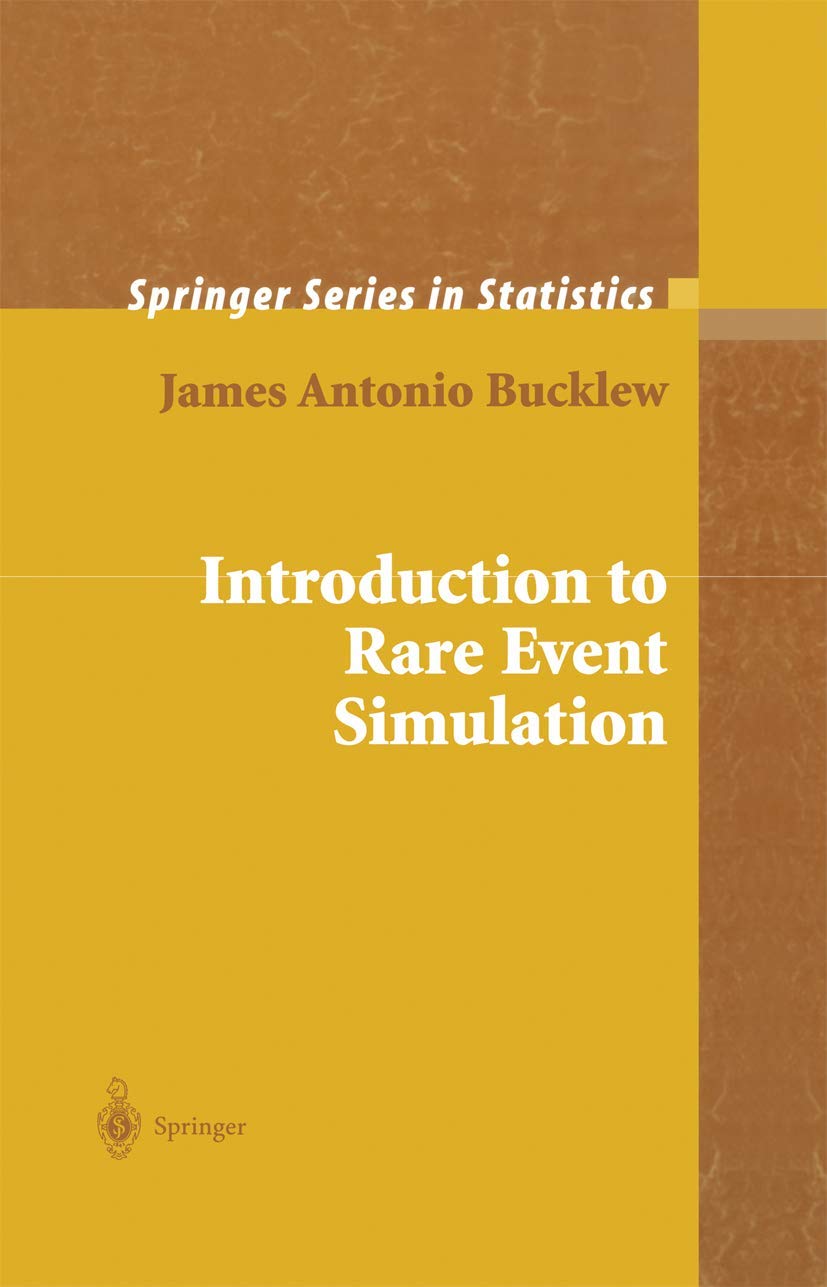
Title
Introduction to Rare Event Simulation (Springer Statistics),New
Sold by Ergodebooks, an authorized reseller.
Returns accepted within 30 days | support@ergodebooks.com
Shipping Information
- Free Standard Shipping — United States only
- Processing Time: 3–5 business days
- Estimated Delivery: 6–10 business days after dispatch
- Double-boxed, fully insured & discreetly packaged
- Tracking number sent via email once dispatched
Returns & Refund
Returns accepted within 30 days of delivery.
Damaged or Defective Item
Free return shipping + replacement or full refund
Wrong Item Received
Free return shipping + replacement or full refund
Change of Mind
Return shipping at customer's expense · 25% restocking fee applies
Payment Option

This book is an attempt to present a unified theory of rare event simulation and the variance reduction technique known as importance sampling from the point of view of the probabilistic theory of large deviations. This framework allows us to view a vast assortment of simulation problems from a single unified perspective. It gives a great deal of insight into the fundamental nature of rare event simulation. Unfortunately, this area has a reputation among simulation practitioners of requiring a great deal of technical and probabilistic expertise. In this text, I have tried to keep the mathematical preliminaries to a minimum; the only prerequisite is a single large deviation theorem dealing with sequences of Rd valued random variables. (This theorem and a proof are given in the text.) Large deviation theory is a burgeoning area of probability theory and many of the results in it can be applied to simulation problems. Rather than try to be as complete as possible in the exposition of all possible aspects of the available theory, I have tried to concentrate on demonstrating the methodology and the principal ideas in a fairly simple setting. Madison, Wisconsin 2003 James Antonio Bucklew Contents 1. Random Number Generation . . . . . . . . . . . . . . . . . . . . . 1 . . . . . . . . 1.1 Uniform Generators. . . . . . . . . . . . . . . . . . . . . . . . . . . . . . . . . . . . . 1 1.2 Nonuniform Generation . . . . . . . . . . . . . . . . . . . . . . . . . . . . . . . . . 8 1.2.1 The Inversion Method . . . . . . . . . . . . . . . . . . . . . . . . . . . . 8 1.2.2 The AcceptanceRejection Method . . . . . . . . . . . . 10 . . . . . 1.3 Discrete Distributions . . . . . . . . . . . . . . . . . . . . . . . . 13 . . . . . . . . . . . 1.3.1 Inversion by Truncation of a ContinuousAnalog. . . . . . 14 1.3.2 AcceptanceRejection . . . . . . . . . . . . . . . . . . . . 15 . . . . . . . . .
⚠️ WARNING (California Proposition 65):
This product may contain chemicals known to the State of California to cause cancer, birth defects, or other reproductive harm.
For more information, please visit www.P65Warnings.ca.gov.