
Title
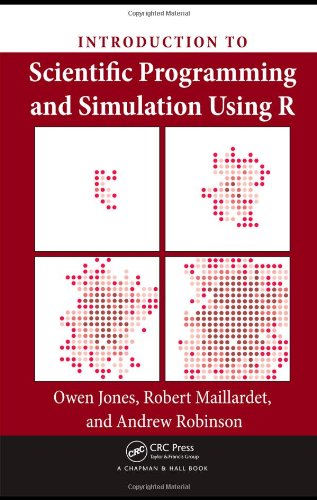
Introduction to Scientific Programming and Simulation Using R (Chapman & Hall/CRC The R Series),Used
Sold by Ergodebooks, an authorized reseller.
Returns accepted within 30 days | support@ergodebooks.com
Shipping Information
- Free Standard Shipping — United States only
- Processing Time: 3–5 business days
- Estimated Delivery: 6–10 business days after dispatch
- Double-boxed, fully insured & discreetly packaged
- Tracking number sent via email once dispatched
Returns & Refund
Returns accepted within 30 days of delivery.
Damaged or Defective Item
Free return shipping + replacement or full refund
Wrong Item Received
Free return shipping + replacement or full refund
Change of Mind
Return shipping at customer's expense · 25% restocking fee applies
Payment Option

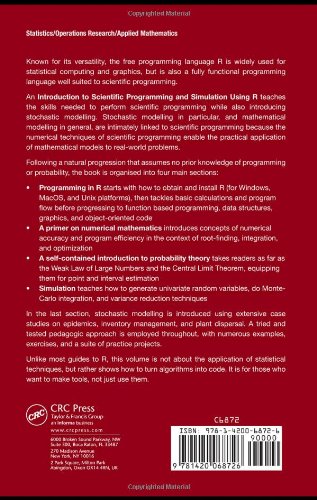
Known for its versatility, the free programming language R is widely used for statistical computing and graphics, but is also a fully functional programming language well suited to scientific programming.An Introduction to Scientific Programming and Simulation Using R teaches the skills needed to perform scientific programming while also introducing stochastic modelling. Stochastic modelling in particular, and mathematical modelling in general, are intimately linked to scientific programming because the numerical techniques of scientific programming enable the practical application of mathematical models to realworld problems.Following a natural progression that assumes no prior knowledge of programming or probability, the book is organised into four main sections:Programming In R starts with how to obtain and install R (for Windows, MacOS, and Unix platforms), then tackles basic calculations and program flow, before progressing to function based programming, data structures, graphics, and objectoriented code A Primer on Numerical Mathematics introduces concepts of numerical accuracy and program efficiency in the context of rootfinding, integration, and optimization A Selfcontained Introduction to Probability Theory takes readers as far as the Weak Law of Large Numbers and the Central Limit Theorem, equipping them for point and interval estimation Simulation teaches how to generate univariate random variables, do MonteCarlo integration, and variance reduction techniquesIn the last section, stochastic modelling is introduced using extensive case studies on epidemics, inventory management, and plant dispersal. A tried and tested pedagogic approach is employed throughout, with numerous examples, exercises, and a suite of practice projects. Unlike most guides to R, this volume is not about the application of statistical techniques, but rather shows how to turn algorithms into code. It is for those who want to make tools, not just use them.
⚠️ WARNING (California Proposition 65):
This product may contain chemicals known to the State of California to cause cancer, birth defects, or other reproductive harm.
For more information, please visit www.P65Warnings.ca.gov.