
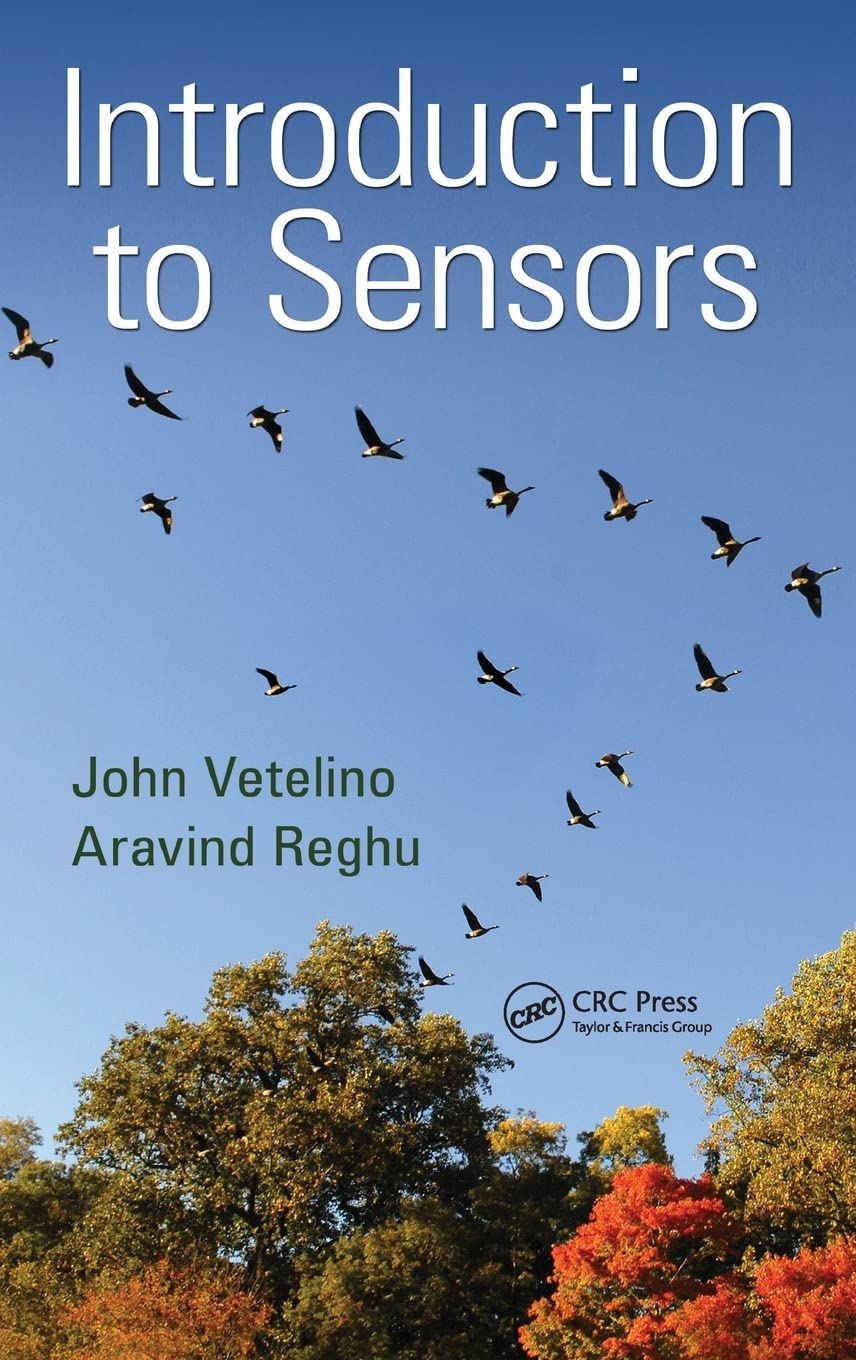
Title
Introduction To Sensors,Used
Sold by Ergodebooks, an authorized reseller.
Returns accepted within 30 days | support@ergodebooks.com
Shipping Information
- Free Standard Shipping — United States only
- Processing Time: 3–5 business days
- Estimated Delivery: 6–10 business days after dispatch
- Double-boxed, fully insured & discreetly packaged
- Tracking number sent via email once dispatched
Returns & Refund
Returns accepted within 30 days of delivery.
Damaged or Defective Item
Free return shipping + replacement or full refund
Wrong Item Received
Free return shipping + replacement or full refund
Change of Mind
Return shipping at customer's expense · 25% restocking fee applies
Payment Option

The Need For New Types Of Sensors Is More Critical Than Ever. This Is Due To The Emergence Of Increasingly Complex Technologies, Health And Security Concerns Of A Burgeoning World Population, And The Emergence Of Terrorist Activities, Among Other Factors. Depending On Their Application, The Design, Fabrication, Testing, And Use Of Sensors, All Require Various Kinds Of Both Technical And Nontechnical Expertise.With This In Mind, Introduction To Sensors Examines The Theoretical Foundations And Practical Applications Of Electrochemical, Piezoelectric, Fiber Optic, Thermal, And Magnetic Sensors And Their Use In The Modern Era. Incorporating Information From Sensorbased Industries To Review Current Developments In The Field, This Book:Presents A Complete Sensor System That Includes The Preparation Phase, The Sensing Element And Platform, And Appropriate Electronics Resulting In A Digital Readoutdiscusses Solidstate Electronic Sensors, Such As The Metal Oxide Semiconductor (Mos) Capacitor, The Micromachined Capacitive Polymer, And The Schottky Diode Sensorsuses The Twodimensional Hexagonal Lattice As An Example To Detail The Basic Theory Associated With Piezoelectricityexplores The Fundamental Relationship Between Stress, Strain, Electric Field, And Electric Displacementthe Magnetic Sensors Presented Are Used To Determine Measurands Such As The Magnetic Field And Semiconductor Properties, Including Carrier Concentration And Mobility. Offering The Human Body And The Automobile As Examples Of Entities That Rely On A Multiplicity Of Sensors, The Authors Address The Application Of Various Types Of Sensors, As Well As The Theory And Background Information Associated With Their Development And The Materials Used In Their Design. The Coverage In This Book Reveals The Underlying Rationale For The Application Of Different Sensors While Also Defining The Properties And Characteristics Of Each.
⚠️ WARNING (California Proposition 65):
This product may contain chemicals known to the State of California to cause cancer, birth defects, or other reproductive harm.
For more information, please visit www.P65Warnings.ca.gov.
- Q: What is the binding type of 'Introduction to Sensors'? A: The binding type is hardcover. This provides durability and a professional appearance, ideal for academic and technical settings.
- Q: How many pages does 'Introduction to Sensors' have? A: The book has two hundred and ten pages. This length allows for comprehensive coverage of various sensor types and their applications.
- Q: What are the dimensions of 'Introduction to Sensors'? A: The dimensions are six point two six inches by nine point two five inches by zero point seven five inches. This size makes it easy to handle and store.
- Q: Who is the author of 'Introduction to Sensors'? A: The author is John Vetelino. He brings expertise in sensor technology to provide insightful explanations and practical examples.
- Q: What topics does 'Introduction to Sensors' cover? A: It covers electrochemical, piezoelectric, fiber optic, thermal, and magnetic sensors. This diversity makes it suitable for various applications in sensor technology.
- Q: How do I use the information in 'Introduction to Sensors'? A: You can use it to understand sensor technology and its applications. The book provides theoretical foundations and practical insights, making it useful for students and professionals.
- Q: Is 'Introduction to Sensors' suitable for beginners? A: Yes, it is suitable for beginners. The book explains complex concepts in an accessible manner, making it a great starting point for anyone interested in sensors.
- Q: Can I use 'Introduction to Sensors' for academic purposes? A: Yes, it is suitable for academic purposes. The comprehensive coverage and detailed explanations make it a valuable resource for students and educators.
- Q: How should I care for my copy of 'Introduction to Sensors'? A: Store it in a dry, cool place away from direct sunlight. This will help maintain the book's condition and longevity.
- Q: Is 'Introduction to Sensors' safe for all age groups? A: Yes, it is appropriate for all age groups. However, it is best suited for those with a keen interest in technology and science.
- Q: What if my copy of 'Introduction to Sensors' arrives damaged? A: You should contact the seller for a return or exchange. Most sellers have policies in place to handle damaged items.
- Q: Does 'Introduction to Sensors' include practical applications? A: Yes, it includes practical applications of various sensors. This enhances the understanding of how sensors are used in real-world scenarios.
- Q: Are there any prerequisites to understanding 'Introduction to Sensors'? A: No formal prerequisites are required. However, a basic understanding of electronics may enhance comprehension.
- Q: Can 'Introduction to Sensors' help in professional development? A: Yes, it can aid in professional development. The insights gained from this book can be beneficial for careers in engineering and technology.
- Q: Is there a warranty or guarantee for 'Introduction to Sensors'? A: Warranty details depend on the seller. It’s advisable to check with the retailer regarding their specific return policies.
- Q: What makes 'Introduction to Sensors' a unique resource? A: Its comprehensive coverage of various sensor types and practical applications makes it a unique resource. It combines theoretical knowledge with real-world examples.