
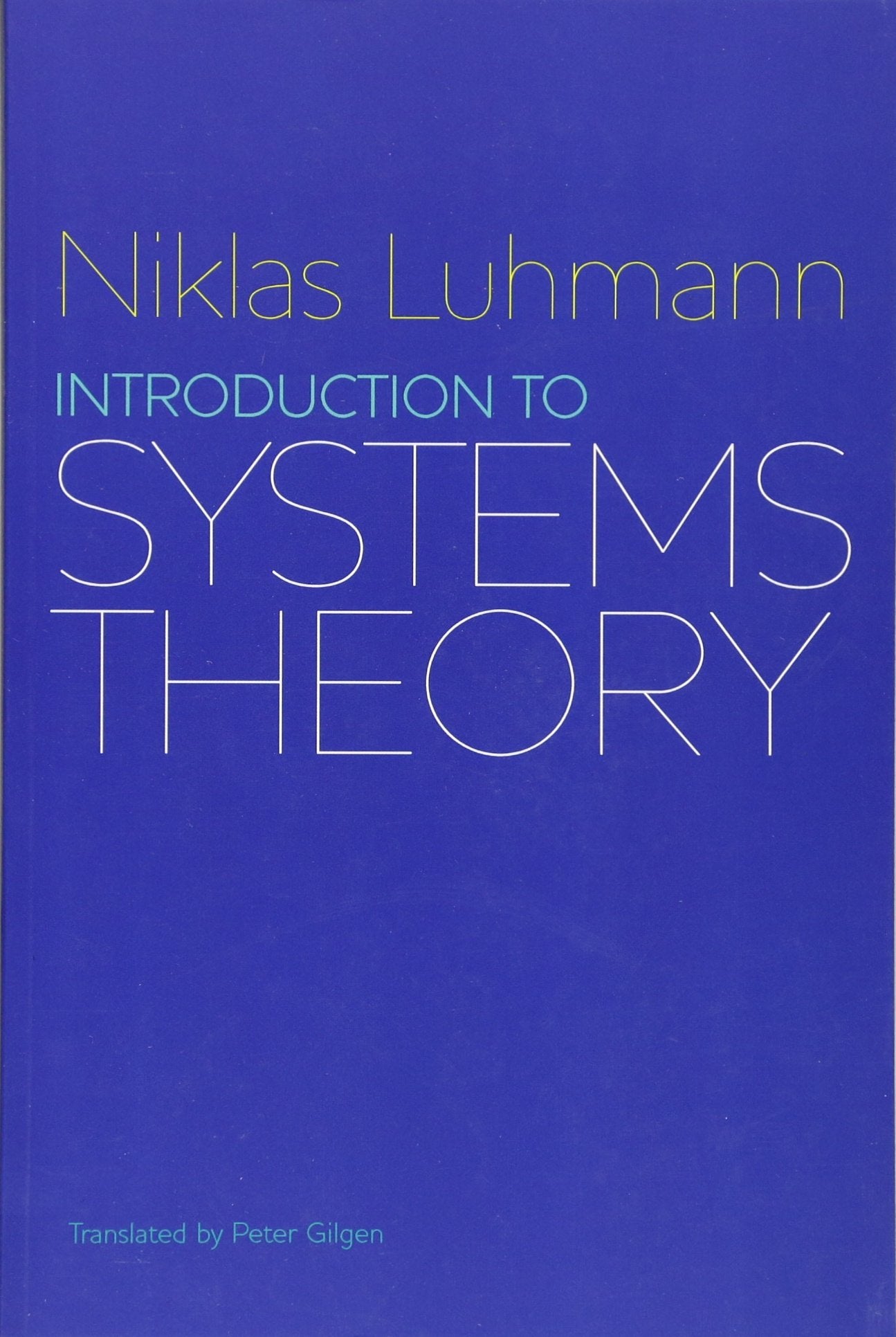
Title
Introduction to Systems Theory,New
Sold by Ergodebooks, an authorized reseller.
Returns accepted within 30 days | support@ergodebooks.com
Shipping Information
- Free Standard Shipping — United States only
- Processing Time: 3–5 business days
- Estimated Delivery: 6–10 business days after dispatch
- Double-boxed, fully insured & discreetly packaged
- Tracking number sent via email once dispatched
Returns & Refund
Returns accepted within 30 days of delivery.
Damaged or Defective Item
Free return shipping + replacement or full refund
Wrong Item Received
Free return shipping + replacement or full refund
Change of Mind
Return shipping at customer's expense · 25% restocking fee applies
Payment Option

Niklas Luhmann ranks as one of the most important sociologists and social theorists of the twentieth century. Through his many books he developed a highly original form of systems theory that has been hugely influential in a wide variety of disciplines.In Introduction to Systems Theory, Luhmann explains the key ideas of general and sociological systems theory and supplies a wealth of examples to illustrate his approach. The book offers a wide range of concepts and theorems that can be applied to politics and the economy, religion and science, art and education, organization and the family. Moreover, Luhmanns ideas address important contemporary issues in such diverse fields as cognitive science, ecology, and the study of social movements.This book provides all the necessary resources for readers to work through the foundations of systems theory no other work by Luhmann is as clear and accessible as this. There is also much here that will be of great interest to more advanced scholars and practitioners in sociology and the social sciences.
⚠️ WARNING (California Proposition 65):
This product may contain chemicals known to the State of California to cause cancer, birth defects, or other reproductive harm.
For more information, please visit www.P65Warnings.ca.gov.
- Q: What is the main focus of 'Introduction to Systems Theory'? A: 'Introduction to Systems Theory' by Niklas Luhmann focuses on the key ideas of general and sociological systems theory, providing a comprehensive overview of his influential concepts and theories applicable across multiple disciplines.
- Q: Who is the author of this book? A: The author of 'Introduction to Systems Theory' is Niklas Luhmann, a prominent sociologist and social theorist known for his original contributions to systems theory.
- Q: What topics does this book cover? A: The book covers a wide range of topics, including politics, economy, religion, science, art, education, organization, and family, along with contemporary issues in cognitive science, ecology, and social movements.
- Q: How many pages are in 'Introduction to Systems Theory'? A: 'Introduction to Systems Theory' has 300 pages, providing an in-depth exploration of systems theory.
- Q: What is the condition of the book? A: The book is listed as 'New', ensuring that readers receive a product in excellent condition.
- Q: What type of binding does this book have? A: 'Introduction to Systems Theory' is available in a paperback binding, making it a lightweight and portable option for readers.
- Q: When was 'Introduction to Systems Theory' published? A: 'Introduction to Systems Theory' was published on December 10, 2012, making it a relatively recent contribution to the field of sociology.
- Q: Is this book suitable for beginners in systems theory? A: Yes, this book is designed to be clear and accessible, making it suitable for both beginners and advanced scholars interested in understanding the foundations of systems theory.
- Q: Does this book include practical examples? A: Yes, the book provides a wealth of examples to illustrate Luhmann's approach to systems theory, enhancing understanding of complex concepts.
- Q: What edition is 'Introduction to Systems Theory'? A: 'Introduction to Systems Theory' is available in its first edition, representing the author's original insights and theories.