
Title
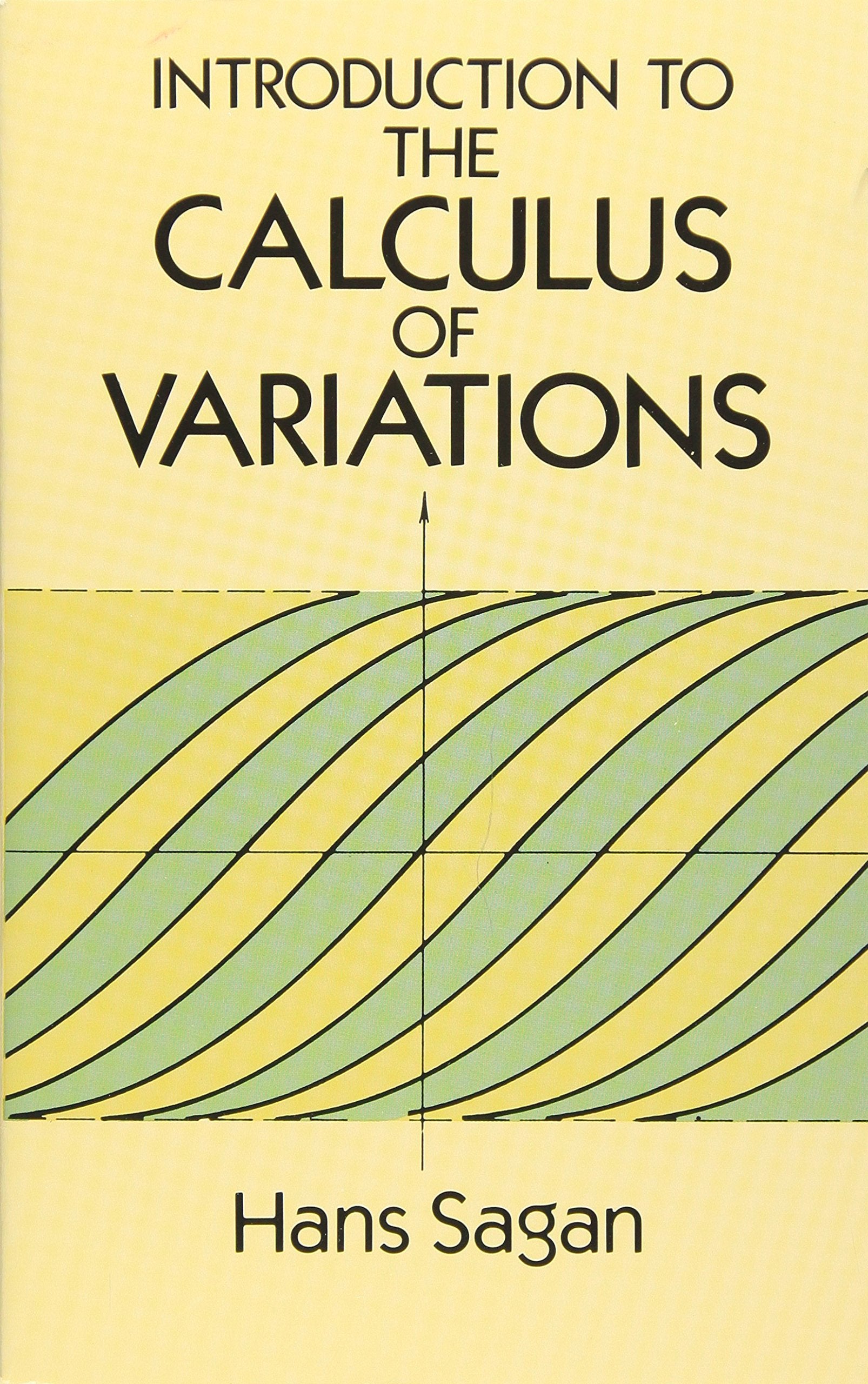
Introduction to the Calculus of Variations (Dover Books on Mathematics),New
Sold by Ergodebooks, an authorized reseller.
Returns accepted within 30 days | support@ergodebooks.com
Shipping Information
- Free Standard Shipping — United States only
- Processing Time: 3–5 business days
- Estimated Delivery: 6–10 business days after dispatch
- Double-boxed, fully insured & discreetly packaged
- Tracking number sent via email once dispatched
Returns & Refund
Returns accepted within 30 days of delivery.
Damaged or Defective Item
Free return shipping + replacement or full refund
Wrong Item Received
Free return shipping + replacement or full refund
Change of Mind
Return shipping at customer's expense · 25% restocking fee applies
Payment Option

. . . eminently suitable as a text for an introductory course: the style is pleasant; the prerequisites are kept to a minimum . . . and the pace of the development is appropriate for most students at the senior or first year graduate level.' American Mathematical MonthlyThe purpose of this text is to lay a broad foundation for an understanding of the problems of the calculus of variations and its many methods and techniques, and to prepare readers for the study of modern optimal control theory.The treatment is limited to a thorough discussion of singleintegral problems in one or more unknown functions, where the integral is employed in the riemannian sense.The first three chapters deal with variational problems without constraints. Chapter 4 is a selfcontained treatment of the homogeneous problem in the twodimensional plane. In Chapter 5, the minimum principle of Pontryagin as it applies to optimal control problems of nonpredetermined duration, where the state variables satisfy an autonomous system of firstorder equations, is developed to the extent possible by classical means within the general framework of the HamiltonJacobi theory. Chapter 6 is devoted to a derivation of the multiplier rule for the problem of Mayer with fixed and variable endpoints and its application to the problem of Lagrange and the isoperimetric problem. In the last chapter, Legendre's necessary condition for a weak relative minimum and a sufficient condition for a weak relative minimum are derived within the framework of the theory of the second variation.This book, which includes many strategically placed problems and over 400 exercises, is directed to advanced undergraduate and graduate students with a background in advanced calculus and intermediate differential equations, and is adaptable to either a one or twosemester course on the subject.
⚠️ WARNING (California Proposition 65):
This product may contain chemicals known to the State of California to cause cancer, birth defects, or other reproductive harm.
For more information, please visit www.P65Warnings.ca.gov.