
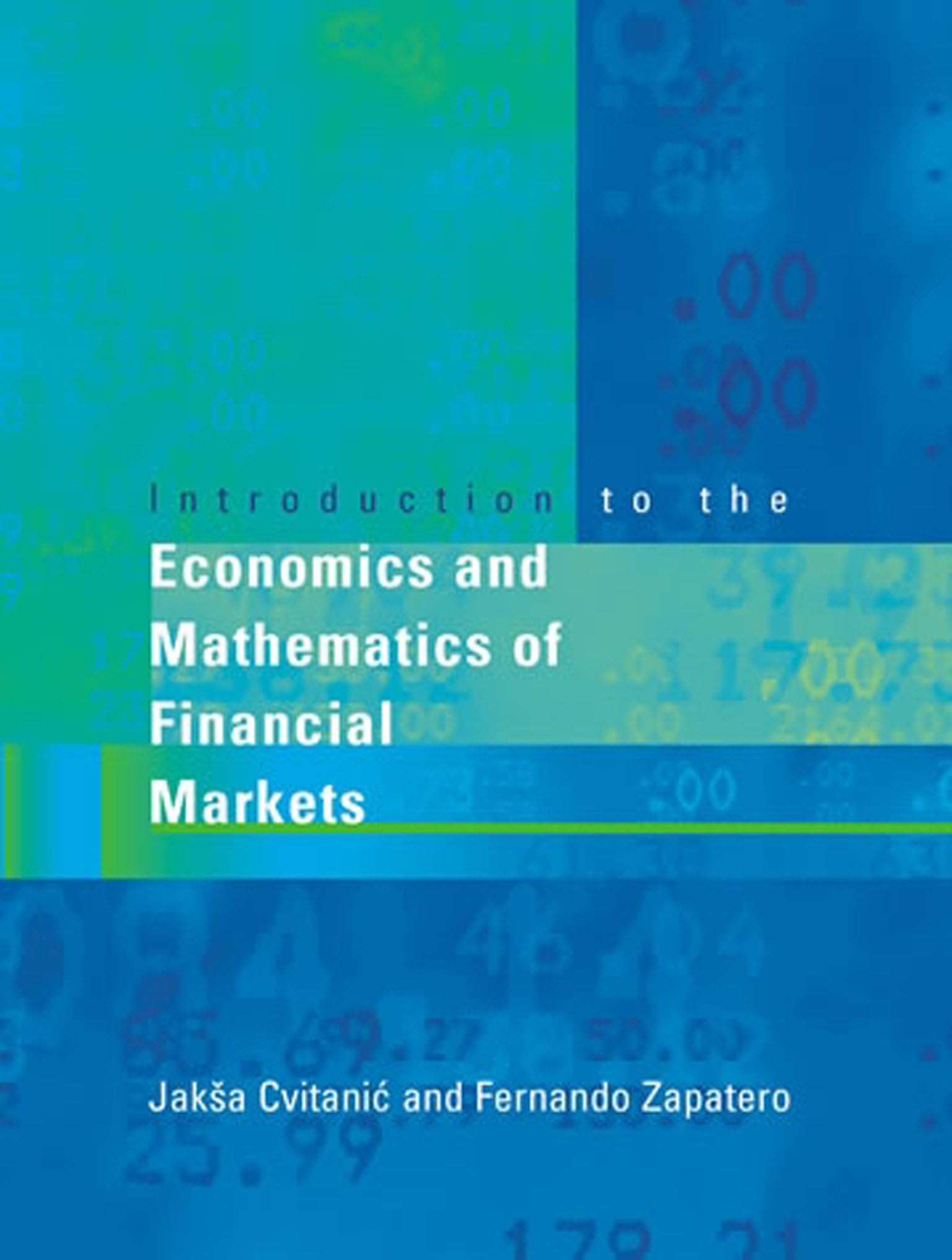
Title
Introduction To The Economics And Mathematics Of Financial Markets
Sold by Ergodebooks, an authorized reseller.
Returns accepted within 30 days | support@ergodebooks.com
Shipping Information
- Free Standard Shipping — United States only
- Processing Time: 3–5 business days
- Estimated Delivery: 6–10 business days after dispatch
- Double-boxed, fully insured & discreetly packaged
- Tracking number sent via email once dispatched
Returns & Refund
Returns accepted within 30 days of delivery.
Damaged or Defective Item
Free return shipping + replacement or full refund
Wrong Item Received
Free return shipping + replacement or full refund
Change of Mind
Return shipping at customer's expense · 25% restocking fee applies
Payment Option

An Innovative Textbook For Use In Advanced Undergraduate And Graduate Courses; Accessible To Students In Financial Mathematics, Financial Engineering And Economics.Introduction To The Economics And Mathematics Of Financial Markets Fills The Longstanding Need For An Accessible Yet Serious Textbook Treatment Of Financial Economics. The Book Provides A Rigorous Overview Of The Subject, While Its Flexible Presentation Makes It Suitable For Use With Different Levels Of Undergraduate And Graduate Students. Each Chapter Presents Mathematical Models Of Financial Problems At Three Different Degrees Of Sophistication: Singleperiod, Multiperiod, And Continuoustime. The Singleperiod And Multiperiod Models Require Only Basic Calculus And An Introductory Probability/Statistics Course, While An Advanced Undergraduate Course In Probability Is Helpful In Understanding The Continuoustime Models. In This Way, The Material Is Given Complete Coverage At Different Levels; The Less Advanced Student Can Stop Before The More Sophisticated Mathematics And Still Be Able To Grasp The General Principles Of Financial Economics.The Book Is Divided Into Three Parts. The First Part Provides An Introduction To Basic Securities And Financial Market Organization, The Concept Of Interest Rates, The Main Mathematical Models, And Quantitative Ways To Measure Risks And Rewards. The Second Part Treats Option Pricing And Hedging; Here And Throughout The Book, The Authors Emphasize The Martingale Or Probabilistic Approach. Finally, The Third Part Examines Equilibrium Modelsa Subject Often Neglected By Other Texts In Financial Mathematics, But Included Here Because Of The Qualitative Insight It Offers Into The Behavior Of Market Participants And Pricing.
⚠️ WARNING (California Proposition 65):
This product may contain chemicals known to the State of California to cause cancer, birth defects, or other reproductive harm.
For more information, please visit www.P65Warnings.ca.gov.
- Q: How many pages does this book have? A: This book has four hundred ninety-four pages. It provides comprehensive coverage of financial economics, making it suitable for advanced undergraduate and graduate courses.
- Q: What is the binding type of this book? A: The book is a hardcover. This binding provides durability and a professional appearance, ideal for academic use.
- Q: What are the dimensions of the book? A: The book measures nine point twenty-five inches in length, six point ninety-eight inches in width, and zero point ninety-eight inches in height. These dimensions make it easy to handle and store.
- Q: Who is the author of this book? A: The author of this book is Jaksa Cvitanic. He is known for his expertise in financial mathematics and economics.
- Q: What is the main subject of this book? A: The main subject of this book is the economics and mathematics of financial markets. It combines rigorous mathematical models with practical financial concepts.
- Q: What level of understanding do I need to read this book? A: A basic understanding of calculus and introductory probability is required for the earlier chapters. Advanced topics require knowledge of higher-level probability.
- Q: Is this book suitable for beginners? A: Yes, this book is suitable for beginners as it covers topics at different levels of sophistication. Less advanced students can focus on foundational concepts before tackling more complex mathematics.
- Q: Can I use this book for self-study? A: Yes, this book can be used for self-study. The structured chapters and varying levels of complexity make it accessible for independent learners.
- Q: How should I care for this hardcover book? A: To keep this hardcover book in good condition, store it upright on a shelf and avoid exposure to direct sunlight. This helps preserve the binding and pages.
- Q: Are there any specific cleaning instructions for this book? A: No specific cleaning instructions are needed for this book. Simply keep it in a dry environment and avoid moisture to protect the pages.
- Q: What should I do if the book arrives damaged? A: If the book arrives damaged, contact the seller to inquire about their return policy. Most sellers provide options for returns or exchanges for damaged items.
- Q: Is there a warranty for this book? A: Books typically do not come with a warranty. However, check with the seller for their specific policies regarding returns.
- Q: How does this book compare to other financial textbooks? A: This book offers a unique blend of accessibility and rigor, making it stand out among financial textbooks. It covers equilibrium models, which are often neglected in other texts.
- Q: What kind of mathematical models are discussed in this book? A: The book discusses single-period, multi-period, and continuous-time mathematical models. Each model is tailored to different levels of sophistication, catering to various student backgrounds.
- Q: Who is the publisher of this book? A: The publisher of this book is MIT Press. They are known for high-quality academic publications in various fields.